Martins Elisabete, Cordovil Rita, Oliveira Raul, Pinho Joana, Diniz Ana, Vaz Joao R
Faculdade de Motricidade Humana, Universidade de Lisboa, Lisbon, Portugal.
Escola Superior de Saúde do Alcoitão, Lisbon, Portugal.
Front Pediatr. 2019 Feb 21;7:42. doi: 10.3389/fped.2019.00042. eCollection 2019.
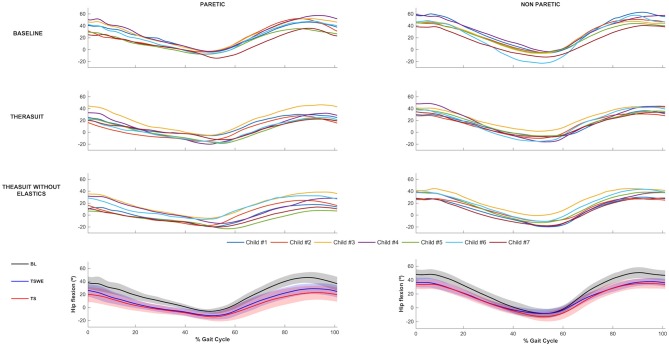
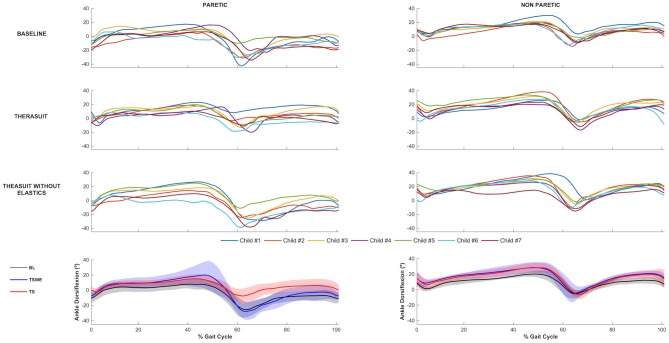
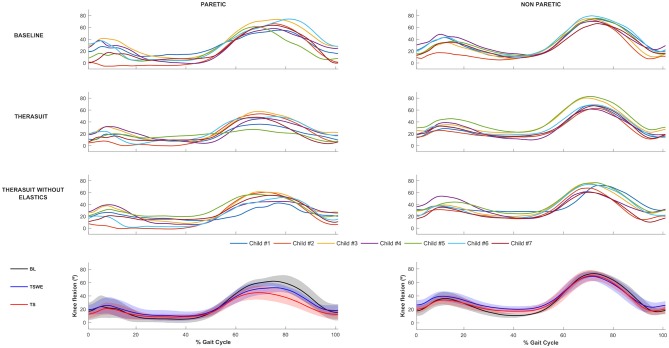
This study analyzes the immediate effects of wearing a Therasuit on sagittal plane lower limb angular displacements during gait in children with unilateral spastic cerebral palsy (US-CP). Seven participants (median age = 7.00 years; ranging from 5.83 to 9.00 years) with US-CP, levels I and II of the Gross Motor Function Classification System, were assessed with kinematic gait analysis in three different conditions: (A) Baseline; (B) Therasuit without elastics and (C) Therasuit with elastics. Significant improvements were observed at the hip joint of both lower limbs during most of the gait cycle in participants wearing a Therasuit, including a decrease in the flexion pattern at the initial contact and swing phase in both lower limbs, and an increase in the extension pattern in the paretic lower limb during the stance phase. At the knee joint in the paretic lower limb, significant differences were found between the baseline and Therasuit with elastics conditions on the knee angle at initial contact, and between baseline and both Therasuit conditions on the flexion angle at swing phase. However, the inter-individual variability in kinematic patterns at the knee joint was high. At the ankle joint, decreased plantar flexion at initial contact and increased dorsiflexion during stance and swing phases were observed at the Therasuit with elastics condition, helping to correct the equinus-foot in the paretic lower limb during the whole gait cycle. The Z-values showed large effect sizes particularly for most of the angular hip variables in both lower limbs and for the angular ankle variables in the paretic lower limb. The Therasuit seems to have some positive immediate effects on gait kinematics in children with spastic unilateral cerebral palsy by providing a more functional and safer gait pattern. Future investigations with larger samples are recommended to further support these findings.
本研究分析了Therasuit对单侧痉挛性脑瘫(US-CP)儿童步态中矢状面下肢角位移的即时影响。对七名US-CP儿童(中位年龄 = 7.00岁;年龄范围为5.83至9.00岁)进行了评估,这些儿童的粗大运动功能分类系统为I级和II级,在三种不同条件下进行了运动步态分析:(A)基线;(B)无弹性的Therasuit;(C)有弹性的Therasuit。在穿着Therasuit的参与者中,在大多数步态周期内,双下肢髋关节均观察到显著改善,包括双下肢在初始接触和摆动期的屈曲模式减少,以及患侧下肢在站立期的伸展模式增加。在患侧下肢膝关节,初始接触时的膝关节角度在基线与有弹性的Therasuit条件之间存在显著差异,摆动期的屈曲角度在基线与两种Therasuit条件之间存在显著差异。然而,膝关节运动模式的个体间变异性较高。在踝关节,在有弹性的Therasuit条件下,观察到初始接触时跖屈减少,站立期和摆动期背屈增加,有助于在整个步态周期中纠正患侧下肢的马蹄足。Z值显示出较大的效应量,特别是对于双下肢的大多数髋关节角变量以及患侧下肢的踝关节角变量。Therasuit似乎通过提供更具功能性和安全性的步态模式,对痉挛性单侧脑瘫儿童的步态运动学产生了一些积极的即时影响。建议未来进行更大样本的研究以进一步支持这些发现。