Department of Internal Medicine, Chonnam National University Medical School, Gwangju, Republic of Korea.
Department of Internal Medicine, Yeungnam University College of Medicine, Daegu, Republic of Korea.
Sci Rep. 2019 Mar 8;9(1):3946. doi: 10.1038/s41598-019-40559-w.
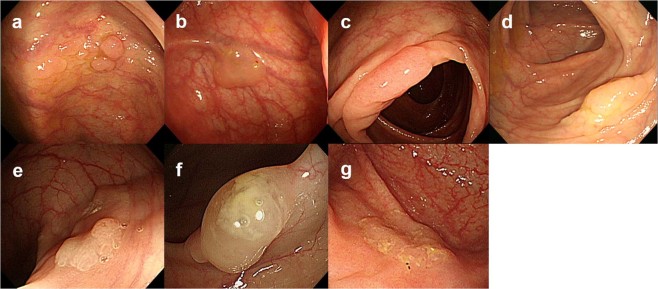
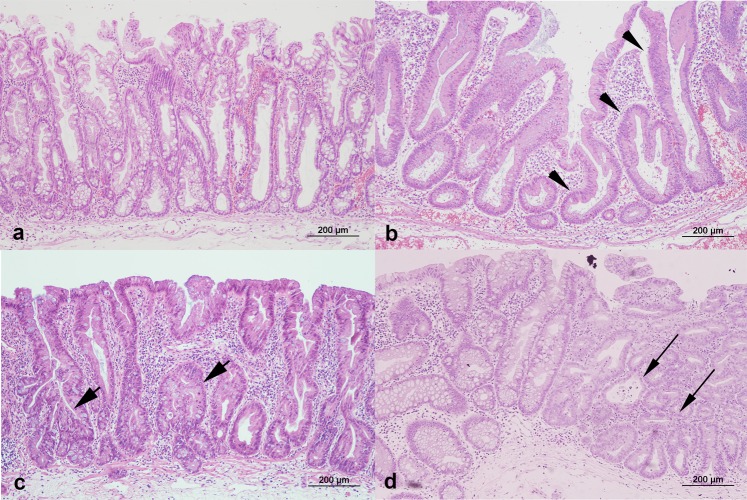
Sessile serrated adenomas/polyps (SSA/Ps) are precancerous lesions that account for one-third of colorectal cancers. The endoscopic and pathologic differentiation between SSA/Ps without dysplasia (SSA/POs) and SSA/Ps with dysplasia or adenocarcinoma (SSA/PDAs) can be difficult. This study aimed to assess the clinical characteristics of SSA/PDs. This multicenter retrospective cohort study included 532 patients who underwent endoscopic resection and were pathologically diagnosed with SSA/POs and SSA/PDAs. Initially, medical, endoscopic, and histopathological records of patients who underwent endoscopic resection of SSA/POs and SSA/PDAs at eight university hospitals in Korea between January 2005 and December 2015 were reviewed. A total of 307 (57.7%) patients were detected in men and 319 (60.0%) were located in the proximal colon. Most SSA/Ps had a flat, slightly elevated, or sessile morphology. The most prevalent endoscopic findings of SSA/Ps were nodular surface (244, 45.9%), disrupted vascular pattern (232, 43.6%), altered fold contour (141, 26.5%), dome-shaped morphology (135, 25.4%), and pale color (115, 21.6%). SSA/POs were more commonly found in the proximal colon, compared to SSA/PDAs. SSA/PDAs displayed 0-Ip, Isp, IIb or IIa + IIc morphologies more frequently, while SSA/POs displayed 0-Is or IIa morphology more frequently. The frequency of a rim of debris/bubbles was significantly higher in SSA/POs, while nodular surface and disrupted vascular pattern were significantly higher in SSA/PDAs. In the univariate analysis of endoscopic features, SSA/PDAs were significantly associated with the distal colon location, 0-Isp and IIb morphologies, nodular surface, and disrupted vascular pattern. In the multivariate analysis, 0-IIb, nodular surface, and disrupted vascular pattern were significantly associated with SSA/PDAs. SSA/Ps with 0-IIb morphology, nodular surface and disrupted vascular pattern are associated with an increased risk of dysplasia or adenocarcinoma.
无蒂锯齿状腺瘤/息肉(SSA/Ps)是一种癌前病变,占结直肠癌的三分之一。无发育不良的 SSA/Ps(SSA/POs)和有发育不良或腺癌的 SSA/Ps(SSA/PDAs)在内镜和病理上的区别可能很困难。本研究旨在评估 SSA/PD 的临床特征。这项多中心回顾性队列研究纳入了 2005 年 1 月至 2015 年 12 月期间在韩国 8 所大学医院接受内镜下切除并经病理诊断为 SSA/POs 和 SSA/PDAs 的 532 例患者。首先,回顾了在这 8 所大学医院接受内镜下 SSA/POs 和 SSA/PDAs 切除术的患者的医疗、内镜和组织病理学记录。共有 307 例(57.7%)患者为男性,319 例(60.0%)患者病变位于近端结肠。大多数 SSA/Ps 呈扁平、稍隆起或无蒂形态。最常见的 SSA/Ps 内镜表现为结节状表面(244 例,45.9%)、破坏的血管模式(232 例,43.6%)、改变的褶皱轮廓(141 例,26.5%)、穹窿状形态(135 例,25.4%)和苍白颜色(115 例,21.6%)。与 SSA/PDAs 相比,SSA/POs 更常见于近端结肠。SSA/PDAs 更常表现为 0-Ip、Isp、IIb 或 IIa+IIc 形态,而 SSA/POs 更常表现为 0-Is 或 IIa 形态。SSA/POs 中碎屑/气泡边缘的频率明显较高,而 SSA/PDAs 中结节状表面和破坏的血管模式明显较高。在对内镜特征的单变量分析中,SSA/PDAs 与远端结肠位置、0-Isp 和 IIb 形态、结节状表面和破坏的血管模式显著相关。在多变量分析中,0-IIb、结节状表面和破坏的血管模式与 SSA/PDAs 显著相关。具有 0-IIb 形态、结节状表面和破坏的血管模式的 SSA/Ps 与发育不良或腺癌的风险增加相关。