• 文献检索
  • 文档翻译
  • 深度研究
  • 学术资讯
  • Suppr Zotero 插件Zotero 插件
  • 邀请有礼
  • 套餐&价格
  • 历史记录
应用&插件
Suppr Zotero 插件Zotero 插件浏览器插件Mac 客户端Windows 客户端微信小程序
定价
高级版会员购买积分包购买API积分包
服务
文献检索文档翻译深度研究API 文档MCP 服务
关于我们
关于 Suppr公司介绍联系我们用户协议隐私条款
关注我们

Suppr 超能文献

核心技术专利:CN118964589B侵权必究
粤ICP备2023148730 号-1Suppr @ 2026

文献检索

告别复杂PubMed语法,用中文像聊天一样搜索,搜遍4000万医学文献。AI智能推荐,让科研检索更轻松。

立即免费搜索

文件翻译

保留排版,准确专业,支持PDF/Word/PPT等文件格式,支持 12+语言互译。

免费翻译文档

深度研究

AI帮你快速写综述,25分钟生成高质量综述,智能提取关键信息,辅助科研写作。

立即免费体验

描述快速反应和心脏骤停团队组成和激活标准的差异:对美国五个州的联邦医疗保险参与医院的调查。

Characterising variation in composition and activation criteria of rapid response and cardiac arrest teams: a survey of Medicare participating hospitals in five American states.

机构信息

Department of Internal Medicine, New York University School of Medicine, New York City, New York, USA.

Division of Cardiology, New York University School of Medicine, New York City, New York, USA.

出版信息

BMJ Open. 2019 Mar 8;9(3):e024548. doi: 10.1136/bmjopen-2018-024548.

DOI:10.1136/bmjopen-2018-024548
PMID:30852537
原文链接:https://pmc.ncbi.nlm.nih.gov/articles/PMC6429839/
Abstract

OBJECTIVES

To characterise the variation in composition, leadership, and activation criteria of rapid response and cardiac arrest teams in five north-eastern states of the USA.

DESIGN

Cross-sectional study consisting of a voluntary 46-question survey of acute care hospitals in north-eastern USA.

SETTING

Acute care hospitals in New York, New Jersey, Rhode Island, Vermont, and Pennsylvania.

PARTICIPANTS

Surveys were completed by any member of the rapid response team (RRT) with a working knowledge of team composition and function. Participants were all Medicare-participating acute care hospitals, including teaching and community hospitals as well as hospitals from rural, urban and suburban areas.

RESULTS

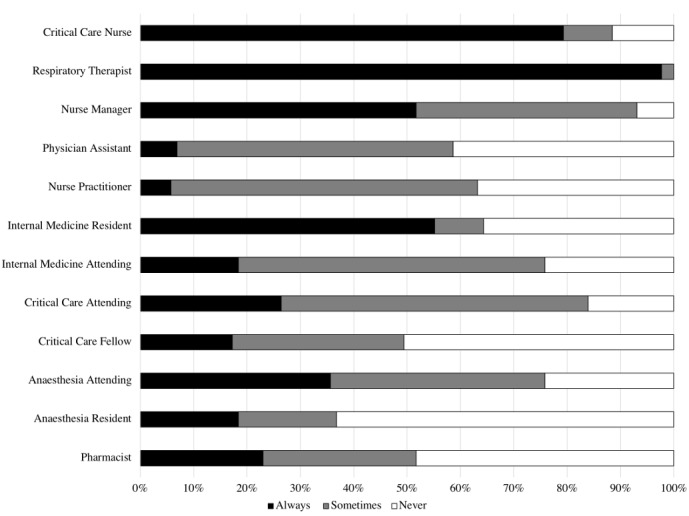
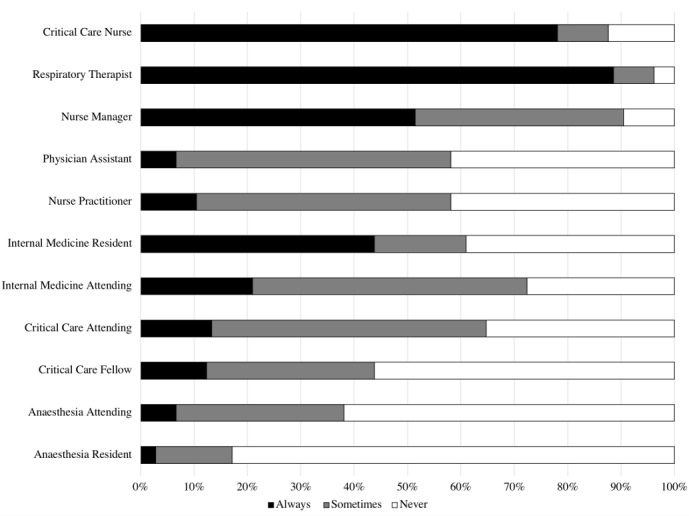
Out of 378 hospitals, contacts were identified for 303, and 107 surveys were completed. All but two hospitals had an RRT, 70% of which changed members daily. The most common activation criteria were clinical concern (95%), single vital sign abnormalities (77%) and early warning score (59%). Eighty one per cent of hospitals had a dedicated cardiac arrest team.RRT composition varied widely, with respiratory therapists, critical care nurses, physicians and nurse managers being the most likely to attend (89%, 78%, 64% and 51%, respectively). Consistent presence of critical care physicians was uncommon and both cardiac arrest teams and teams were frequently led by trainee physicians, often without senior supervision.

CONCLUSIONS

As the largest study to date in the USA, we have demonstrated wide heterogeneity, rapid team turnover and a lack of senior supervision of RRT and cardiac arrest teams. These factors likely contribute to the mixed results seen in studies of RRTs.

摘要

目的

描述美国东北部五个州的快速反应和心脏骤停团队在组成、领导和激活标准方面的差异。

设计

对美国东北部急性护理医院进行的一项包含 46 个问题的横断面调查。

地点

纽约、新泽西、罗得岛、佛蒙特和宾夕法尼亚的急性护理医院。

参与者

对团队组成和功能有一定了解的快速反应团队(RRT)的任何成员均可完成调查。参与者均为参与医疗保险的急性护理医院,包括教学医院和社区医院以及来自农村、城市和郊区的医院。

结果

在 378 家医院中,确定了 303 家医院的联系人,并完成了 107 份调查。除了两家医院外,所有医院都有 RRT,其中 70%的 RRT 每天更换成员。最常见的激活标准是临床关注(95%)、单个生命体征异常(77%)和早期预警评分(59%)。81%的医院有专门的心脏骤停团队。RRT 的组成差异很大,最有可能参加的是呼吸治疗师、重症监护护士、医生和护士长(分别为 89%、78%、64%和 51%)。重症监护医生的持续存在并不常见,心脏骤停团队和 RRT 团队通常由住院医师领导,通常没有高级监督。

结论

作为迄今为止在美国进行的最大规模研究,我们已经证明了快速反应和心脏骤停团队的异质性大、团队人员流动快且缺乏高级监督。这些因素可能是导致 RRT 研究结果不一致的原因。
https://cdn.ncbi.nlm.nih.gov/pmc/blobs/7842/6429839/02981f40d18a/bmjopen-2018-024548f02.jpg
https://cdn.ncbi.nlm.nih.gov/pmc/blobs/7842/6429839/772857adde0c/bmjopen-2018-024548f01.jpg
https://cdn.ncbi.nlm.nih.gov/pmc/blobs/7842/6429839/02981f40d18a/bmjopen-2018-024548f02.jpg
https://cdn.ncbi.nlm.nih.gov/pmc/blobs/7842/6429839/772857adde0c/bmjopen-2018-024548f01.jpg
https://cdn.ncbi.nlm.nih.gov/pmc/blobs/7842/6429839/02981f40d18a/bmjopen-2018-024548f02.jpg

相似文献

1
Characterising variation in composition and activation criteria of rapid response and cardiac arrest teams: a survey of Medicare participating hospitals in five American states.描述快速反应和心脏骤停团队组成和激活标准的差异:对美国五个州的联邦医疗保险参与医院的调查。
BMJ Open. 2019 Mar 8;9(3):e024548. doi: 10.1136/bmjopen-2018-024548.
2
Organisation of in-hospital cardiac arrest teams - a nationwide study.院内心脏骤停团队的组织——一项全国性研究。
Resuscitation. 2015 Apr;89:123-8. doi: 10.1016/j.resuscitation.2015.01.014. Epub 2015 Jan 21.
3
Cardiac arrest leadership: in need of resuscitation?心脏骤停领导力:需要复苏吗?
Postgrad Med J. 2016 Dec;92(1094):715-720. doi: 10.1136/postgradmedj-2015-133738. Epub 2016 Jun 8.
4
Prevalence, characteristics, and opinions of pediatric rapid response teams in the United States.美国儿科快速反应小组的患病率、特征及观点
Hosp Pediatr. 2012 Jul;2(3):133-40. doi: 10.1542/hpeds.2011-0030.
5
Rapid Response Team activation in New Zealand hospitals-a multicentre prospective observational study.新西兰医院快速反应小组的启动——一项多中心前瞻性观察性研究
Anaesth Intensive Care. 2016 May;44(3):391-7. doi: 10.1177/0310057X1604400314.
6
Reduction in hospital-wide mortality after implementation of a rapid response team: a long-term cohort study.快速反应团队实施后全院死亡率降低:一项长期队列研究。
Crit Care. 2011;15(6):R269. doi: 10.1186/cc10547. Epub 2011 Nov 15.
7
Rapid Response Team composition, resourcing and calling criteria in Australia.澳大利亚快速反应团队的组成、资源配置和呼叫标准。
Resuscitation. 2012 May;83(5):563-7. doi: 10.1016/j.resuscitation.2011.10.023. Epub 2011 Nov 6.
8
Rapid response team activation prior to in-hospital cardiac arrest: Areas for improvements based on a national cohort study.住院心脏骤停前快速反应团队的启动:基于一项全国队列研究的改进领域
Resuscitation. 2023 Dec;193:109978. doi: 10.1016/j.resuscitation.2023.109978. Epub 2023 Sep 22.
9
Residents feel unprepared and unsupervised as leaders of cardiac arrest teams in teaching hospitals: a survey of internal medicine residents.教学医院内科住院医师对担任心脏骤停团队领导者感到准备不足且缺乏监督:一项针对内科住院医师的调查
Crit Care Med. 2007 Jul;35(7):1668-72. doi: 10.1097/01.CCM.0000268059.42429.39.
10
Original Research: The Benefits of Rapid Response Teams: Exploring Perceptions of Nurse Leaders, Team Members, and End Users.原创研究:快速反应团队的益处:探究护士领导者、团队成员及终端用户的看法
Am J Nurs. 2016 Mar;116(3):38-47. doi: 10.1097/01.NAJ.0000481279.45428.5a.

引用本文的文献

1
Ten Steps for Implementing a Hospital Rapid Response System.实施医院快速反应系统的十个步骤。
J Med Syst. 2025 Apr 28;49(1):55. doi: 10.1007/s10916-025-02186-z.
2
An exploratory study on the effect of rescuer team size on basic and advanced life support technical skills in a high-fidelity simulation of canine cardiopulmonary arrest.在犬类心肺复苏的高保真模拟中,关于救援团队规模对基础及高级生命支持技术技能影响的探索性研究。
J Vet Emerg Crit Care (San Antonio). 2025 Jan-Feb;35(1):9-18. doi: 10.1111/vec.13445. Epub 2025 Jan 20.
3
Outcomes of in-hospital cardiac arrest managed with and without a specialized code team: A retrospective observational study.

本文引用的文献

1
How Do Resuscitation Teams at Top-Performing Hospitals for In-Hospital Cardiac Arrest Succeed? A Qualitative Study.顶尖院内心脏骤停救治医院的复苏团队如何取得成功?一项定性研究。
Circulation. 2018 Jul 10;138(2):154-163. doi: 10.1161/CIRCULATIONAHA.118.033674.
2
Intensivist Presence at Code Events Is Associated with High Survival and Increased Documentation Rates.集中治疗医师在场与高存活率和更高的文档记录率相关。
Crit Care Clin. 2018 Apr;34(2):259-266. doi: 10.1016/j.ccc.2017.12.009. Epub 2018 Feb 13.
3
Use of a modified early warning score system to reduce the rate of in-hospital cardiac arrest.
院内心搏骤停患者在有和无专业编码团队管理下的结局:一项回顾性观察研究。
PLoS One. 2024 Sep 20;19(9):e0309376. doi: 10.1371/journal.pone.0309376. eCollection 2024.
4
The effect of a dedicated intensivist staffing to a medical emergency team on airway management in general wards.专职重症医学专家配置对普通病房中医疗急救团队进行气道管理的影响。
Medicine (Baltimore). 2024 Jun 21;103(25):e38571. doi: 10.1097/MD.0000000000038571.
5
Construct and clinical verification of a nurse-led rapid response systems and activation criteria.护士主导的快速反应系统及启动标准的构建与临床验证。
BMC Nurs. 2022 Nov 14;21(1):311. doi: 10.1186/s12912-022-01087-7.
6
National Survey: How Do We Approach the Patient at Risk of Clinical Deterioration outside the ICU in the Spanish Context?国家调查:在西班牙背景下,我们如何处理 ICU 外临床恶化风险患者?
Int J Environ Res Public Health. 2022 Oct 3;19(19):12627. doi: 10.3390/ijerph191912627.
7
Strategies for successful implementation and permanent maintenance of a rapid response system.成功实施和永久维护快速反应系统的策略。
Korean J Intern Med. 2021 Sep;36(5):1031-1039. doi: 10.3904/kjim.2020.693. Epub 2021 Aug 18.
8
Comparison of clinical outcomes between nurse practitioner and registrar-led medical emergency teams: a propensity-matched analysis.护士主导的和住院医师主导的医疗急救团队的临床结局比较:倾向评分匹配分析。
Crit Care. 2021 Mar 22;25(1):117. doi: 10.1186/s13054-021-03534-4.
9
Rapid Response and Cardiac Arrest Teams: A Descriptive Analysis of 103 American Hospitals.快速反应小组与心脏骤停团队:对103家美国医院的描述性分析
Crit Care Explor. 2019 Aug 7;1(8):e0031. doi: 10.1097/CCE.0000000000000031. eCollection 2019 Aug.
使用改良早期预警评分系统降低院内心搏骤停发生率。
J Intensive Care. 2016 Feb 9;4:12. doi: 10.1186/s40560-016-0134-7. eCollection 2016.
4
Outcomes Associated With the Nationwide Introduction of Rapid Response Systems in The Netherlands.与荷兰全国范围内快速反应系统的引入相关的结果。
Crit Care Med. 2015 Dec;43(12):2544-51. doi: 10.1097/CCM.0000000000001272.
5
Deployment of rapid response teams by 31 hospitals in a statewide collaborative.全州范围内31家医院合作组建快速反应小组。
Jt Comm J Qual Patient Saf. 2015 Apr;41(4):186-91. doi: 10.1016/s1553-7250(15)41024-4.
6
Organisation of in-hospital cardiac arrest teams - a nationwide study.院内心脏骤停团队的组织——一项全国性研究。
Resuscitation. 2015 Apr;89:123-8. doi: 10.1016/j.resuscitation.2015.01.014. Epub 2015 Jan 21.
7
Aggregate National Early Warning Score (NEWS) values are more important than high scores for a single vital signs parameter for discriminating the risk of adverse outcomes.综合国民早期预警评分(NEWS)值对于区分不良结局风险而言,比单一生命体征参数的高分更为重要。
Resuscitation. 2015 Feb;87:75-80. doi: 10.1016/j.resuscitation.2014.11.014. Epub 2014 Nov 26.
8
Cardiac arrest teams and medical emergency teams in Finland: a nationwide cross-sectional postal survey.芬兰的心脏骤停团队和医疗急救团队:一项全国性的横断面邮政调查。
Acta Anaesthesiol Scand. 2014 Apr;58(4):420-7. doi: 10.1111/aas.12280. Epub 2014 Feb 19.
9
Hospital cardiac arrest resuscitation practice in the United States: a nationally representative survey.美国医院心脏骤停复苏实践:一项具有全国代表性的调查。
J Hosp Med. 2014 Jun;9(6):353-7. doi: 10.1002/jhm.2174. Epub 2014 Feb 19.
10
A review of rapid response team activation parameters in New Zealand hospitals.新西兰医院快速反应团队激活参数的回顾。
Resuscitation. 2013 Aug;84(8):1040-4. doi: 10.1016/j.resuscitation.2013.01.022. Epub 2013 Jan 29.