Maj Magdalena, Wagner Ludwig, Tretter Verena
Department of Biological Sciences, California Polytechnic State University, San Luis Obispo, CA, United States.
Department of Internal Medicine III, Division of Nephrology and Dialysis, Medizinische Universität Wien, Vienna, Austria.
Front Mol Neurosci. 2019 Feb 12;12:29. doi: 10.3389/fnmol.2019.00029. eCollection 2019.
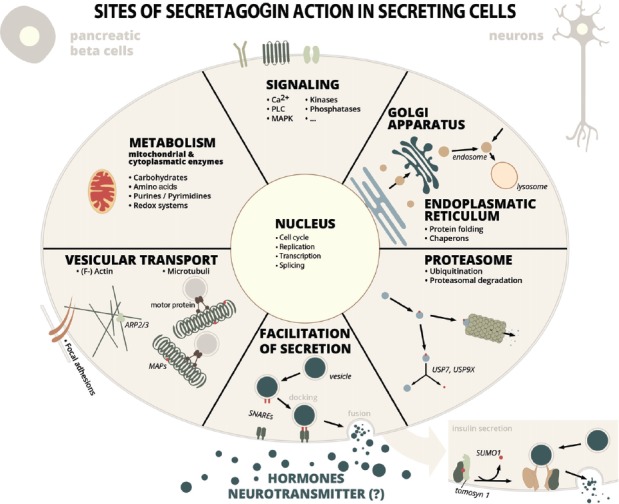
Calcium is one of the most important signaling factors in mammalian cells. Specific temporal and spatial calcium signals underlie fundamental processes such as cell growth, development, circadian rhythms, neurotransmission, hormonal actions and apoptosis. In order to translate calcium signals into cellular processes a vast number of proteins bind this ion with affinities from the nanomolar to millimolar range. Using classical biochemical methods an impressing number of calcium binding proteins (CBPs) have been discovered since the late 1960s, some of which are expressed ubiquitously, others are more restricted to specific cell types. In the nervous system expression patterns of different CBPs have been used to discern different neuronal cell populations, especially before advanced methods like single-cell transcriptomics and activity recording were available to define neuronal identity. However, understanding CBPs and their interacting proteins is still of central interest. The post-genomic era has coined the term "calciomics," to describe a whole new research field, that engages in the identification and characterization of CBPs and their interactome. Secretagogin is a CBP, that was discovered 20 years ago in the pancreas. Consecutively it was found also in other organs including the nervous system, with characteristic expression patterns mostly forming cell clusters. Its regional expression and subcellular location together with the identification of protein interaction partners implicated, that secretagogin has a central role in hormone secretion. Meanwhile, with the help of modern proteomics a large number of actual and putative interacting proteins has been identified, that allow to anticipate a much more complex role of secretagogin in developing and adult neuronal cells. Here, we review recent findings that appear like puzzle stones of a greater picture.
钙是哺乳动物细胞中最重要的信号因子之一。特定的时空钙信号是细胞生长、发育、昼夜节律、神经传递、激素作用和细胞凋亡等基本过程的基础。为了将钙信号转化为细胞过程,大量蛋白质以纳摩尔到毫摩尔范围内的亲和力结合这种离子。自20世纪60年代末以来,使用经典生化方法已经发现了数量惊人的钙结合蛋白(CBP),其中一些在全身表达,另一些则更局限于特定细胞类型。在神经系统中,不同CBP的表达模式已被用于区分不同的神经元细胞群体,尤其是在单细胞转录组学和活动记录等先进方法可用于定义神经元身份之前。然而,了解CBP及其相互作用蛋白仍然是核心关注点。后基因组时代创造了“钙组学”一词,以描述一个全新的研究领域,该领域致力于CBP及其相互作用组的鉴定和表征。分泌粒蛋白是一种CBP,20年前在胰腺中被发现。随后在包括神经系统在内的其他器官中也发现了它,其特征性表达模式大多形成细胞簇。它的区域表达和亚细胞定位以及蛋白质相互作用伙伴的鉴定表明,分泌粒蛋白在激素分泌中起核心作用。与此同时,借助现代蛋白质组学,已经鉴定出大量实际的和假定的相互作用蛋白,这使得人们可以预期分泌粒蛋白在发育中的和成年神经元细胞中发挥更复杂的作用。在这里,我们回顾了最近的发现,这些发现就像一幅更大图景的拼图碎片。