Department of Molecular Neurosciences, Center for Brain Research, Medical University of Vienna, Spitalgasse 4, A-1090, Vienna, Austria; Department of Neuroscience, Karolinska Institutet, Retzius väg 8, SE-17177, Stockholm, Sweden.
Department of Molecular Neurosciences, Center for Brain Research, Medical University of Vienna, Spitalgasse 4, A-1090, Vienna, Austria; Paracelsus Medical University, Strubergasse 21, A-5020, Salzburg, Austria.
Mol Metab. 2018 Aug;14:108-120. doi: 10.1016/j.molmet.2018.05.019. Epub 2018 Jun 5.
Specification of endocrine cell lineages in the developing pancreas relies on extrinsic signals from non-pancreatic tissues, which initiate a cell-autonomous sequence of transcription factor activation and repression switches. The steps in this pathway share reliance on activity-dependent Ca signals. However, the mechanisms by which phasic Ca surges become converted into a dynamic, cell-state-specific and physiologically meaningful code made up by transcription factors constellations remain essentially unknown.
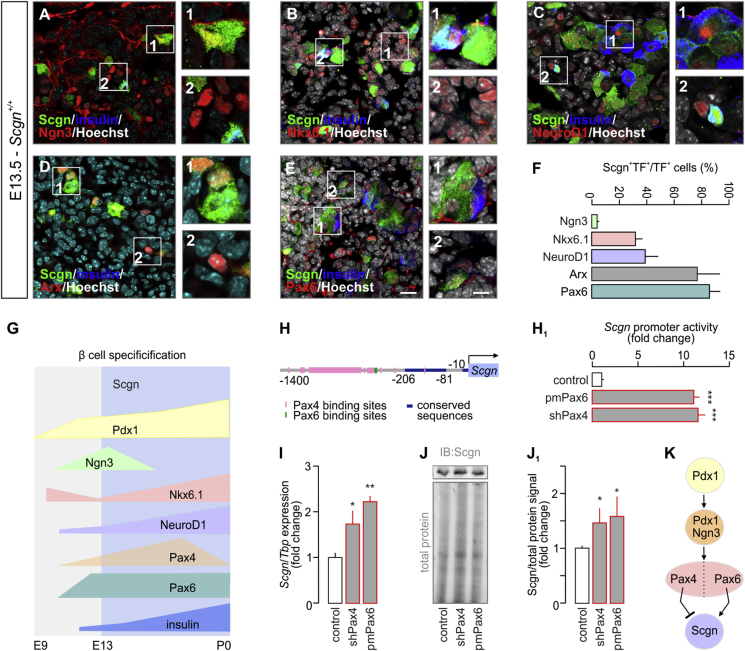
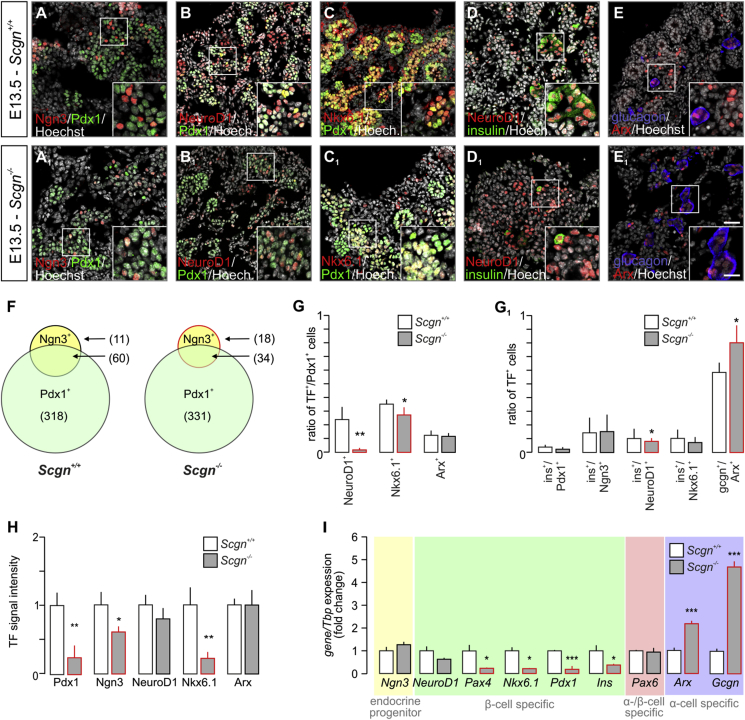
We used high-resolution histochemistry to explore the coincident expression of secretagogin and transcription factors driving β cell differentiation. Secretagogin promoter activity was tested in response to genetically manipulating Pax6 and Pax4 expression. Secretagogin null mice were produced with their pancreatic islets morphologically and functionally characterized during fetal development. A proteomic approach was utilized to identify the Ca-dependent interaction of secretagogin with subunits of the 26S proteasome and verified in vitro by focusing on Pdx1 retention.
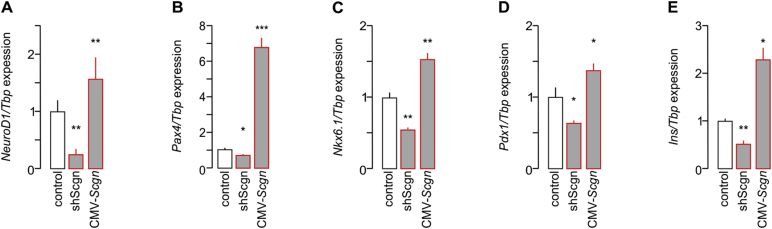
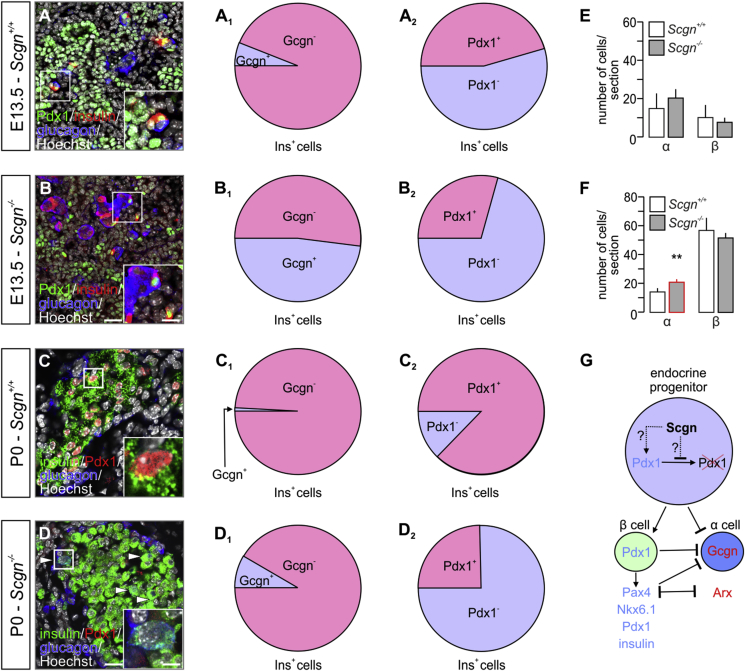
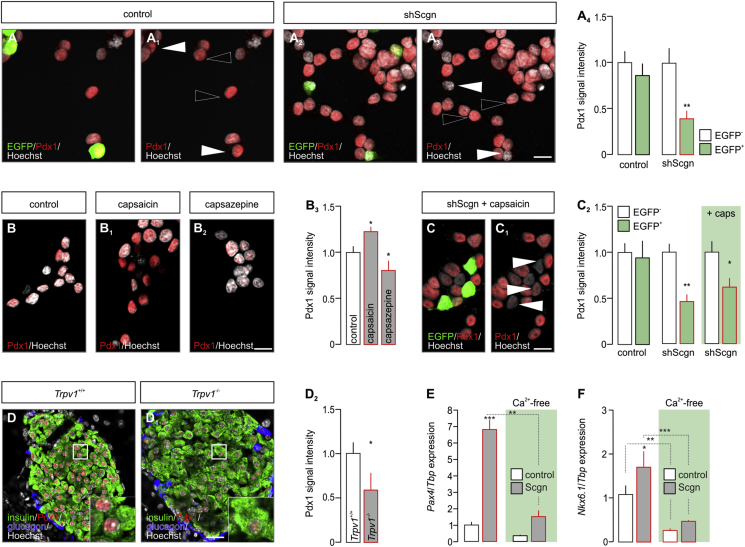
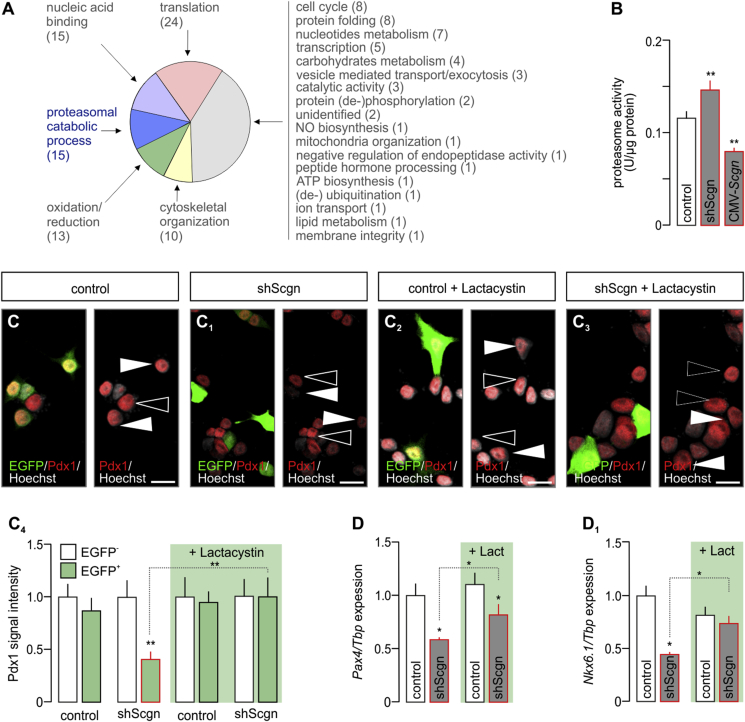
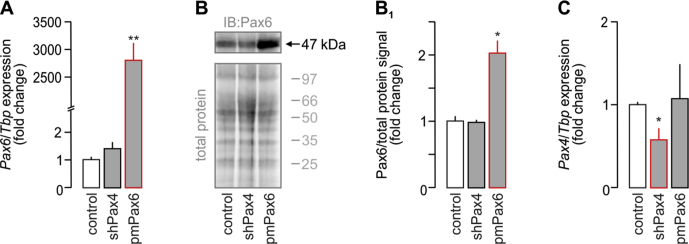
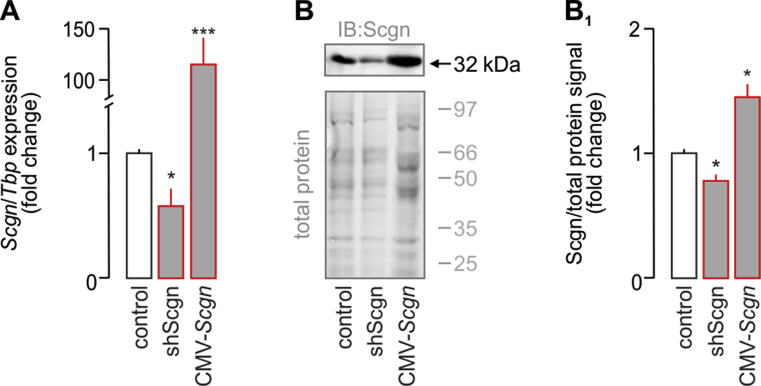
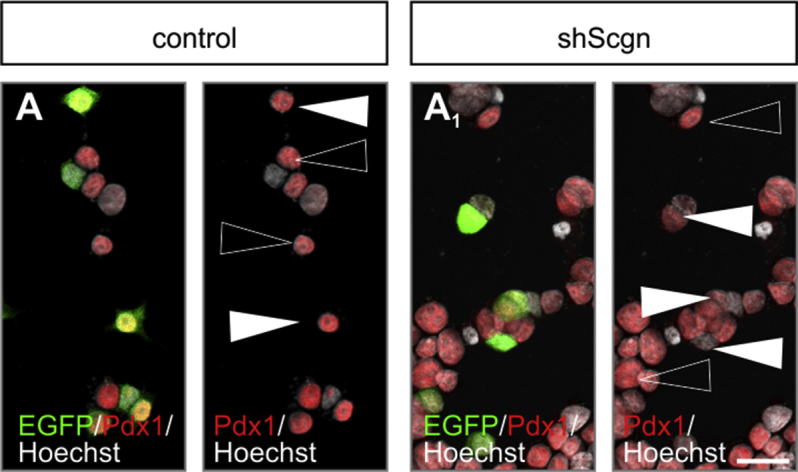
Here, we show that secretagogin, a Ca sensor protein that controls α and β cell turnover in adult, is in fact expressed in endocrine pancreas from the inception of lineage segregation in a Pax4-and Pax6-dependent fashion. By genetically and pharmacologically manipulating secretagogin expression and interactome engagement in vitro, we find secretagogin to gate excitation-driven Ca signals for β cell differentiation and insulin production. Accordingly, secretagogin fetuses retain a non-committed pool of endocrine progenitors that co-express both insulin and glucagon. We identify the Ca-dependent interaction of secretagogin with subunits of the 26S proteasome complex to prevent Pdx1 degradation through proteasome inactivation. This coincides with retained Nkx6.1, Pax4 and insulin transcription in prospective β cells.
In sum, secretagogin scales the temporal availability of a Ca-dependent transcription factor network to define β cell identity.
发育中胰腺内分泌细胞谱系的特化依赖于非胰腺组织的外在信号,这些信号启动了转录因子激活和抑制开关的自主序列。该途径中的步骤都依赖于活性依赖的 Ca 信号。然而,将阶段性 Ca 涌变成由转录因子组合组成的动态、细胞状态特异性和生理相关的密码的机制在很大程度上仍然未知。
我们使用高分辨率组织化学方法来探索促分泌素和驱动β细胞分化的转录因子的同时表达。通过遗传操纵 Pax6 和 Pax4 的表达来测试促分泌素启动子活性。利用其胰岛的形态和功能特征,在胎儿发育过程中产生了促分泌素缺失的小鼠。利用蛋白质组学方法鉴定了促分泌素与 26S 蛋白酶体亚基的 Ca 依赖性相互作用,并通过关注 Pdx1 的保留在体外进行了验证。
在这里,我们表明促分泌素,一种控制成年期α和β细胞更新的 Ca 传感器蛋白,实际上是在谱系分离开始时,以 Pax4 和 Pax6 依赖的方式在内分泌胰腺中表达的。通过遗传和药理学操纵促分泌素的表达和体外相互作用,我们发现促分泌素可以为β细胞分化和胰岛素产生门控兴奋驱动的 Ca 信号。因此,促分泌素胎儿保留了一个未分化的内分泌祖细胞池,这些细胞共同表达胰岛素和胰高血糖素。我们确定了促分泌素与 26S 蛋白酶体复合物亚基的 Ca 依赖性相互作用,通过蛋白酶体失活来防止 Pdx1 的降解。这与保留的 Nkx6.1、Pax4 和胰岛素转录在潜在的β细胞中一致。
总之,促分泌素通过调节 Ca 依赖性转录因子网络的时间可用性来确定β细胞的身份。