Yamazaki Haruhiko, Iwasaki Hiroyuki, Takasaki Hirotaka, Suganuma Nobuyasu, Sakai Rika, Masudo Katsuhiko, Nakayama Hirotaka, Rino Yasushi, Masuda Munetaka
Department of Breast and Endocrine Surgery.
Department of Medical Oncology, Kanagawa Cancer Center.
Medicine (Baltimore). 2019 Mar;98(10):e14774. doi: 10.1097/MD.0000000000014774.
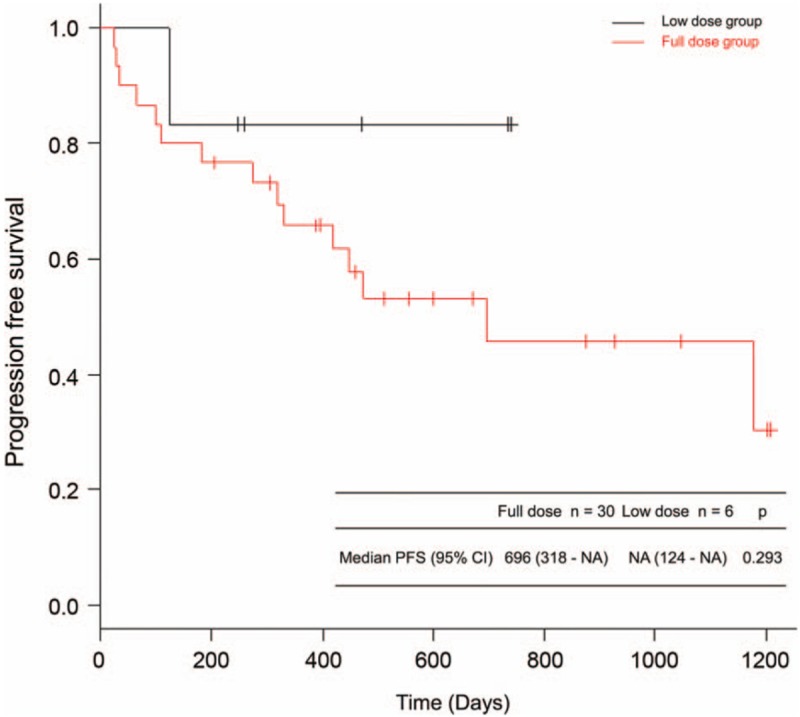
Some patients with differentiated thyroid cancer (DTC) may require an initial low dose (LD) of lenvatinib. However, few studies have investigated the efficacy of LD lenvatinib. We compared the efficacy and tolerability of lenvatinib at an initial LD to those of the standard initial dose of 24 mg in patients with DTC.In this cross-sectional study, records of patients with DTC treated with lenvatinib were retrospectively reviewed. Patients were divided into 2 groups based on the initial dose of lenvatinib: a full-dose (FD) group that received an initial dose of 24 mg/d and a LD group that received an initial dose of less than 24 mg/d. Categorical variables were compared with the Fisher exact test and continuous variables with Student t test. A progression-free survival (PFS) curve was constructed with the Kaplan-Meier method. A probability (P) value of < .05 was considered statistically significant.Thirty-six patients with DTC were treated with lenvatinib (30 in the FD group and 6 in the LD group). The response rates were 43% and 33% in the FD and LD groups, respectively. The median PFS duration was 696 [95% confidence interval (CI): 318-not available (NA)] days in the FD group. The median PFS of the LD group was not reached (95% CI: 124-NA) (P = .293). Treatment interruptions were required in 25 (83%) patients in the FD group and 4 (67%) in the LD group (P = .573). Dose reductions were required in 28 (93%) patients in the FD group and 4 (67%) in the LD group (P = .121). There were no significant differences in the incidences of common adverse events between the 2 groups.The LD group also required dose reduction and interruption frequently. Since these findings are only the short-term results of a limited number of cases, a large number of cases and long-term observations are needed to determine whether an initial LD is effective for patients with DTC in poor general condition.
一些分化型甲状腺癌(DTC)患者可能需要初始低剂量(LD)的乐伐替尼。然而,很少有研究调查低剂量乐伐替尼的疗效。我们比较了DTC患者初始低剂量乐伐替尼与标准初始剂量24mg的疗效和耐受性。
在这项横断面研究中,对接受乐伐替尼治疗的DTC患者记录进行回顾性分析。根据乐伐替尼初始剂量将患者分为两组:全剂量(FD)组接受初始剂量24mg/d,低剂量(LD)组接受初始剂量小于24mg/d。分类变量采用Fisher精确检验比较,连续变量采用Student t检验比较。采用Kaplan-Meier法构建无进展生存(PFS)曲线。P值<0.05被认为具有统计学意义。
36例DTC患者接受乐伐替尼治疗(FD组30例,LD组6例)。FD组和LD组的缓解率分别为43%和33%。FD组的中位PFS持续时间为696[95%置信区间(CI):318-不可用(NA)]天。LD组的中位PFS未达到(95%CI:124-NA)(P=0.293)。FD组25例(83%)患者需要中断治疗,LD组4例(67%)(P=0.573)。FD组28例(93%)患者需要降低剂量,LD组4例(67%)(P=0.121)。两组常见不良事件发生率无显著差异。
LD组也经常需要降低剂量和中断治疗。由于这些发现只是少数病例的短期结果,因此需要大量病例和长期观察来确定初始低剂量对一般状况较差的DTC患者是否有效。