College of Geomatics, Shandong University of Science and Technology, Qingdao 266590, China.
State Key Laboratory of Remote Sensing Science, Institute of Remote Sensing and Digital Earth of Chinese Academy of Sciences, Beijing 100101, China.
Sensors (Basel). 2019 Mar 9;19(5):1207. doi: 10.3390/s19051207.
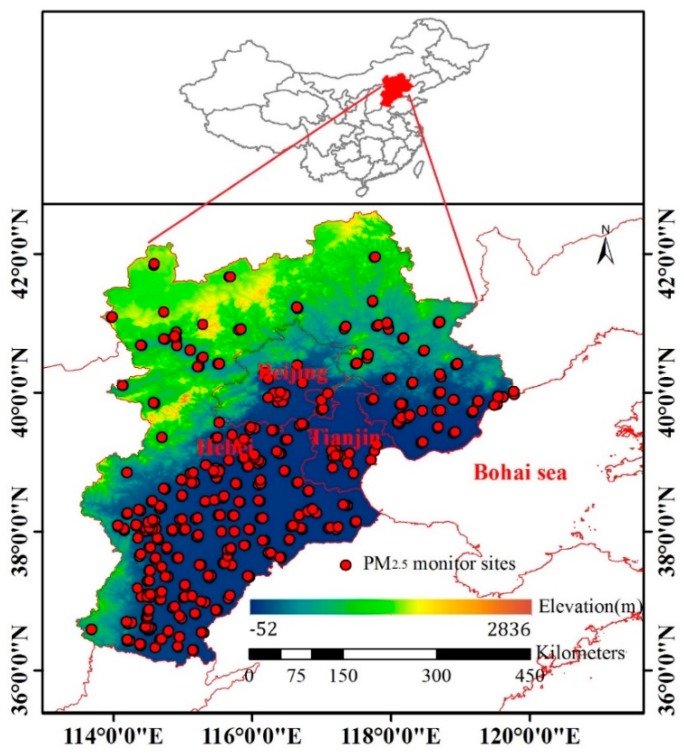
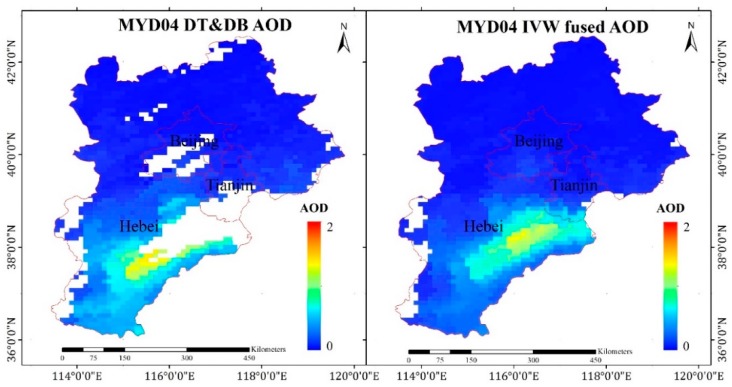
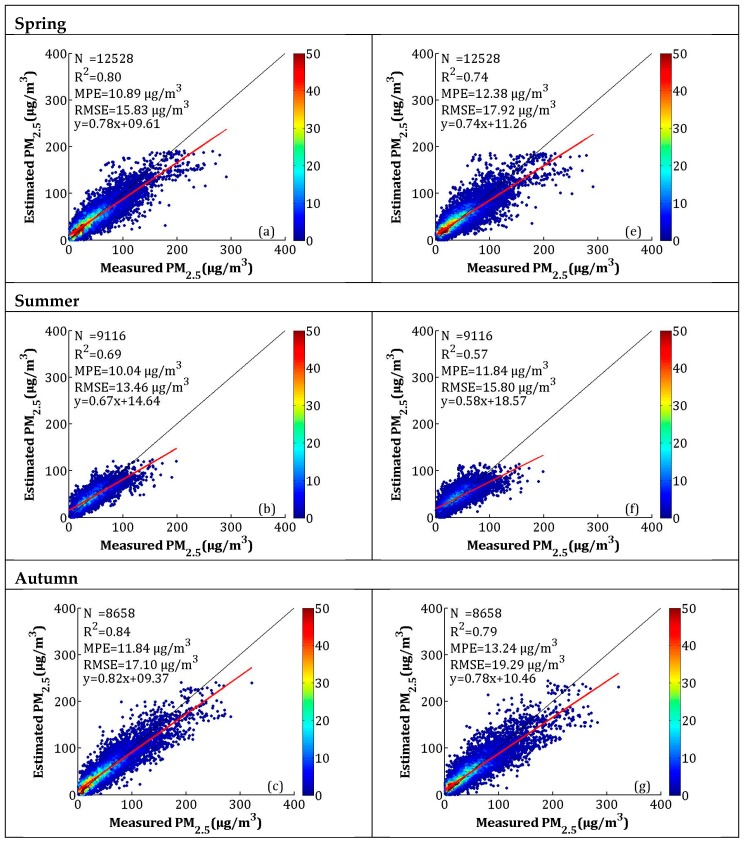
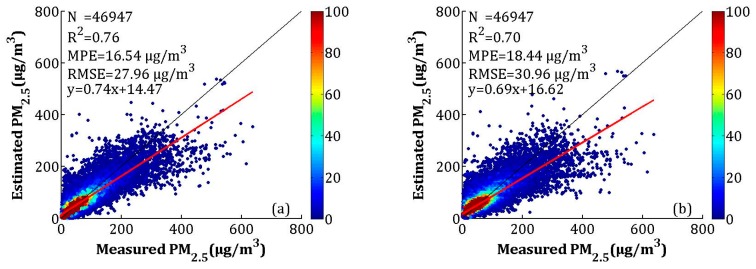
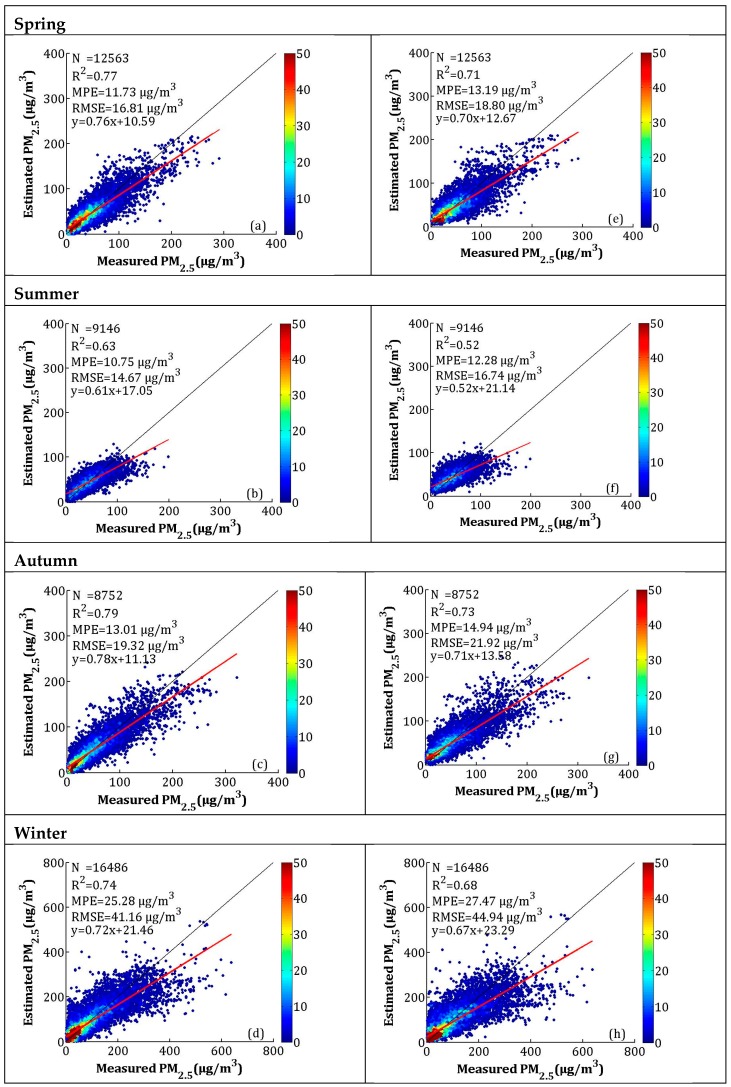
Accurately estimating fine ambient particulate matter (PM) is important to assess air quality and to support epidemiological studies. To analyze the spatiotemporal variation of PM concentrations, previous studies used different methodologies, such as statistical models or neural networks, to estimate PM. However, there is little research on full-coverage PM estimation using a combination of ground-measured, satellite-estimated, and atmospheric chemical model data. In this study, the linear mixed effect (LME) model, which used the aerosol optical depth (AOD) from the Moderate Resolution Imaging Spectroradiometer (MODIS), meteorological data, normalized difference vegetation index (NDVI), and elevation data as predictors, was fitted for 2017 over Beijing⁻Tianjin⁻Hebei (BTH). The LME model was used to calibrate the PM concentration using the nested air-quality prediction modeling system (NAQPMS) simulated with ground measurements. The inverse variance weighting (IVW) method was used to fuse satellite-estimated and model-calibrated PM. The results showed a strong agreement with ground measurements, with an overall coefficient (²) of 0.78 and a root-mean-square error (RMSE) of 26.44 μg/m³ in cross-validation (CV). The seasonal ² values were 0.75, 0.62, 0.80, and 0.78 in the spring, summer, autumn, and winter, respectively. The fusion results supplement the lack of satellite estimates and can capture more detailed information than the NAQPMS model. Therefore, the results will be helpful for pollution process analyses and health-related studies.
准确估计细颗粒物(PM)对于评估空气质量和支持流行病学研究非常重要。为了分析 PM 浓度的时空变化,先前的研究使用了不同的方法,如统计模型或神经网络,来估计 PM。然而,使用地面测量、卫星估计和大气化学模型数据的组合来进行全面覆盖的 PM 估计的研究很少。在这项研究中,使用了线性混合效应(LME)模型,该模型使用了中分辨率成像光谱仪(MODIS)的气溶胶光学深度(AOD)、气象数据、归一化差异植被指数(NDVI)和海拔数据作为预测因子,对 2017 年京津冀地区进行了拟合。LME 模型用于校准使用地面测量模拟的嵌套空气质量预测建模系统(NAQPMS)中 PM 浓度。逆方差加权(IVW)方法用于融合卫星估计和模型校准的 PM。结果与地面测量数据具有很强的一致性,交叉验证的总体系数(²)为 0.78,均方根误差(RMSE)为 26.44μg/m³。在春季、夏季、秋季和冬季,季节 ² 值分别为 0.75、0.62、0.80 和 0.78。融合结果补充了卫星估计的不足,可以比 NAQPMS 模型更准确地捕捉更详细的信息。因此,这些结果将有助于污染过程分析和与健康相关的研究。