Department of Microbiology and Immunology, University of Minnesota, Minneapolis, MN 55455.
Center for Immunology, University of Minnesota, Minneapolis, MN 55455.
J Immunol. 2019 May 1;202(9):2535-2545. doi: 10.4049/jimmunol.1801609. Epub 2019 Mar 11.
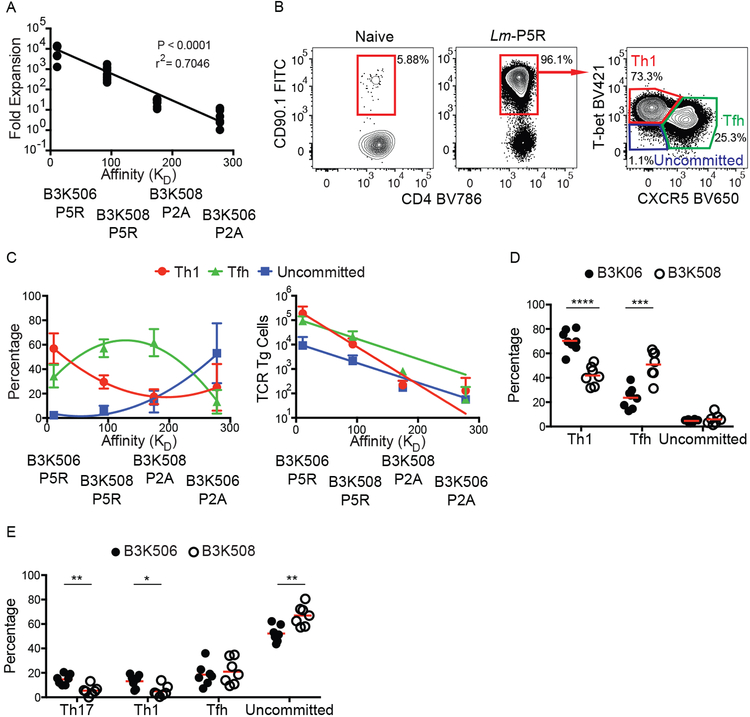
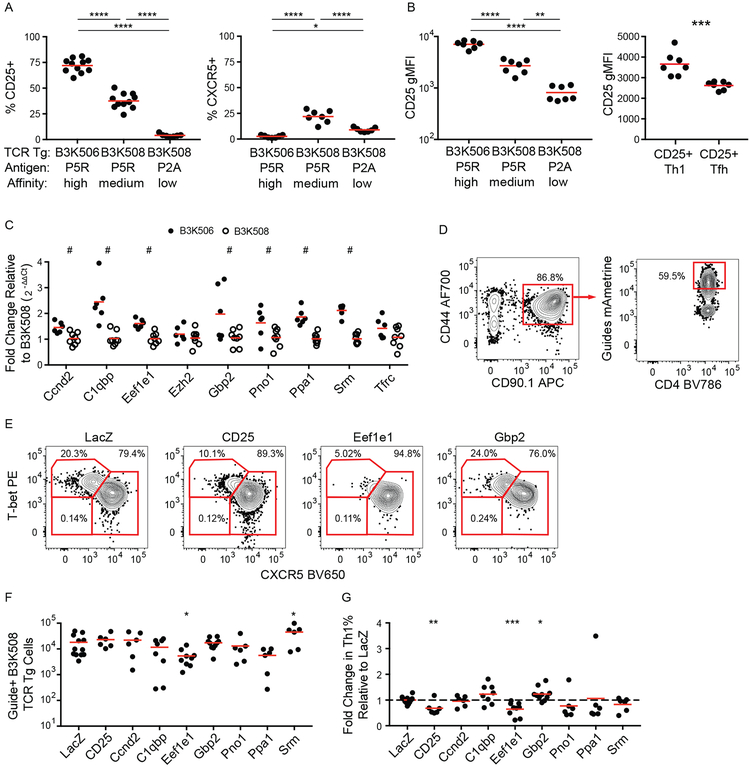
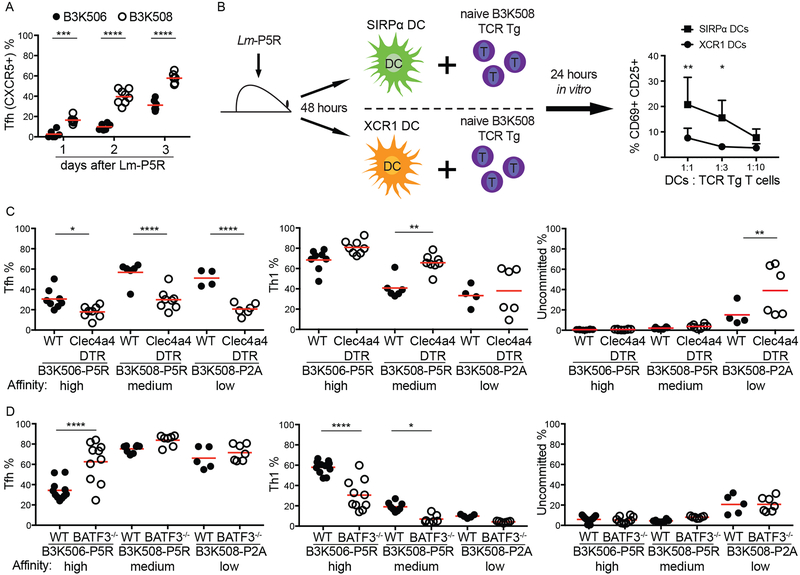
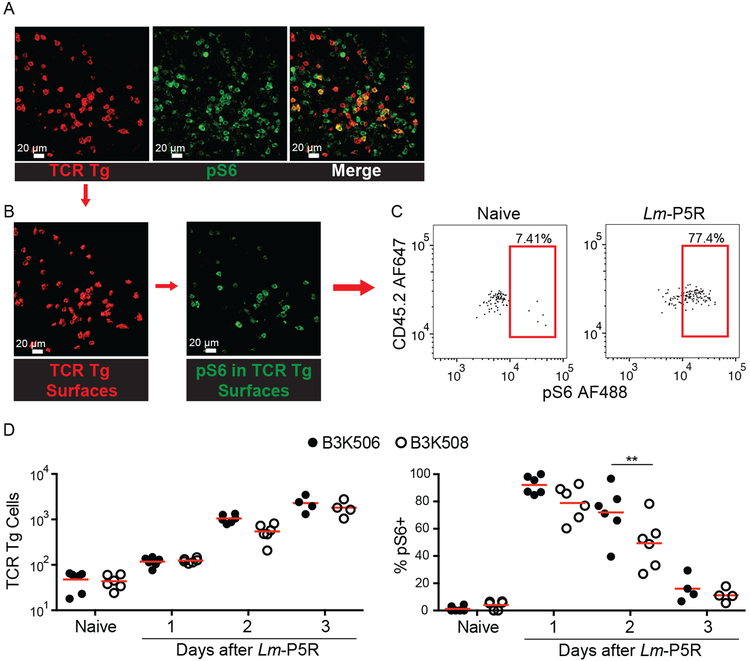
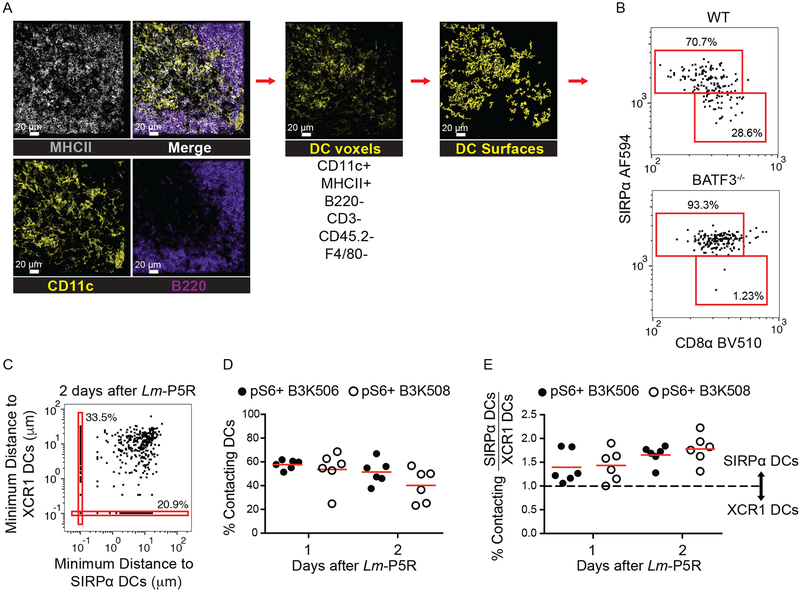
Naive CD4 T lymphocytes differentiate into various Th cell subsets following TCR binding to microbial peptide:MHC class II (p:MHCII) complexes on dendritic cells (DCs). The affinity of the TCR interaction with p:MHCII plays a role in Th differentiation by mechanisms that are not completely understood. We found that low-affinity TCRs biased mouse naive T cells to become T follicular helper (Tfh) cells, whereas higher-affinity TCRs promoted the formation of Th1 or Th17 cells. We explored the basis for this phenomenon by focusing on IL-2R signaling, which is known to promote Th1 and suppress Tfh cell differentiation. SIRP⍺ DCs produce abundant p:MHCII complexes and consume IL-2, whereas XCR1 DCs weakly produce p:MHCII but do not consume IL-2. We found no evidence, however, of preferential interactions between Th1 cell-prone, high-affinity T cells and XCR1 DCs or Tfh cell-prone, low-affinity T cells and SIRP⍺ DCs postinfection with bacteria expressing the peptide of interest. Rather, high-affinity T cells sustained IL-2R expression longer and expressed two novel Th cell differentiation regulators, Eef1e1 and Gbp2, to a higher level than low-affinity T cells. These results suggest that TCR affinity does not influence Th cell differentiation by biasing T cell interactions with IL-2-consuming DCs, but instead, directly regulates genes in naive T cells that control the differentiation process.
幼稚 CD4 T 淋巴细胞在 TCR 与树突状细胞 (DC) 上的微生物肽:MHC Ⅱ类 (p:MHCII) 复合物结合后,分化为各种 Th 细胞亚群。TCR 与 p:MHCII 的亲和力在 Th 分化中起作用,但机制尚不完全清楚。我们发现,低亲和力 TCR 使小鼠幼稚 T 细胞偏向成为滤泡辅助性 T 细胞 (Tfh),而较高亲和力的 TCR 则促进 Th1 或 Th17 细胞的形成。我们通过关注已知促进 Th1 并抑制 Tfh 细胞分化的 IL-2R 信号转导,来探索这种现象的基础。SIRP⍺ DC 产生丰富的 p:MHCII 复合物并消耗 IL-2,而 XCR1 DC 则弱产生 p:MHCII 但不消耗 IL-2。然而,我们没有发现倾向于产生 Th1 细胞的高亲和力 T 细胞与 XCR1 DC 之间,或倾向于产生 Tfh 细胞的低亲和力 T 细胞与 SIRP⍺ DC 之间存在优先相互作用的证据,在感染表达相关肽的细菌后。相反,高亲和力 T 细胞维持 IL-2R 表达的时间更长,并以更高的水平表达两种新的 Th 细胞分化调节剂,Eef1e1 和 Gbp2,比低亲和力 T 细胞更高。这些结果表明,TCR 亲和力不是通过偏向与消耗 IL-2 的 DC 相互作用来影响 Th 细胞分化,而是直接调节幼稚 T 细胞中的基因,从而控制分化过程。