Hiramatsu Akira, Aikata Hiroshi, Uchikawa Shinsuke, Ohya Kazuki, Kodama Kenichiro, Nishida Yuno, Daijo Kana, Osawa Mitsutaka, Teraoka Yuji, Honda Fumi, Inagaki Yuki, Morio Kei, Morio Reona, Fujino Hatsue, Nakahara Takashi, Murakami Eisuke, Yamauchi Masami, Kawaoka Tomokazu, Miki Daiki, Tsuge Masataka, Imamura Michio, Tanaka Junko, Chayama Kazuaki
Department of Gastroenterology and Metabolism, Applied Life Sciences Institute of Biomedical and Health Sciences, Hiroshima University Hiroshima Japan.
Liver Research Project Center Hiroshima University Hiroshima Japan.
Hepatol Commun. 2019 Jan 22;3(3):348-355. doi: 10.1002/hep4.1309. eCollection 2019 Mar.
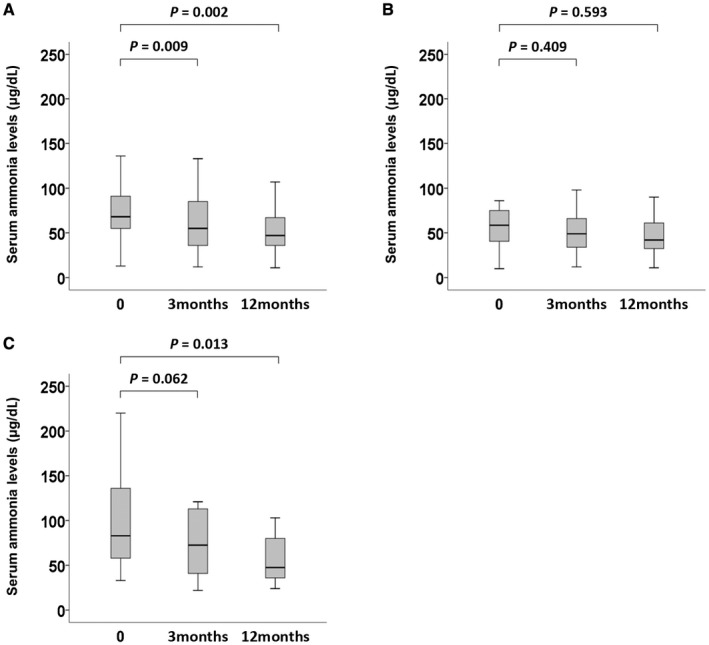
Although the effect of levocarnitine (L-carnitine) on hyperammonemia has been reported in patients with liver cirrhosis (LC), its effect on sarcopenia remains to be elucidated. We assessed the effects of L-carnitine on sarcopenia in patients with LC. We retrospectively evaluated 52 patients with LC who were treated with L-carnitine for more than 3 months between February 2013 and June 2017. Computed tomography was used to measure the cross-sectional area of the skeletal muscles at the level of the third lumbar vertebra. The relative change in skeletal muscle index (SMI) per year (ΔSMI/year) was computed in each patient. We evaluated the relationship between ΔSMI/year and various parameters, such as age, sex, liver functional reserve, and dose of L-carnitine. The median ΔSMI/year for all patients was -0.22%. The ΔSMI/year values in Child-Pugh classes A, B, and C were not significantly different among the three groups. There was no significant relationship between ΔSMI/year and sex, age, body mass index, and sarcopenia. Multivariate analysis showed that only a high dose of L-carnitine (odds ratio [OR], 4.812; 95% confidence interval [CI], 1.233-18.784; 0.024) was associated with increased muscle mass. The L-carnitine high-dose group included a significantly larger number of patients with increased muscle mass compared with the low-dose group (OR, 3.568; 95% CI, 1.138-11.185; 0.027). Administration of L-carnitine led to a significant and gradual reduction in serum ammonia levels. L-carnitine seems to suppress the progression of sarcopenia dose dependently, and this was noted to be associated with the improvement of hyperammonemia in patients with LC.
尽管左旋肉碱(L-肉碱)对肝硬化(LC)患者高氨血症的影响已有报道,但其对肌肉减少症的影响仍有待阐明。我们评估了L-肉碱对LC患者肌肉减少症的影响。我们回顾性评估了2013年2月至2017年6月期间接受L-肉碱治疗超过3个月的52例LC患者。使用计算机断层扫描测量第三腰椎水平骨骼肌的横截面积。计算每位患者每年骨骼肌指数(SMI)的相对变化(ΔSMI/年)。我们评估了ΔSMI/年与各种参数之间的关系,如年龄、性别、肝功能储备和L-肉碱剂量。所有患者的ΔSMI/年中位数为-0.22%。Child-Pugh A、B和C级患者的ΔSMI/年值在三组之间无显著差异。ΔSMI/年与性别、年龄体重指数和肌肉减少症之间无显著关系。多因素分析显示,只有高剂量的L-肉碱(优势比[OR],4.812;95%置信区间[CI],1.233-18.784;P=0.024)与肌肉量增加有关。与低剂量组相比,L-肉碱高剂量组中肌肉量增加的患者数量明显更多(OR,3.568;95%CI,1.138-11.185;P=0.027)。L-肉碱的给药导致血清氨水平显著且逐渐降低。L-肉碱似乎剂量依赖性地抑制肌肉减少症的进展,并且注意到这与LC患者高氨血症的改善有关。