Department of Organisation and Consumption Economics, Faculty of Human Nutrition and Consumer Sciences,Warsaw University of Life Sciences (WULS-SGGW),Nowoursynowska 159 C Street,02-776Warsaw,Poland.
Public Health Nutr. 2019 May;22(7):1330-1339. doi: 10.1017/S1368980019000326. Epub 2019 Mar 12.
To obtain a better insight into the conceptualization of sustainable consumption among consumers with special focus on food choice determinants. Previous studies show that people present positive attitude towards sustainable diet while their everyday food choices do not follow sustainable diet rules.
A structured questionnaire was designed and data were collected via computer-assisted telephone interview among a random group (n 600) of city-dwellers. Quota sampling was used in proportion to the city population. Cluster analysis (k-means method) was applied to identify consumer segments according to the determinants of food choices. Consumer segments were identified using one-way ANOVA with post hoc Duncan comparison of mean scores and cross-tabulation with χ 2. The Friedman test was applied to identify enablers and barriers of sustainable food choices.
Cities in Mazovia, the best developed, central region of Poland.ParticipantsAdults (21-70 years old).
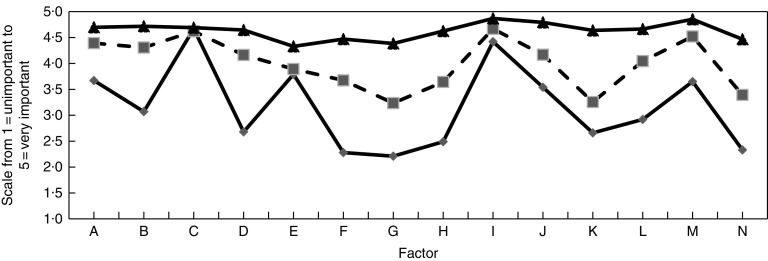
Consumers are not familiar with the concept of sustainability and are not able to define it adequately. Only 6 % of the studied population indicated that sustainable consumption is connected with nutrition which has possibly less impact on the environment. Three segments of consumers were distinguished regarding their attitude to food choice determinants adequate to sustainable diet: Non-Adopters (17 %), Emergents (32 %), Adopters (51 %). Desire to improve health by decreasing body weight was the main driver for sustainable food choices, while prices were the main limitation.
Knowledge dissemination on sustainability issues is needed to empower consumers to make more sustainable food choices and to make public health and food policy measures more effective.
深入了解消费者对可持续消费的概念理解,特别关注食品选择决定因素。先前的研究表明,人们对可持续饮食持积极态度,而他们的日常食品选择却不符合可持续饮食规则。
设计了一份结构化问卷,并通过计算机辅助电话访谈方式在随机组(n=600)城市居民中收集数据。配额抽样按城市人口比例进行。应用聚类分析(k-均值法)根据食品选择决定因素对消费者群体进行分类。使用单向方差分析(ANOVA)和事后邓肯均值比较以及交叉表和卡方检验(χ 2)对消费者群体进行识别。应用弗里德曼检验(Friedman test)确定可持续食品选择的促进因素和障碍。
波兰中部最发达的马佐夫舍地区的城市。
成年人(21-70 岁)。
消费者不熟悉可持续性概念,无法充分定义。只有 6%的研究人群表示,可持续消费与营养有关,这对环境的影响可能较小。根据对可持续饮食适当的食品选择决定因素的态度,将消费者分为三个群体:非采纳者(17%)、新兴者(32%)和采纳者(51%)。通过减轻体重来改善健康是可持续食品选择的主要驱动因素,而价格是主要限制因素。
需要传播有关可持续性问题的知识,以使消费者有能力做出更可持续的食品选择,并使公共卫生和食品政策措施更加有效。