Department Alcohol, Tobacco & Drugs, Norwegian Institute of Public Health, P.O. Box 222 Skøyen, N-0213 Oslo, Norway.
Int J Environ Res Public Health. 2019 Mar 11;16(5):879. doi: 10.3390/ijerph16050879.
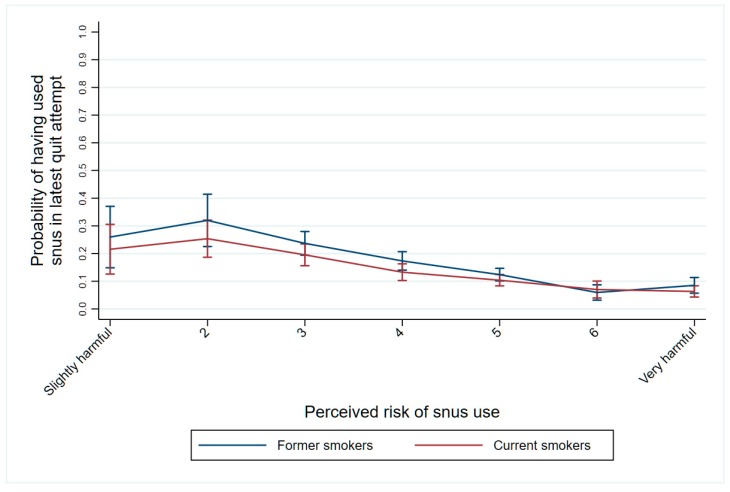
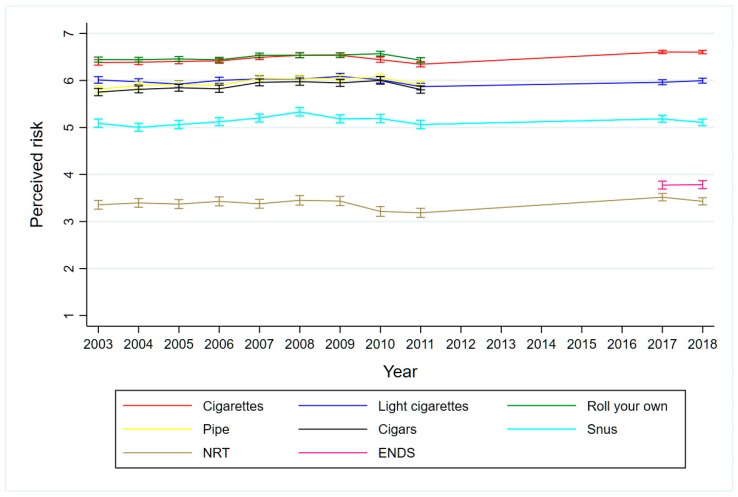
Most studies on perceived risks of smokeless tobacco products (SLT) have been conducted in the U.S., and the vast majority conclude that perceptions of the relative harmfulness of SLT versus cigarettes in the population are inconsistent with epidemiologically-based risk estimates, and typically conflated to that of cigarettes. We tested whether such inaccuracies also existed in Norway, where SLT-products are less toxic (Swedish snus) and SLT use is more prevalent than in the U.S. Over a 16 years period (2003⁻2018), 13,381 respondents (aged 16⁻79 years) answered questions about risk perceptions in Statistics Norway's nationally representative survey of tobacco behavior. We applied an indirect measure of comparative harm where risk beliefs for eight nicotine products were assessed independently of other products and then compared the answers. The wording of the question was: "We will now mention a variety of nicotine products and ask you how harmful you think daily use of these are. Use a scale from 1 to 7, where 1 is slightly harmful and 7 is very harmful". Mean scores with 95% confidence intervals were calculated. The overall risk score for cigarettes was 6.48. The risk score for snus was 5.14⁻79.3% of the risk score of cigarettes. The relative risk scores for e-cigarettes (3.78) and NRT products (3.39) was 58.4% and 52.3% when compared to cigarettes. Perceptions of risk were stable over time. A strong association was observed between perceived risk of snus and having used snus in attempts to quit smoking. Perceptions of relative risk between snus and cigarettes is inconsistent with estimates from medical expert committees, which assess the overall health risk from use of Swedish snus to be minor when compared to the risk from smoking. Like the situation in the US, incorrect beliefs about SLT risks seem to be prevalent also in the snus-prevalent Norwegian setting. Accurate information on differential harms needs to be communicated. Future research should try to identify reasons why health authorities in the US and Scandinavia allow these well-documented misconceptions to persist.
大多数关于无烟气烟草制品(SLT)感知风险的研究都是在美国进行的,绝大多数研究的结论是,人群中对 SLT 相对于香烟的相对危害性的看法与基于流行病学的风险估计不一致,而且通常与香烟的看法相混淆。我们检验了这种不准确是否也存在于挪威,在挪威,SLT 产品的毒性较低(瑞典鼻烟),SLT 的使用比美国更为普遍。在 16 年的时间里(2003 年至 2018 年),13381 名(年龄在 16 岁至 79 岁之间)的受访者在挪威统计局的全国烟草行为调查中回答了关于风险认知的问题。我们应用了一种间接的比较危害衡量方法,即独立于其他产品评估八种尼古丁产品的风险信念,然后对答案进行比较。问题的措辞是:“现在我们将提到各种尼古丁产品,并询问您认为每天使用这些产品的危害性如何。使用 1 到 7 的等级,其中 1 表示略有危害,7 表示非常危害”。计算了带有 95%置信区间的平均值。香烟的总体风险评分为 6.48。鼻烟的风险评分为 5.14-79.3%的香烟风险评分。与香烟相比,电子烟的相对风险评分(3.78)和尼古丁替代疗法产品的相对风险评分(3.39)分别为 58.4%和 52.3%。对风险的认知随着时间的推移而保持稳定。观察到鼻烟的感知风险与试图戒烟时使用鼻烟之间存在强烈关联。鼻烟和香烟之间的相对风险认知与医学专家委员会的评估不一致,专家委员会评估使用瑞典鼻烟的总体健康风险相对较小,而与吸烟的风险相比。与美国的情况一样,关于 SLT 风险的错误信念似乎在鼻烟流行的挪威环境中也很普遍。需要传达有关差异危害的准确信息。未来的研究应该试图确定为什么美国和斯堪的纳维亚的卫生当局允许这些有充分文件记录的误解持续存在。