Horowitz Richard I, Freeman Phyllis R
Health and Human Services, Tick-Borne Disease Working Group, Washington, DC 20201 USA,
Hudson Valley Healing Arts Center, Hyde Park, NY 12538, USA,
Int J Gen Med. 2019 Feb 18;12:101-119. doi: 10.2147/IJGM.S193608. eCollection 2019.
We collected data from an online survey of 200 of our patients, which evaluated the efficacy of dapsone (diaminodiphenyl sulfone, ie, DDS) combined with other antibiotics and agents that disrupt biofilms for the treatment of chronic Lyme disease/post-treatment Lyme disease syndrome (PTLDS). We also collected aggregate data from direct retrospective chart review, including laboratory testing for Lyme, other infections, and associated tick-borne coinfections. This helped us to determine the frequency of exposure to other infections/coinfections among a cohort of chronically ill Lyme patients, evaluate the efficacy of newer "persister" drug regimens like DDS, and determine how other infections and tick-borne coinfections may be contributing to the burden of chronic illness leading to resistant symptomatology.
A total of 200 adult patients recruited from a specialized Lyme disease medical practice had been ill for at least 1 year. We regularly monitored laboratory values and participants' symptom severity, and the patients completed the online symptom questionnaire both before beginning treatment and after 6 months on DDS combination therapy (DDS CT). Paired-samples -tests and Wilcoxon signed-rank nonparametric test were performed on each of eight major Lyme symptoms, both before DDS CT and after 6 months of therapy.
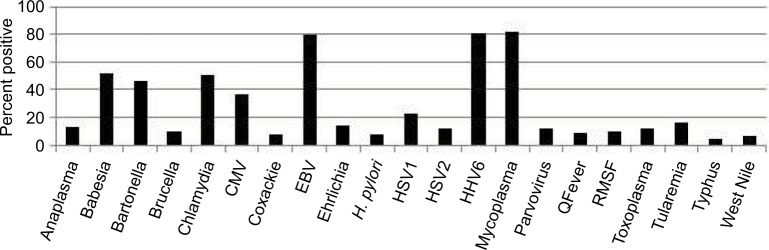
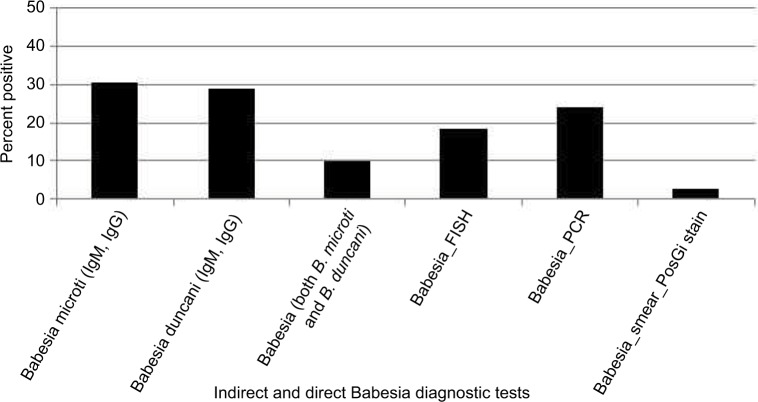
DDS CT statistically improved the eight major Lyme symptoms. We found multiple species of intracellular bacteria including rickettsia, Bartonella, Mycoplasma, Chlamydia, Tularemia, and Brucella contributing to the burden of illness and a high prevalence of Babesia complicating management with probable geographic spread of to the Northeast. Borrelia, Bartonella, and Mycoplasma species, as well as had variable manifestations and diverse seroreactivity, with evidence of persistence despite commonly prescribed courses of anti-infective therapies. Occasional reactivation of viral infections including human herpes virus 6 was also seen in immunocompromised individuals.
DDS CT decreased eight major Lyme symptoms severity and improved treatment outcomes among patients with chronic Lyme disease/PTLDS and associated coinfections.
我们收集了对200名患者进行在线调查的数据,该调查评估了氨苯砜(二氨基二苯砜,即DDS)联合其他抗生素及破坏生物膜的药物治疗慢性莱姆病/治疗后莱姆病综合征(PTLDS)的疗效。我们还从直接回顾性病历审查中收集了汇总数据,包括莱姆病、其他感染及相关蜱传共感染的实验室检测。这有助于我们确定一组慢性莱姆病患者中其他感染/共感染的暴露频率,评估像DDS这样的新型“持续菌”药物方案的疗效,并确定其他感染和蜱传共感染如何可能导致慢性疾病负担并引发耐药症状。
从一家专门的莱姆病医疗诊所招募了总共200名成年患者,他们患病至少1年。我们定期监测实验室值和参与者的症状严重程度,患者在开始治疗前以及接受DDS联合治疗(DDS CT)6个月后完成在线症状问卷。对DDS CT前和治疗6个月后的八项主要莱姆病症状分别进行配对样本t检验和Wilcoxon符号秩非参数检验。
DDS CT在统计学上改善了八项主要莱姆病症状。我们发现多种细胞内细菌,包括立克次体、巴尔通体、支原体、衣原体、兔热病杆菌和布鲁氏菌,导致疾病负担,并且巴贝斯虫的高流行使管理复杂化,可能已向东北部地区传播。伯氏疏螺旋体、巴尔通体和支原体物种,以及[此处原文缺失相关内容]有不同的表现和多样的血清反应性,尽管通常规定了抗感染治疗疗程,但仍有持续存在的证据。在免疫功能低下的个体中也偶尔出现包括人类疱疹病毒6在内的病毒感染再激活。
DDS CT降低了慢性莱姆病/PTLDS及相关共感染患者的八项主要莱姆病症状严重程度并改善了治疗结果。