Alcohol, Tobacco and Other Drug Research Unit, South African Medical Research Council, Francie Van Zijl Drive, Parow Valley, Cape Town, South Africa.
Department of Psychiatry and Mental Health, University of Cape Town, J-Block, Groote Schuur Hospital, Observatory, Cape Town, South Africa.
Health Policy Plan. 2019 Mar 1;34(2):132-140. doi: 10.1093/heapol/czz017.
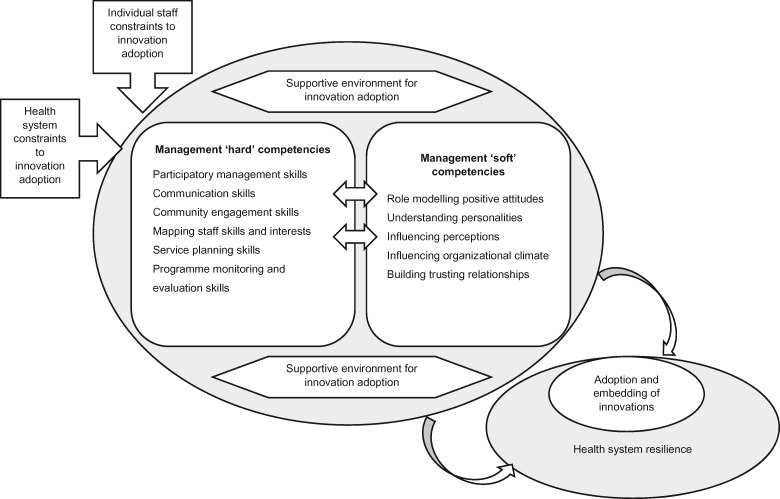
Building resilience in health systems is an imperative for low- and middle- income countries. Health service managers' ability to implement health innovations may be a key aspect of resilience in primary healthcare facilities, promoting adaptability and functionality. This study investigated health service managers' perceptions and experiences of adopting health innovations. We aimed to identify perceptions of constraints to adoption and emergent behaviours in response to these constraints. A convenience sample of 34 facility, clinical service and sub-district level managers was invited to participate. Six did not respond and were not contactable. In-depth individual interviews in a private space at participants' place of work were conducted with 28 participants. Interviews were audio recorded and transcribed verbatim. NVivo 11 was used to store data and facilitate framework analysis. Study participants described constraints to innovation adoption including: staff lack of understanding of potential benefits; staff personalities, attitudes and behaviours which lead to resistance to change; high workload related to resource constraints and frequent policy changes inducing resistance to change; and suboptimal communication through health system structures. Managers reported employing various strategies to mitigate these constraints. These comprised (1) technical skills including participatory management skills, communication skills, community engagement skills and programme monitoring and evaluation skills, and (2) non-technical skills including role modelling positive attitudes, understanding staff personalities, influencing perceptions of innovations, influencing organizational climate and building trusting relationships. Managers have a vital role in the embedding of service innovations into routine practice. We present a framework of technical and non-technical skills that managers need to facilitate the adoption of health innovations. Future efforts to build managers' capacity to implement health innovations should target these competencies.
在中低收入国家,增强卫生系统的弹性是当务之急。卫生服务管理者实施卫生创新的能力可能是基层医疗保健设施弹性的关键方面,可促进适应性和功能性。本研究调查了卫生服务管理者对采用卫生创新的看法和经验。我们旨在确定对采用的限制的看法以及对这些限制的出现行为。邀请了 34 名设施、临床服务和分区级别的管理人员参加方便样本调查。其中 6 人未回复且无法联系。在参与者工作场所的私人空间中对 28 名参与者进行了深入的个人访谈。访谈进行了录音,并逐字记录。使用 NVivo 11 存储数据并促进框架分析。研究参与者描述了创新采用的限制因素,包括:工作人员对潜在利益缺乏了解;工作人员的个性、态度和行为导致对变革的抵制;与资源限制相关的高工作量和频繁的政策变化导致对变革的抵制;以及通过卫生系统结构导致沟通不畅。管理者报告了采用各种策略来减轻这些限制,包括:(1)技术技能,包括参与式管理技能、沟通技能、社区参与技能和方案监测和评估技能,和(2)非技术技能,包括树立积极态度的榜样、了解工作人员的个性、影响对创新的看法、影响组织氛围和建立信任关系。管理者在将服务创新融入常规实践中起着至关重要的作用。我们提出了一个管理者需要促进卫生创新采用的技术和非技术技能框架。未来应针对这些能力来增强管理者实施卫生创新的能力。