Department of Cellular and Molecular Medicine, School of Medicine , University of California , San Diego , La Jolla , California 92093 , United States.
Turku PET Centre , Turku University Hospital , Turku 20521 , Finland.
Mol Pharm. 2019 Apr 1;16(4):1507-1515. doi: 10.1021/acs.molpharmaceut.8b01169. Epub 2019 Mar 22.
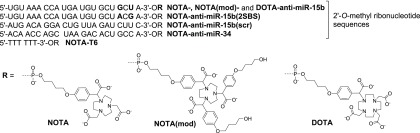
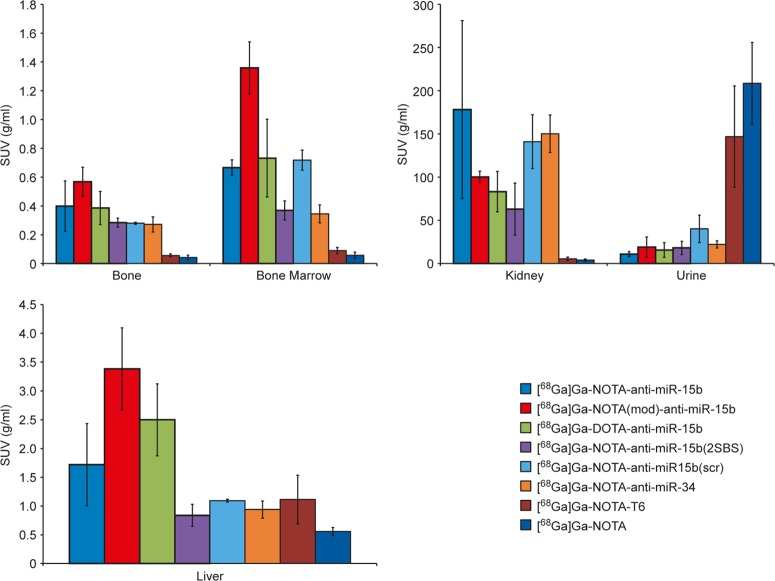
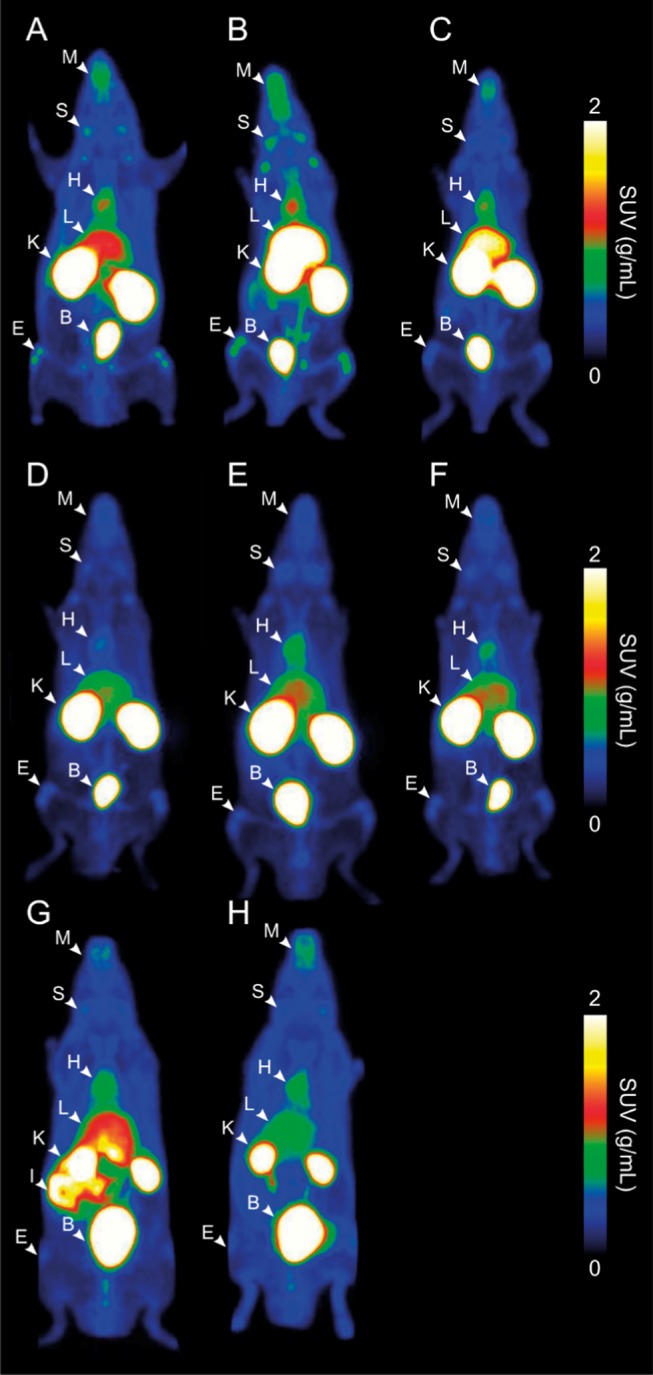
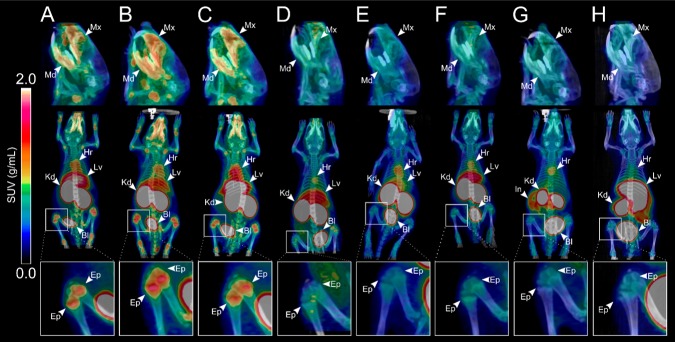
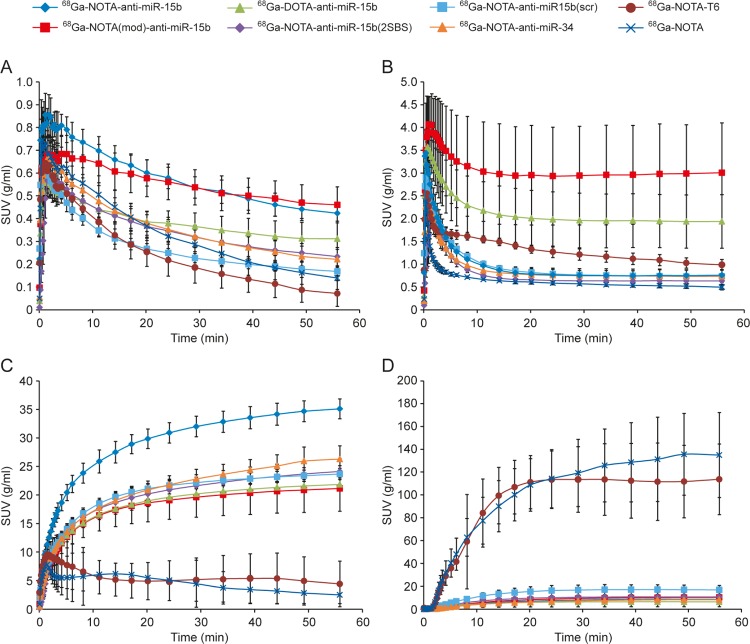
MicroRNAs (miRNAs) are endogenous, small, noncoding ribonucleic acids (RNAs) that bind to the 3' untranslated regions of messenger RNAs (mRNAs) and induce translational repression or mRNA degradation. Although numerous studies have reported that miRNAs are of potential use for disease diagnostics and gene therapy, little is known about their fates in vivo. This study elucidated the whole-body distributions and kinetics of intravenously administered miRNA-targeting molecules in vivo by positron emission tomography (PET) imaging. A 22-mer sequence targeting miR-15b was conjugated with three different chelators and labeled with gallium-68 (Ga). These tracers were compared with a scrambled 22-mer sequence; 22-mer with two single base substitutions; anti-miR-34 22-mer; hexathymidylate (T), a 6-mer sequence; and an unconjugated chelator. miR-15b was chosen as a target because it is important for bone remodeling. All three Ga-labeled anti-miR-15b molecules had similar biodistributions and kinetics, and they all accumulated in the bones, kidneys, and liver. The bone accumulation of these tracers was the highest in the epiphyses of long tubular bones, maxilla, and mandible. By contrast, the scrambled 22-mer sequence, the 6-mer, and the unconjugated chelator did not accumulate in bones. PET imaging successfully elucidated the distributions and kinetics of Ga-labeled chelated miRNA-targeting molecules in vivo. This approach is potentially useful to evaluate new miRNA-based drugs.
MicroRNAs (miRNAs) 是内源性的、小的、非编码的核糖核酸 (RNAs),可与信使 RNA (mRNA) 的 3'非翻译区结合,并诱导翻译抑制或 mRNA 降解。尽管许多研究报告称 miRNAs 具有用于疾病诊断和基因治疗的潜力,但它们在体内的命运知之甚少。本研究通过正电子发射断层扫描 (PET) 成像阐明了静脉内给予 miRNA 靶向分子的全身分布和动力学。靶向 miR-15b 的 22 个碱基序列与三种不同的螯合剂结合,并与镓-68 (Ga) 标记。将这些示踪剂与 scrambled 22 个碱基序列、具有两个单碱基取代的 22 个碱基序列、抗 miR-34 22 个碱基序列、六胸腺嘧啶 (T)、6 个碱基序列和未缀合的螯合剂进行比较。选择 miR-15b 作为靶点是因为它对骨重塑很重要。三种 Ga 标记的抗 miR-15b 分子具有相似的生物分布和动力学,它们都在骨骼、肾脏和肝脏中积累。这些示踪剂在长管状骨、上颌骨和下颌骨的骨骺中积累最高。相比之下, scrambled 22 个碱基序列、6 个碱基和未缀合的螯合剂不会在骨骼中积累。PET 成像成功阐明了体内 Ga 标记的螯合 miRNA 靶向分子的分布和动力学。这种方法有可能用于评估新的基于 miRNA 的药物。