Research group for Rehabilitation Medicine, Section for Clinical Neuroscience, Institute of Neuroscience and Physiology, Sahlgrenska Academy, University of Gothenburg, Gothenburg, Sweden.
Centre for Person-Centred Care (GPCC), University of Gothenburg, Gothenburg, Sweden.
PLoS One. 2019 Mar 13;14(3):e0213447. doi: 10.1371/journal.pone.0213447. eCollection 2019.
To enhance the understanding of long-term participation in working-aged people 7-8 years after stroke.
This study had a qualitative design, using a thematic analysis methodology. Eleven individuals took part in an in depth interview 7-8 years after a first time stroke. They had received care at the Sahlgrenska University Hospital in Gothenburg, and were recruited as a heterogenic sample with respect to age, gender, stroke severity and subtype.
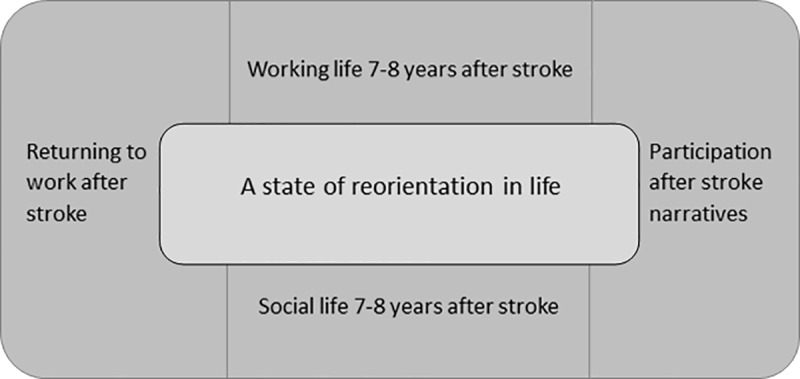
From the participants' experiences four themes emerged: "Returning to work after stroke"; "Working life 7-8 years after stroke"; "Social life 7-8 years after stroke"; and "A state of reorientation in life". Quotes about experienced participation in everyday life were summarized and presented as "Participation after stroke narratives". Participants chose to emphasize on work- and social life when describing situations of successful participation. Being included in the wider community and having a sense of purpose, when interacting with others, were factors that these narratives had in common. Participants had gradually become accustomed to a somewhat altered life situation. Some consequences after stroke were still considered frustrating in social or work situations. However, the importance of these issues had reduced and were no longer problematized.
Participants felt content with their everyday life in general, which was a principal and positive result of this study. Reaching a stage of acceptance seemed to be a complex and continuous struggle, and an individual approach in long-term rehabilitation would be valuable to support this personal process. More knowledge about what factors that facilitate participation in people of working-age many years after stroke is needed, so that more people can reach a state of positive identity and participation.
深入了解脑卒中后 7-8 年仍在工作的成年人的长期参与情况。
本研究采用定性设计,使用主题分析方法。11 名参与者在首次脑卒中后 7-8 年接受了深入访谈。他们曾在哥德堡的萨尔格伦斯卡大学医院接受治疗,并按照年龄、性别、脑卒中严重程度和类型进行了异质抽样。
从参与者的经验中出现了四个主题:“脑卒中后重返工作岗位”;“脑卒中后 7-8 年的工作生活”;“脑卒中后 7-8 年的社会生活”;以及“生活重新定位的状态”。总结了参与者对日常生活中经历的描述,并以“脑卒中后参与叙事”的形式呈现。参与者在描述成功参与的情况时,选择强调工作和社会生活。被纳入更广泛的社区并与他人互动时具有目的感,是这些叙事共有的因素。参与者已经逐渐习惯了稍有改变的生活状况。一些脑卒中后的后果在社交或工作环境中仍然令人感到沮丧。然而,这些问题的重要性已经降低,不再成为问题。
参与者总体上对自己的日常生活感到满意,这是本研究的一个主要积极结果。达到接受的阶段似乎是一个复杂且持续的斗争,在长期康复中采用个体化方法将有助于支持这一个人过程。需要更多关于促进工作年龄段人群多年后参与的因素的知识,以便更多的人能够达到积极认同和参与的状态。