From the Centre for Naturally Randomized Trials (B.A.F., T.B.F.), Medical Research Council, British Heart Foundation Cardiovascular Epidemiology Unit, Department of Public Health and Primary Care (B.A.F., S.B., C.O.-W., A.M.W., A.S.B., E.D.A., J.D.), Medical Research Council Biostatistics Unit (S.B.), and NIHR Blood and Transplant Research Unit in Donor Health and Genomics (A.S.B., E.D.A., J.D.), University of Cambridge, Cambridge, and Imperial Centre for Cardiovascular Disease Prevention, Department of Primary Care and Public Health, School of Public Health, Imperial College London, London (K.K.R.) - all in the United Kingdom; the Department of Pharmacologic and Biomolecular Sciences, University of Milan and Multimedica IRCCS, Milan (A.L.C.); Michigan State University, East Lansing (D.R.N.); the Department of Vascular Medicine, Academic Medical Center, University of Amsterdam, Amsterdam (J.J.P.K.); and Monash University, Clayton, VIC, Australia (S.J.N.).
N Engl J Med. 2019 Mar 14;380(11):1033-1042. doi: 10.1056/NEJMoa1806747.
ATP citrate lyase is an enzyme in the cholesterol-biosynthesis pathway upstream of 3-hydroxy-3-methylglutaryl-coenzyme A reductase (HMGCR), the target of statins. Whether the genetic inhibition of ATP citrate lyase is associated with deleterious outcomes and whether it has the same effect, per unit decrease in the low-density lipoprotein (LDL) cholesterol level, as the genetic inhibition of HMGCR is unclear.
We constructed genetic scores composed of independently inherited variants in the genes encoding ATP citrate lyase () and HMGCR to create instruments that mimic the effect of ATP citrate lyase inhibitors and HMGCR inhibitors (statins), respectively. We then compared the associations of these genetic scores with plasma lipid levels, lipoprotein levels, and the risk of cardiovascular events and cancer.
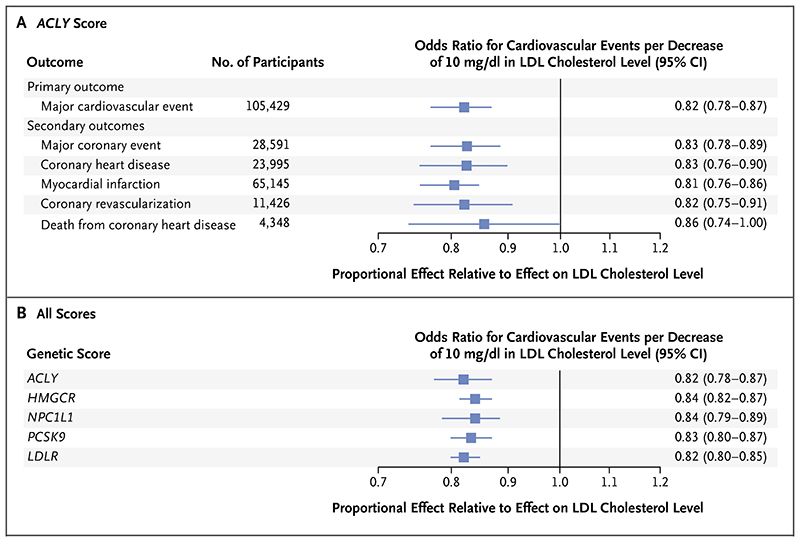
A total of 654,783 participants, including 105,429 participants who had major cardiovascular events, were included in the study. The and scores were associated with similar patterns of changes in plasma lipid and lipoprotein levels and with similar effects on the risk of cardiovascular events per decrease of 10 mg per deciliter in the LDL cholesterol level: odds ratio for cardiovascular events, 0.823 (95% confidence interval [CI], 0.78 to 0.87; P = 4.0×10) for the score and 0.836 (95% CI, 0.81 to 0.87; P = 3.9×10) for the score. Neither lifelong genetic inhibition of ATP citrate lyase nor lifelong genetic inhibition of HMGCR was associated with an increased risk of cancer.
Genetic variants that mimic the effect of ATP citrate lyase inhibitors and statins appeared to lower plasma LDL cholesterol levels by the same mechanism of action and were associated with similar effects on the risk of cardiovascular disease per unit decrease in the LDL cholesterol level. (Funded by Esperion Therapeutics and others.).
三磷酸腺苷柠檬酸裂解酶是胆固醇生物合成途径中位于 3-羟基-3-甲基戊二酰基辅酶 A 还原酶(HMGCR)之前的一种酶,HMGCR 是他汀类药物的作用靶点。目前尚不清楚遗传抑制三磷酸腺苷柠檬酸裂解酶是否与不良结局相关,以及它是否与 HMGCR 的遗传抑制具有相同的效果,即在单位低密度脂蛋白(LDL)胆固醇水平降低的情况下。
我们构建了由编码三磷酸腺苷柠檬酸裂解酶()和 HMGCR 的基因中独立遗传变异组成的遗传评分,以分别模拟三磷酸腺苷柠檬酸裂解酶抑制剂和 HMGCR 抑制剂(他汀类药物)的作用。然后,我们比较了这些遗传评分与血浆脂质水平、脂蛋白水平以及心血管事件和癌症风险的相关性。
共纳入 654783 名参与者,其中 105429 名参与者发生了主要心血管事件。和评分与血浆脂质和脂蛋白水平的变化模式相似,与 LDL 胆固醇每降低 10mg/dL 时心血管事件风险的降低效果相似:心血管事件的比值比,评分为 0.823(95%置信区间 [CI],0.78 至 0.87;P=4.0×10),评分为 0.836(95%CI,0.81 至 0.87;P=3.9×10)。终生遗传抑制三磷酸腺苷柠檬酸裂解酶或 HMGCR 均与癌症风险增加无关。
模拟三磷酸腺苷柠檬酸裂解酶抑制剂和他汀类药物作用的遗传变异似乎通过相同的作用机制降低血浆 LDL 胆固醇水平,并且与 LDL 胆固醇每单位降低时心血管疾病风险的降低效果相似。(由 Esperion 治疗公司等资助)。