Department of Medical Nursing, School of Nursing, College of Medicine and Health Sciences, University of Gondar, Gondar, Ethiopia.
Department of Pediatrics and Child Health Nursing, School of Nursing, College of Medicine and Health Sciences, University of Gondar, Gondar, Ethiopia.
BMC Infect Dis. 2019 Mar 13;19(1):256. doi: 10.1186/s12879-019-3884-8.
Environmental, social, geographical, and other factors could affect the distribution of intestinal parasites. Parasitic infections would impose on health and social problems like mal-absorption, diarrhea, impaired work capacity, and reduced growth rate. However, there is a scarcity of information regarding the prevalence of intestinal parasites and associated factors in the study area.
Institution based cross-sectional study was conducted among 310 study participants from April-May, 2017. Study participants were selected using a systematic random sampling technique. EPI Info version 7 and SPSS version 20 were used to enter and analyze the data. Both bivariate and multivariate logistic regression analyses were computed. In multivariate analysis, variables with P-value < 0.05 were considered statistically significant.
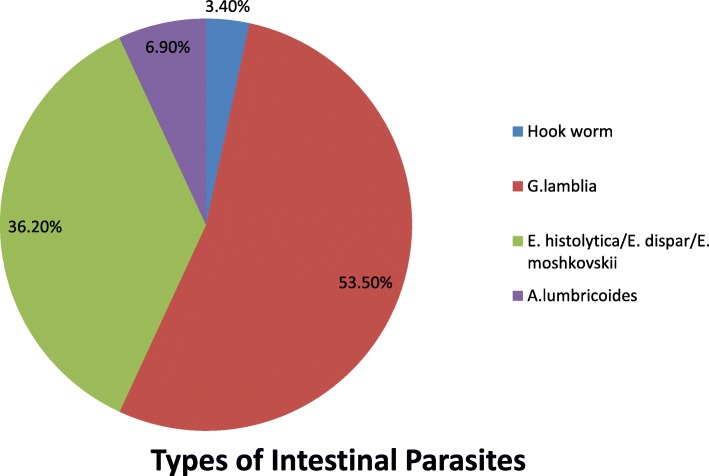
In this study, the mean age of participants was 29.25 Months. The overall prevalence of intestinal parasites was 18.7% (95% CI = 14.4-23.3). Children who rarely feed fresh meal (AOR = 7.74, 95% CI: 1.61, 7.84), Children whose nails were sometimes trimmed (AOR = 3.41, 95% CI: 2.20-10.28), children who had no clean playing ground (AOR = 2.43, 95% CI: 1.25-5.18), and children who had open defecation of the family (AOR = 3.40, 95% CI: 1.27-10.86) were significantly associated with intestinal parasitic infections. Among the intestinal parasites, 31(53.5%) were G.lamblia (Giardia lamblia) and 21(36.2%) were E. histolytica/E. dispar/E. moshkovskii.
In this study, the prevalence of intestinal parasites was found low compared with the WHO annual or biannual population prevalence and treatment. However, strengthening of health education about food, personal and environmental hygiene of both children and mothers/guardians is crucial to limit the transmission. Besides, improving mothers/guardian awareness about the mode of intestinal parasites transmission is necessary.
环境、社会、地理和其他因素可能会影响肠道寄生虫的分布。寄生虫感染会导致吸收不良、腹泻、工作能力受损和生长速度减慢等健康和社会问题。然而,关于该研究区域肠道寄生虫的流行情况和相关因素的信息却很少。
2017 年 4 月至 5 月,采用基于机构的横断面研究,对 310 名研究对象进行研究。采用系统随机抽样技术选择研究对象。使用 EPI Info 版本 7 和 SPSS 版本 20 输入和分析数据。进行了单变量和多变量逻辑回归分析。在多变量分析中,P 值 < 0.05 的变量被认为具有统计学意义。
在这项研究中,参与者的平均年龄为 29.25 个月。肠道寄生虫的总流行率为 18.7%(95%CI=14.4-23.3)。很少吃新鲜食物的儿童(AOR=7.74,95%CI:1.61,7.84)、指甲有时修剪的儿童(AOR=3.41,95%CI:2.20-10.28)、没有干净的玩耍场地的儿童(AOR=2.43,95%CI:1.25-5.18)和家庭中存在随地大小便的儿童(AOR=3.40,95%CI:1.27-10.86)与肠道寄生虫感染显著相关。在肠道寄生虫中,31 种(53.5%)为 G.lamblia(贾第虫属),21 种(36.2%)为 E.histolytica/E.dispar/E.moshkovskii。
与世界卫生组织(WHO)每年或每两年一次的人群流行率和治疗率相比,本研究中肠道寄生虫的流行率较低。然而,加强儿童和母亲/监护人的饮食、个人和环境卫生方面的健康教育对于限制传播至关重要。此外,提高母亲/监护人对肠道寄生虫传播方式的认识也是必要的。