Iso Tatsuya, Haruyama Hikari, Sunaga Hiroaki, Matsui Miki, Matsui Hiroki, Tanaka Rina, Umbarawan Yogi, Syamsunarno Mas Rizky A A, Yokoyama Tomoyuki, Kurabayashi Masahiko
Department of Cardiovascular Medicine, Gunma University Graduate School of Medicine, 3-39-22 Showa-machi, Maebashi, Gunma, 371-8511, Japan.
Department of Laboratory Sciences, Gunma University Graduate School of Health Sciences, 3-39-22 Showa-machi, Maebashi, Gunma, 371-8511, Japan.
BMC Physiol. 2019 Mar 13;19(1):1. doi: 10.1186/s12899-019-0038-6.
Skeletal muscle prefers carbohydrate use to fatty acid (FA) use as exercise intensity increases. In contrast, skeletal muscle minimizes glucose use and relies more on FA during fasting. In mice deficient for FABP4 and FABP5 (double knockout (DKO) mice), FA utilization by red skeletal muscle and the heart is markedly reduced by the impairment of trans-endothelial FA transport, with an increase in glucose use to compensate for reduced FA uptake even during fasting. We attempted to determine whether prolonged fasting affects exercise performance in DKO mice, where constant glucose utilization occurs.
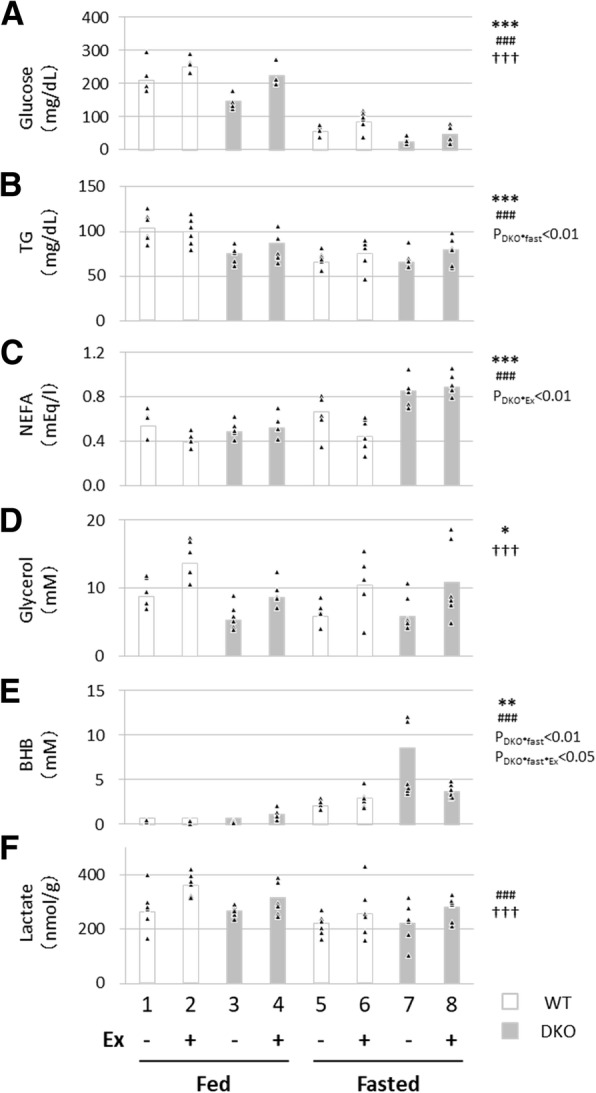
A single bout of treadmill exercise was performed in the fed and fasted states. The initial speed was 10 m/min, and gradually increased by 5 m/min every 5 min up to 30 m/min until the mice stopped running. Running distance was significantly reduced by DKO genotype and prior fasting, leading to the shortest distance in fasted DKO mice. Levels of glycogen in skeletal muscle and the liver were nearly depleted in both WT and DKO mice during prolonged fasting prior to exercise. Levels of TG in skeletal muscle were not reduced by exercise in fasted DKO mice, suggesting that intramuscular TG was not utilized during exercise. Hypoglycaemia was accelerated in fasted DKO mice, and this acceleration could be due to constant glucose utilization by red skeletal muscle and the heart where FA uptake is diminished due to defective trans-endothelial FA transport. Taken together, energy supply from serum and storage in skeletal muscle were very low in fasted DKO mice, which could lead to a significant reduction in exercise performance.
FABP4/5 have crucial roles in nutrient homeostasis during prolonged fasting for maintaining exercise endurance capacity.
随着运动强度增加,骨骼肌更倾向于利用碳水化合物而非脂肪酸(FA)。相反,在禁食期间,骨骼肌会尽量减少葡萄糖的利用,而更多地依赖脂肪酸。在脂肪酸结合蛋白4(FABP4)和脂肪酸结合蛋白5缺乏的小鼠(双敲除(DKO)小鼠)中,红色骨骼肌和心脏对FA的利用因跨内皮FA转运受损而显著降低,即使在禁食期间,葡萄糖的利用也会增加以补偿FA摄取的减少。我们试图确定长期禁食是否会影响持续利用葡萄糖的DKO小鼠的运动表现。
在喂食和禁食状态下进行单次跑步机运动。初始速度为10米/分钟,每5分钟逐渐增加5米/分钟,直至30米/分钟,直到小鼠停止奔跑。DKO基因型和禁食会显著缩短跑步距离,导致禁食的DKO小鼠跑步距离最短。在运动前的长期禁食期间,野生型(WT)和DKO小鼠骨骼肌和肝脏中的糖原水平几乎耗尽。禁食的DKO小鼠运动后骨骼肌中的甘油三酯(TG)水平未降低,这表明运动期间肌肉内的TG未被利用。禁食的DKO小鼠低血糖加速,这种加速可能是由于红色骨骼肌和心脏持续利用葡萄糖,而跨内皮FA转运缺陷导致FA摄取减少。综上所述,禁食的DKO小鼠血清中的能量供应和骨骼肌中的能量储存非常低,这可能导致运动表现显著下降。
FABP4/5在长期禁食期间的营养稳态中对维持运动耐力至关重要。