Department of Research in Education, Amsterdam UMC, Vrije Universiteit Amsterdam, VUmc School of Medical Sciences, Amsterdam, the Netherlands.
LEARN! research institute for learning and education. Faculty of Psychology and Education, VU University, Amsterdam, the Netherlands.
BMC Med Educ. 2019 Mar 12;19(1):80. doi: 10.1186/s12909-019-1511-4.
Evidence for the effectiveness of the selection of medical students is weak. This study aimed to examine the added value of a two-step selection procedure (first step non-academic, second step academic tests) to a pre-university GPA-based lottery procedure. Because previous research has suggested that participation in selection (regardless of the outcome) is a predictor of study success, this study is the first to include students who initially applied for selection, then refrained from (actively) participating in selection and were eventually admitted through lottery.
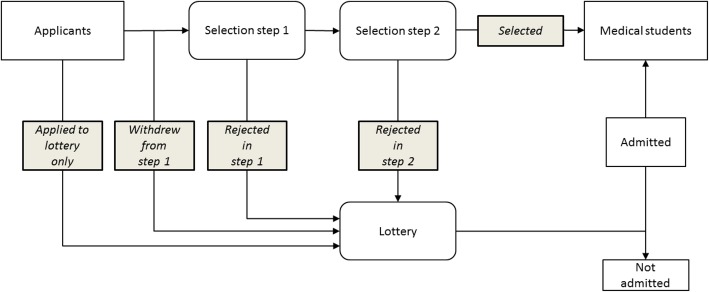
Bachelor completion and dropout rates of selected (n = 416) and lottery-admitted students from four cohorts (2006-2009) were compared using logistic regression analysis. Four groups of lottery-admitted students were distinguished: students who were rejected after step 2 (n = 57), were rejected after step 1 (n = 169), withdrew during selection step 1 (n = 42) and students who only applied for lottery (n = 366). Covariates included gender, age, pre-university GPA and cohort.
There was a significant association between admission group and obtaining a bachelor degree in three years. Selected students were more likely to obtain a bachelor degree within three years (64.2% versus 51.6%; OR = 1.7) or four years (81.5% versus 74.3%; OR = 1.6) than students who only applied to a lottery (p < 0.05); selected students also seemed more likely to obtain all Year-1 course credits than students who withdrew during step 1 (40.4% versus 21.4%; OR = 2.3; p < 0.05). We found no significant association between dropout and admission groups. Students rejected at step 1 or 2 did not perform significantly different from selected students on any of the outcome measures.
The findings indicated that students at risk for study delay in the preclinical phase in our context were more likely to refrain from applying to a demanding selection procedure when a less demanding alternative was available. We found no significant associations between the non-academic and academic selection steps and bachelor completion and dropout rates. These findings suggest that the presence of the selection was more important than these specific selection components. In follow-up research, we plan to investigate the associations between the admission groups and outcome measures in the clinical phase.
医学专业学生选拔有效性的证据较为薄弱。本研究旨在检验两步选拔程序(第一步为非学术性测试,第二步为学术性测试)相对于基于大学预科成绩的抽签程序的附加价值。由于先前的研究表明,参与选拔(无论结果如何)是学业成功的预测因素,因此本研究首次纳入了最初申请选拔但随后选择不(主动)参与选拔、最终通过抽签录取的学生。
使用逻辑回归分析比较了来自四个队列(2006-2009 年)的 416 名选拔学生和抽签录取学生的本科完成率和辍学率。抽签录取的学生被分为四组:在第二步被拒绝的学生(n=57)、在第一步被拒绝的学生(n=169)、在选拔第一步退出的学生(n=42)和仅申请抽签的学生(n=366)。协变量包括性别、年龄、大学预科成绩和队列。
入学分组与在三年内获得学士学位之间存在显著关联。与仅申请抽签的学生相比,选拔学生更有可能在三年内(64.2%比 51.6%;OR=1.7)或四年内(81.5%比 74.3%;OR=1.6)获得学士学位(p<0.05);与在第一步退出的学生相比,选拔学生似乎也更有可能获得所有第一年课程学分(40.4%比 21.4%;OR=2.3;p<0.05)。我们没有发现辍学率与入学分组之间存在显著关联。在第一步或第二步被拒绝的学生在任何结果衡量指标上的表现均与选拔学生无显著差异。
研究结果表明,在我们的背景下,临床前阶段学业延迟风险较高的学生更有可能在可选择要求较低的替代方案时,避免申请要求较高的选拔程序。我们没有发现非学术性和学术性选拔步骤与本科完成率和辍学率之间存在显著关联。这些发现表明,选拔的存在比这些特定的选拔环节更为重要。在后续研究中,我们计划调查入学分组与临床阶段结果衡量指标之间的关联。