Biologist, PhD Student in Cell Biology and Development, Universidade Federal de Santa Catarina, Florianópolis, SC, Brazil.
Biomedic, PhD Student in Cell Biology and Development, Universidade Federal de Santa Catarina, Florianópolis, SC, Brazil.
BMC Med Genomics. 2019 Mar 12;12(1):50. doi: 10.1186/s12920-019-0496-5.
Currently, chromosomal microarrays (CMA) are recommended as first-tier test in the investigation of developmental disorders to examine copy number variations. The modern platforms also include probes for single nucleotide polymorphisms (SNPs) that detect homozygous regions in the genome, such as long contiguous stretches of homozygosity (LCSH) also named runs of homozygosity (ROH). LCHS are chromosomal segments resulting from complete or segmental chromosomal homozygosity, which may be indicative of uniparental disomy (UPD), consanguinity, as well as replicative DNA repair events, however also are common findings in normal populations. Knowing common LCSH of a population, which probably represent ancestral haplotypes of low-recombination regions in the genome, facilitates the interpretation of LCSH found in patients, allowing to prioritize those with possible clinical significance. However, population records of ancestral haplotype derived LCSH by SNP arrays are still scarce, particularly for countries such as Brazil where even for the clinic, microarrays that include SNPs are difficult to request due to their high cost.
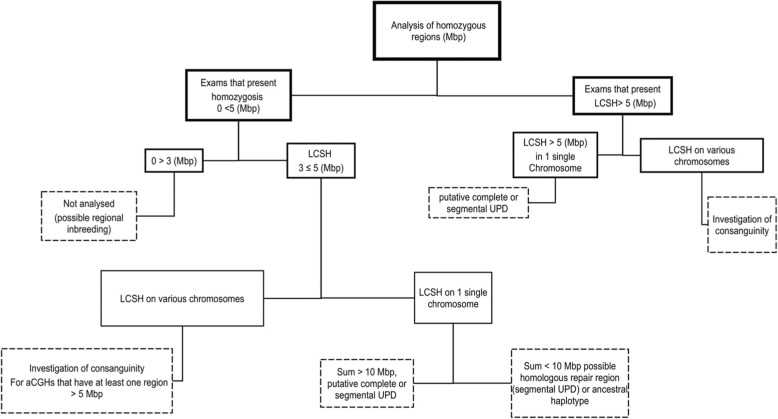
In this study, we evaluate the frequencies and implications of LCSH detected by Affymetrix CytoScan® HD or 750 K platforms in 430 patients with neurodevelopmental disorders in southern Brazil. LCSH were analyzed in the context of pathogenic significance and also explored to identify ancestral haplotype derived LCSH. The criteria for considering a region as LCSH was homozygosis ≥3 Mbp on an autosome.
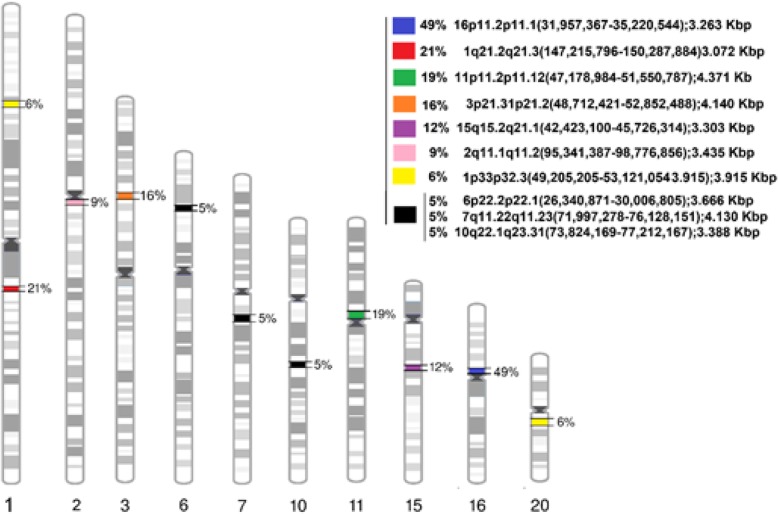
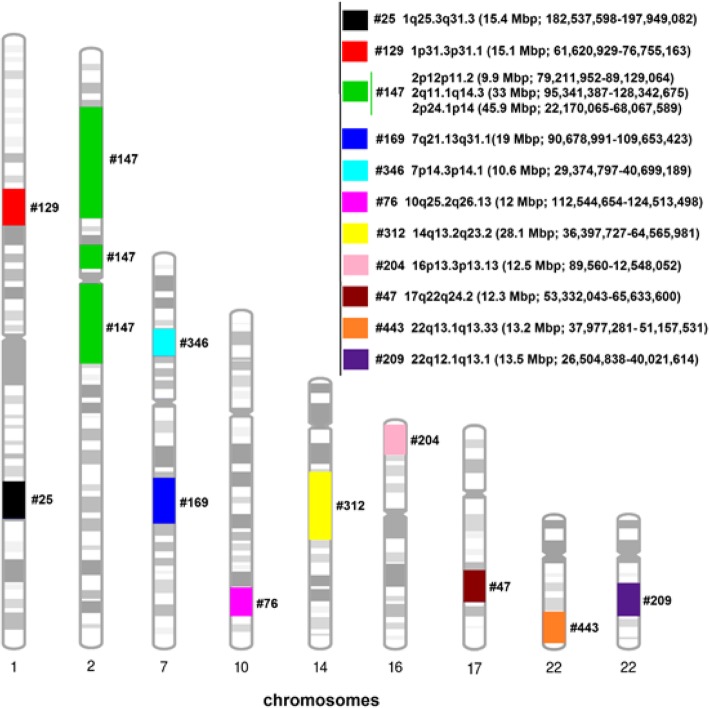
In 95% of the patients, at least one LCSH was detected, a total of 1478 LCSH in 407 patients. In 2.6%, the findings were suggestive of UPD. For about 8.5% LCSH suggest offspring from first to fifth grade, more likely to have a clinical impact. Considering recurrent LCSH found at a frequency of 5% or more, we outline 11 regions as potentially representing ancestral haplotypes in our population. The region most involved with homozygosity was 16p11.2p11.1 (49%), followed by 1q21.2q21.3 (21%), 11p11.2p11.12 (19%), 3p21.31p21.2 (16%), 15q15 1q33p32.3 (12%), 2q11.1q12.1 (9%), 1p33p32.3 (6%), 20q11.21q11.23 (6%), 10q22.1q23.31 (5%), 6p22.2p22 (5%), and 7q11.22q11.23 (5%).
In this work, we show the importance and usefulness of interpreting LCSH in the results of CMA wich incorporate SNPs.
目前,染色体微阵列(CMA)被推荐作为发育障碍研究的一线检测方法,以检查拷贝数变异。现代平台还包括用于检测基因组中纯合区域的单核苷酸多态性(SNP)探针,例如称为长连续纯合区(LCSH)的纯合区域。LCHS 是由于完全或部分染色体纯合引起的染色体片段,可能表明单亲二倍体(UPD)、近亲繁殖以及复制性 DNA 修复事件,但在正常人群中也很常见。了解人群中常见的 LCSH,这些 LCSH 可能代表基因组中低重组区域的祖先单倍型,有助于解释在患者中发现的 LCSH,从而优先考虑那些可能具有临床意义的 LCSH。然而,关于 SNP 阵列衍生的祖先单倍型 LCSH 的人群记录仍然很少,特别是在巴西等国家,即使对于临床医生来说,由于成本高昂,包括 SNP 的微阵列也难以要求。
在这项研究中,我们评估了在巴西南部 430 名神经发育障碍患者的 Affymetrix CytoScan® HD 或 750K 平台检测到的 LCSH 的频率和意义。在致病性意义方面分析了 LCSH,并探索了识别祖先单倍型衍生的 LCSH。将区域视为 LCSH 的标准是常染色体上纯合性≥3 Mbp。
在 95%的患者中,至少检测到一个 LCSH,在 407 名患者中总共检测到 1478 个 LCSH。在 2.6%的情况下,结果提示 UPD。对于约 8.5%的 LCSH 提示来自第一到第五年级的后代,更有可能具有临床影响。考虑到发现的 LCSH 出现频率为 5%或更高,我们概述了 11 个区域作为我们人群中潜在的祖先单倍型。涉及纯合性的区域最多的是 16p11.2p11.1(49%),其次是 1q21.2q21.3(21%)、11p11.2p11.12(19%)、3p21.31p21.2(16%)、15q15 1q33p32.3(12%)、2q11.1q12.1(9%)、1p33p32.3(6%)、20q11.21q11.23(6%)、10q22.1q23.31(5%)、6p22.2p22(5%)和 7q11.22q11.23(5%)。
在这项工作中,我们展示了在包含 SNP 的 CMA 结果中解释 LCSH 的重要性和有用性。