Iourov Ivan Y, Vorsanova Svetlana G, Korostelev Sergei A, Zelenova Maria A, Yurov Yuri B
Mental Health Research Center, 117152 Moscow, Russia ; Separated Structural Unit "Clinical Research Institute of Pediatrics", Russian National Research Medical University named after N.I. Pirogov, Ministry of Health of Russian Federation, 125412 Moscow, Russia ; Department of Medical Genetics, Russian Medical Academy of Postgraduate Education, 123995 Moscow, Russia.
Mental Health Research Center, 117152 Moscow, Russia ; Separated Structural Unit "Clinical Research Institute of Pediatrics", Russian National Research Medical University named after N.I. Pirogov, Ministry of Health of Russian Federation, 125412 Moscow, Russia.
Mol Cytogenet. 2015 Oct 15;8:77. doi: 10.1186/s13039-015-0182-z. eCollection 2015.
Long contiguous stretches of homozygosity (LCSH) (regions/runs of homozygosity) are repeatedly detected by single-nucleotide polymorphism (SNP) chromosomal microarrays. Providing important clues regarding parental relatedness (consanguinity), uniparental disomy, chromosomal recombination or rearrangements, LCSH are rarely considered as a possible epigenetic cause of neurodevelopmental disorders. Additionally, despite being relevant to imprinting, LCSH at imprinted loci have not been truly addressed in terms of pathogenicity. In this study, we examined LCSH in children with unexplained intellectual disability, autism, congenital malformations and/or epilepsy focusing on chromosomal regions which harbor imprinted disease genes.
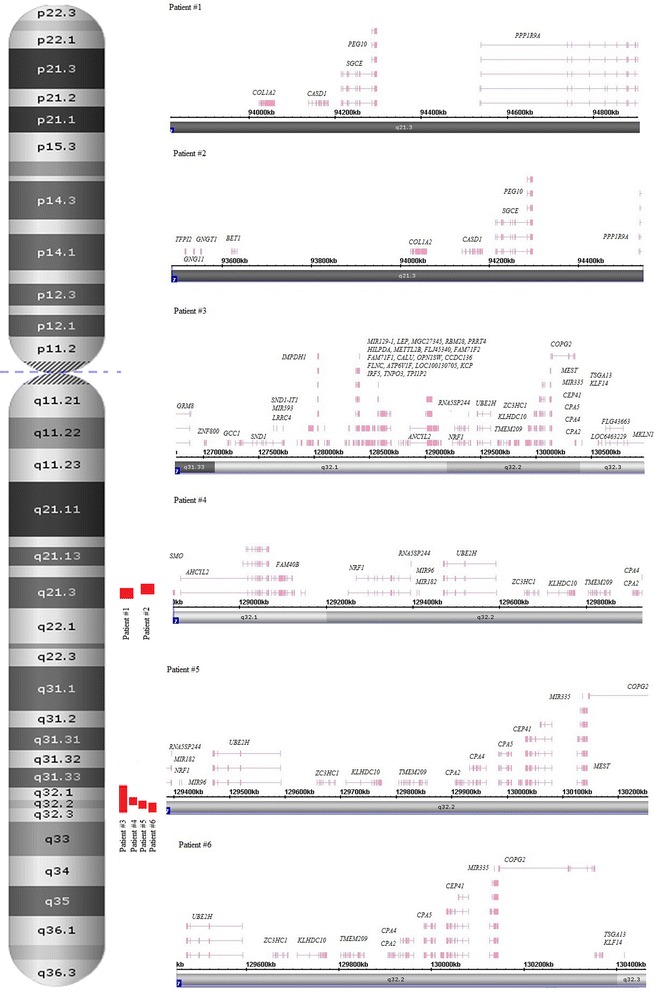
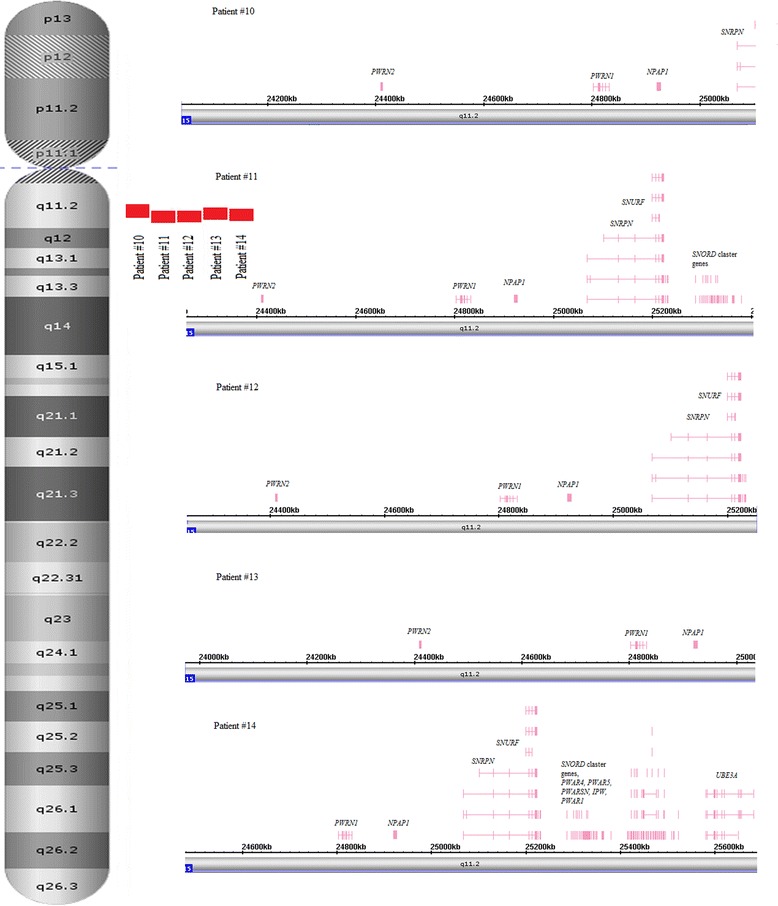
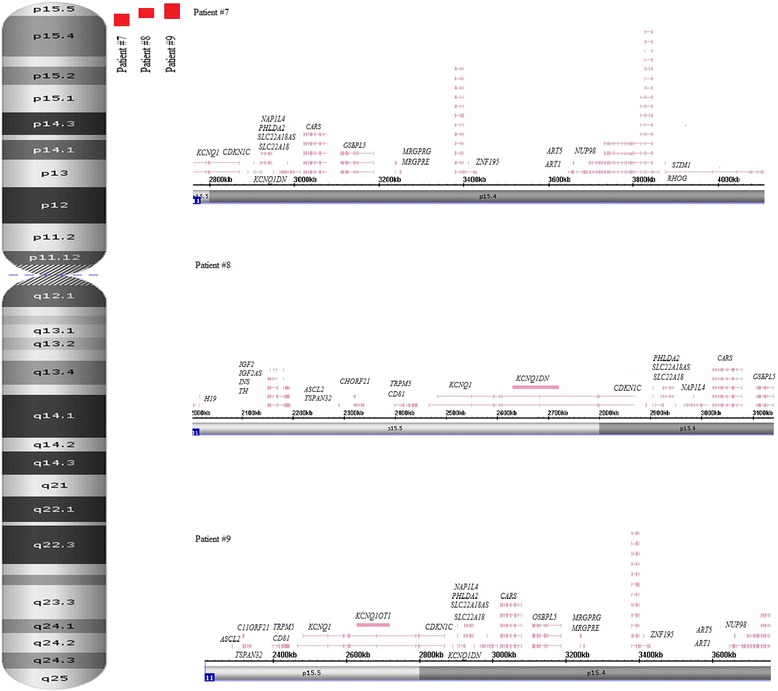
Out of 267 cases, 14 (5.2 %) were found to have LCSH at imprinted loci associated with a clinical outcome. There were 5 cases of LCSH at 15p11.2, 4 cases of LCSH at 7q31.2, 3 cases of LCSH at 11p15.5, and 2 cases of LCSH at 7q21.3. Apart from a case of LCSH at 7q31.33q32.3 (~4 Mb in size), all causative LCSH were 1-1.5 Mb in size. Clinically, these cases were characterized by a weak resemblance to corresponding imprinting diseases (i.e., Silver-Russell, Beckwith-Wiedemann, and Prader-Willi/Angelman syndromes), exhibiting distinctive intellectual disability, autistic behavior, developmental delay, seizures and/or facial dysmorphisms. Parental consanguinity was detected in 8 cases (3 %), and these cases did not exhibit LCSH at imprinted loci.
This study demonstrates that shorter LCSH at chromosomes 7q21.3, 7q31.2, 11p15.5, and 15p11.2 occur with a frequency of about 5 % in the children with intellectual disability, autism, congenital malformations and/or epilepsy. Consequently, this type of epigenetic mutations appears to be the most common one among children with neurodevelopmental diseases. Finally, since LCSH less than 2.5-10 Mb in size are generally ignored in diagnostic SNP microarray studies, one can conclude that an important epigenetic cause of intellectual disability, autism or epilepsy is actually overlooked.
单核苷酸多态性(SNP)染色体微阵列反复检测到长的纯合连续片段(LCSH,即纯合区域/片段)。LCSH为亲源关系(近亲结婚)、单亲二体、染色体重组或重排提供了重要线索,但很少被认为是神经发育障碍可能的表观遗传原因。此外,尽管与印记相关,但印记位点处的LCSH在致病性方面尚未得到真正解决。在本研究中,我们聚焦于含有印记疾病基因的染色体区域,对不明原因智力残疾、自闭症、先天性畸形和/或癫痫患儿的LCSH进行了研究。
在267例病例中,发现14例(5.2%)在与临床结局相关的印记位点存在LCSH。15p11.2处有5例LCSH,7q31.2处有4例LCSH,11p15.5处有3例LCSH,7q21.3处有2例LCSH。除7q31.33q32.3处的1例LCSH(大小约4 Mb)外,所有致病LCSH大小均为1 - 1.5 Mb。临床上,这些病例的特征是与相应的印记疾病(即Silver-Russell、Beckwith-Wiedemann和Prader-Willi/Angelman综合征)有微弱相似性,表现为明显的智力残疾、自闭症行为、发育迟缓、癫痫发作和/或面部畸形。8例(3%)检测到亲源近亲结婚,这些病例在印记位点未表现出LCSH。
本研究表明,在智力残疾、自闭症、先天性畸形和/或癫痫患儿中,7q21.3、7q31.2、11p15.5和15p11.2染色体上较短的LCSH出现频率约为5%。因此,这种类型的表观遗传突变似乎是神经发育疾病患儿中最常见的一种。最后,由于在诊断性SNP微阵列研究中,通常忽略大小小于2.5 - 10 Mb的LCSH,所以可以得出结论,智力残疾、自闭症或癫痫的一个重要表观遗传原因实际上被忽视了。