Department of Biostatistics and Epidemiology, University of Massachusetts Amherst, 411 Arnold House, 715 North Pleasant Street, Amherst, MA, 01003, USA.
Department of Biology, University of Massachusetts Amherst, Amherst, MA, USA.
Environ Health. 2019 Mar 12;18(1):20. doi: 10.1186/s12940-019-0458-6.
Some phthalates are endocrine disrupting chemicals used as plasticizers in consumer products, and have been associated with obesity in cross-sectional studies, yet prospective evaluations of weight change are lacking. Our objective was to evaluate associations between phthalate biomarker concentrations and weight and weight change among postmenopausal women.
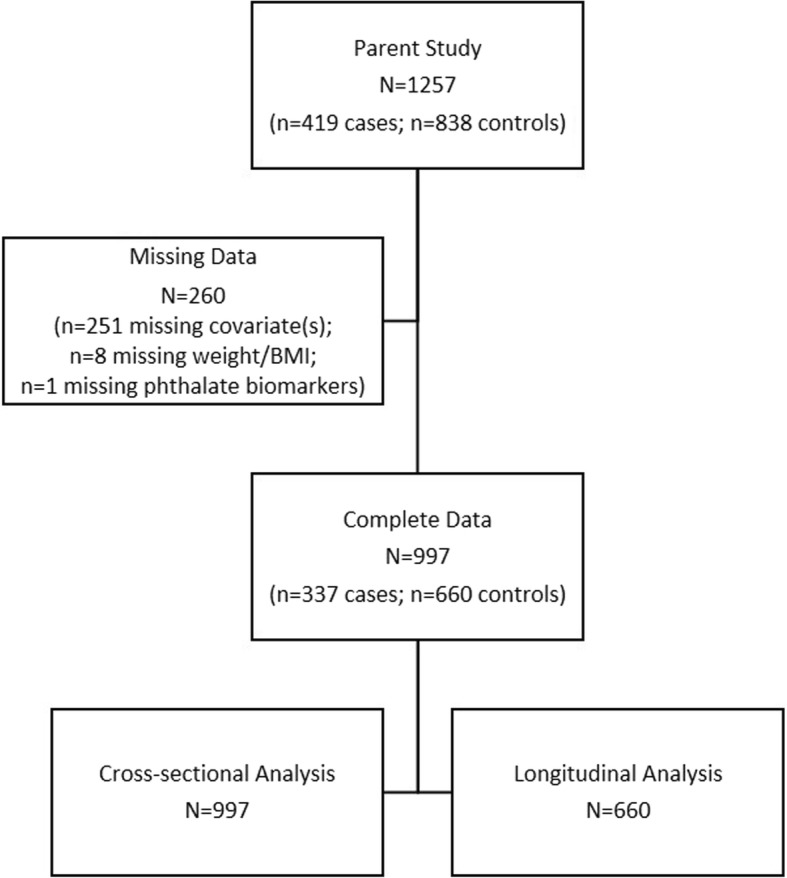
We performed cross-sectional (N = 997) and longitudinal analyses (N = 660) among postmenopausal Women's Health Initiative participants. We measured 13 phthalate metabolites and creatinine in spot urine samples provided at baseline. Participants' weight and height measured at in-person clinic visits at baseline, year 3, and year 6 were used to calculate body mass index (BMI). We fit multivariable multinomial logistic regression models to explore cross-sectional associations between each phthalate biomarker and baseline BMI category. We evaluated longitudinal associations between each biomarker and weight change using mixed effects linear regression models.
In cross-sectional analyses, urinary concentrations of some biomarkers were positively associated with obesity prevalence (e.g. sum of di (2-ethylhexyl) phthalate metabolites [ΣDEHP] 4th vs 1st quartile OR = 3.29, 95% CI 1.80-6.03 [p trend< 0.001] vs normal). In longitudinal analyses, positive trends with weight gain between baseline and year 3 were observed for mono-(2-ethyl-5-oxohexyl) phthalate, monoethyl phthalate (MEP), mono-hydroxybutyl phthalate, and mono-hydroxyisobutyl phthalate (e.g. + 2.32 kg [95% CI 0.93-3.72] for 4th vs 1st quartile of MEP; p trend < 0.001). No statistically significant associations were observed between biomarkers and weight gain over 6 years.
Certain phthalates may contribute to short-term weight gain among postmenopausal women.
一些邻苯二甲酸酯是作为消费品中的增塑剂使用的内分泌干扰化学物质,在横断面研究中与肥胖有关,但缺乏对体重变化的前瞻性评估。我们的目的是评估绝经后妇女中邻苯二甲酸酯生物标志物浓度与体重和体重变化之间的关系。
我们在绝经后妇女健康倡议参与者中进行了横断面(N=997)和纵向分析(N=660)。我们在基线时测量了点尿样中的 13 种邻苯二甲酸酯代谢物和肌酐。参与者在基线、第 3 年和第 6 年的现场临床就诊时测量的体重和身高用于计算体重指数(BMI)。我们使用多变量多项逻辑回归模型来探索每个邻苯二甲酸酯生物标志物与基线 BMI 类别之间的横断面关联。我们使用混合效应线性回归模型评估每个生物标志物与体重变化之间的纵向关联。
在横断面分析中,一些生物标志物的尿液浓度与肥胖患病率呈正相关(例如,二(2-乙基己基)邻苯二甲酸代谢物总和[ΣDEHP]第 4 四分位与第 1 四分位的比值为 3.29,95%置信区间为 1.80-6.03 [p 趋势<0.001] 与正常相比)。在纵向分析中,在基线和第 3 年之间观察到单(2-乙基-5-氧己基)邻苯二甲酸、单乙基邻苯二甲酸(MEP)、单羟基丁基邻苯二甲酸和单羟基异丁基邻苯二甲酸的体重增加呈正趋势(例如,第 4 四分位与第 1 四分位的 MEP 增加 2.32kg[95%置信区间为 0.93-3.72];p 趋势<0.001)。在 6 年期间,生物标志物与体重增加之间没有观察到统计学上显著的关联。
某些邻苯二甲酸酯可能导致绝经后妇女短期体重增加。