From the Mellen Center for Multiple Sclerosis, (R.J.F., S.N.), Department of Bioethics (P.F.), and Department of Bioethics (M.M.), Cleveland Clinic, OH; Center for Survey Research (C.C., L.C.), University of Massachusetts, Boston; Division of Biostatistics (A.S.), Washington University School of Medicine, St. Louis, MO; Dignity Health (T.T.), St. Joseph's Hospital and Medical Center, Phoenix, AZ; and Department of Biostatistics (S.S.C.), School of Public Health, University of Alabama, Birmingham.
Neurology. 2019 Apr 2;92(14):e1634-e1642. doi: 10.1212/WNL.0000000000007245. Epub 2019 Mar 13.
To determine tolerance to various risk scenarios associated with current multiple sclerosis (MS) therapies.
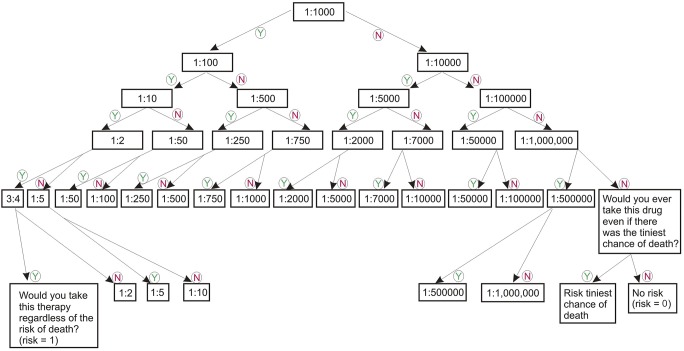
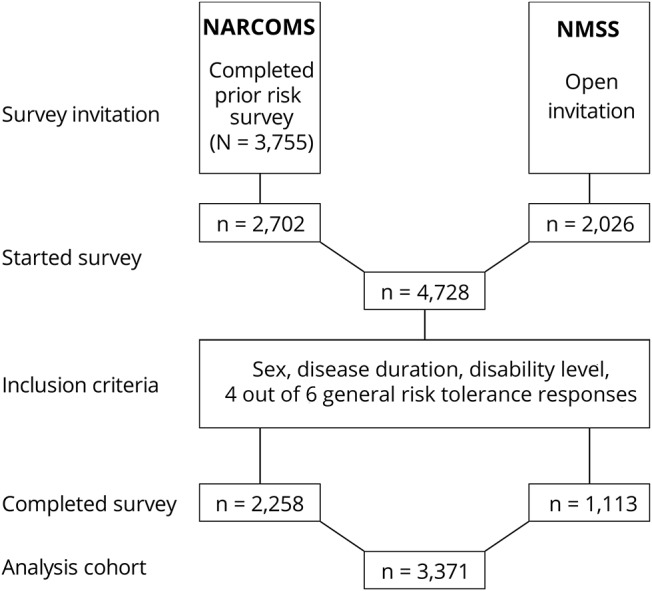
People with MS from the North American Research Committee on Multiple Sclerosis Registry's online cohort and the National Multiple Sclerosis Society were invited to complete a questionnaire on tolerance to real-world risks associated with a hypothetical therapy. Multiple risks levels were presented, including skin rash, infection, kidney injury, thyroid injury, liver injury, and progressive multifocal leukoencephalopathy (PML).
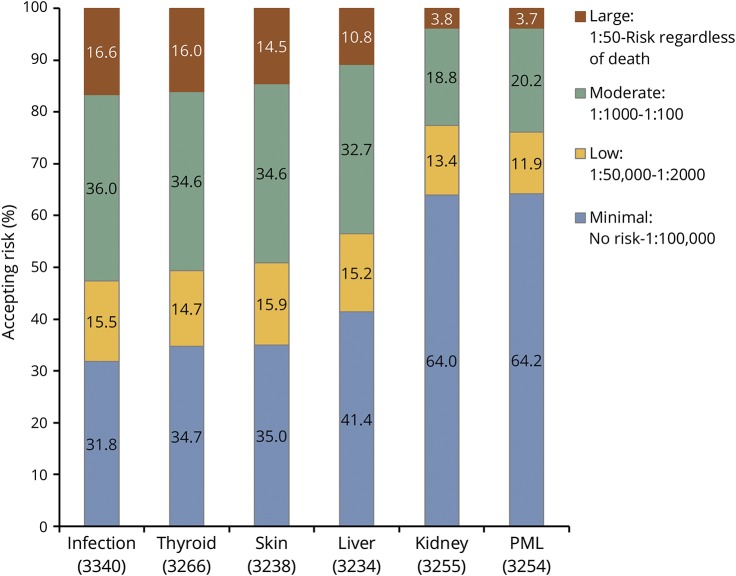
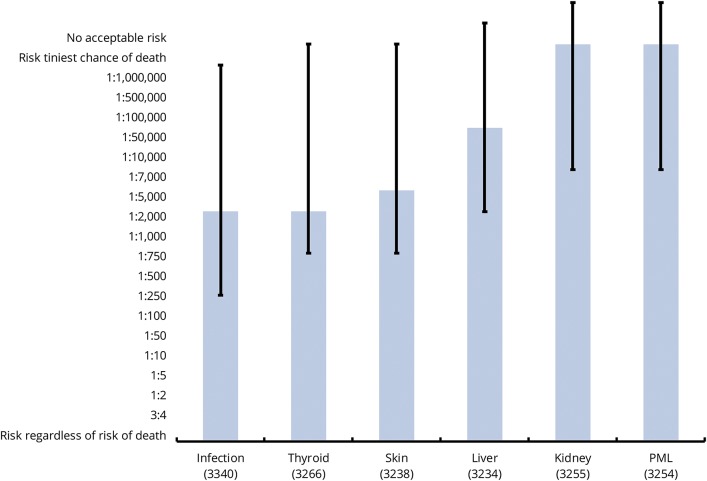
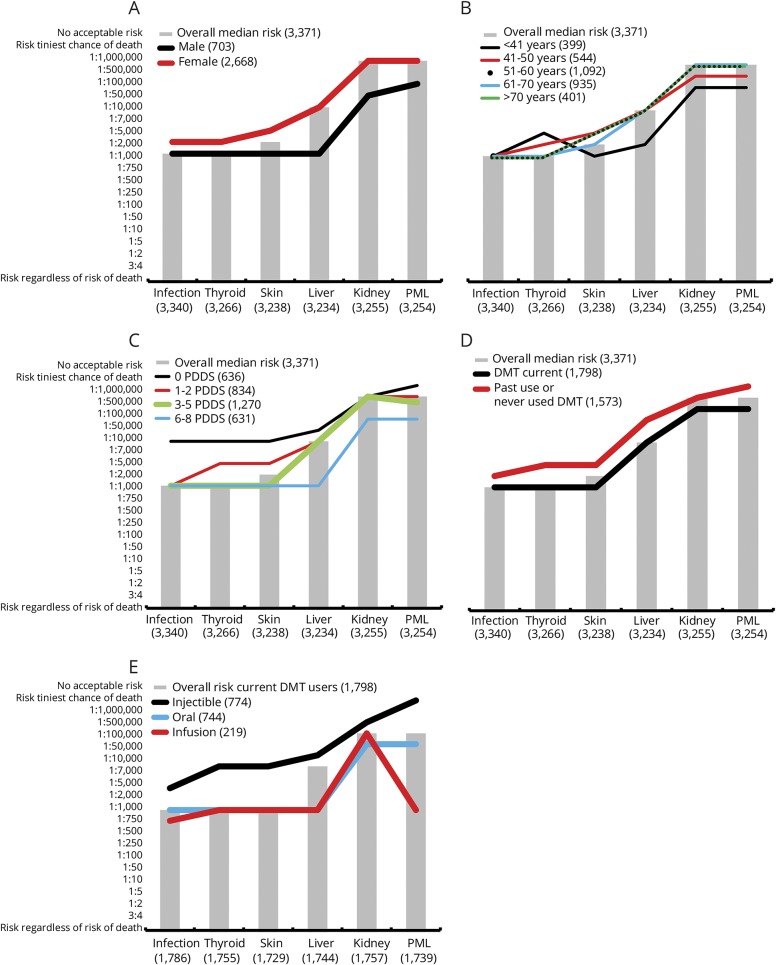
Both PML and kidney injury had the lowest risk tolerance (RT) at 1:1,000,000, and thyroid and infection risks had the highest tolerance at 1:1,000. Men, younger individuals, and participants with greater disability reported a higher tolerance to all risk scenarios. Those who were currently taking an MS therapy reported higher tolerance than those not taking any therapy. Participants taking infusion therapies reported high tolerance to all risks, and those taking injectables reported a lower tolerance.
People with MS displayed a wide range of RT for MS therapies. Our study identified sex, age, disability, and current disease-modifying therapy use to be associated with RT.
确定对与当前多发性硬化症(MS)疗法相关的各种风险情况的耐受性。
邀请来自北美多发性硬化症研究委员会注册在线队列和国家多发性硬化症协会的 MS 患者完成一份关于对假设疗法的真实世界风险的耐受性的问卷。呈现了多个风险水平,包括皮疹、感染、肾损伤、甲状腺损伤、肝损伤和进行性多灶性白质脑病(PML)。
PML 和肾损伤的风险耐受最低,为 1:1,000,000,甲状腺和感染风险的耐受最高,为 1:1,000。男性、年轻人和残疾程度较高的参与者对所有风险情况的耐受性更高。目前正在接受 MS 治疗的患者比未接受任何治疗的患者的耐受性更高。接受输注治疗的患者对所有风险的耐受性较高,而接受注射治疗的患者的耐受性较低。
MS 患者对 MS 疗法的耐受性差异很大。我们的研究确定了性别、年龄、残疾程度和当前疾病修饰治疗的使用与 RT 相关。