Department of Neurology, Memorial Sloan Kettering Cancer Center, New York, NY, USA.
Weill Cornell Medical College, New York, NY, USA.
Nature. 2019 Mar;567(7749):521-524. doi: 10.1038/s41586-019-1012-y. Epub 2019 Mar 13.
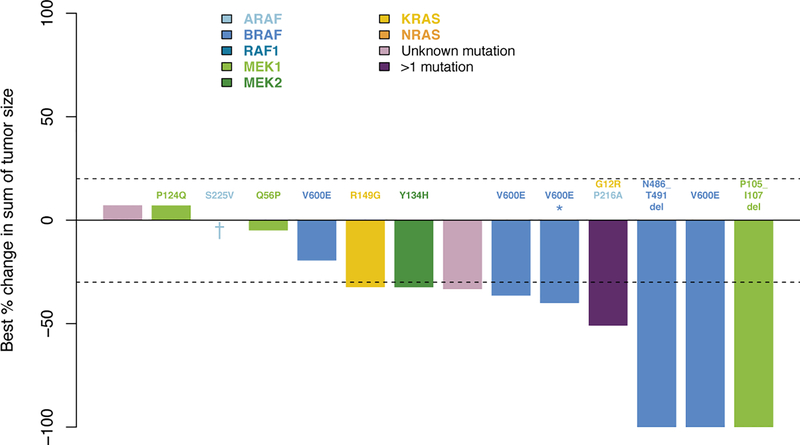
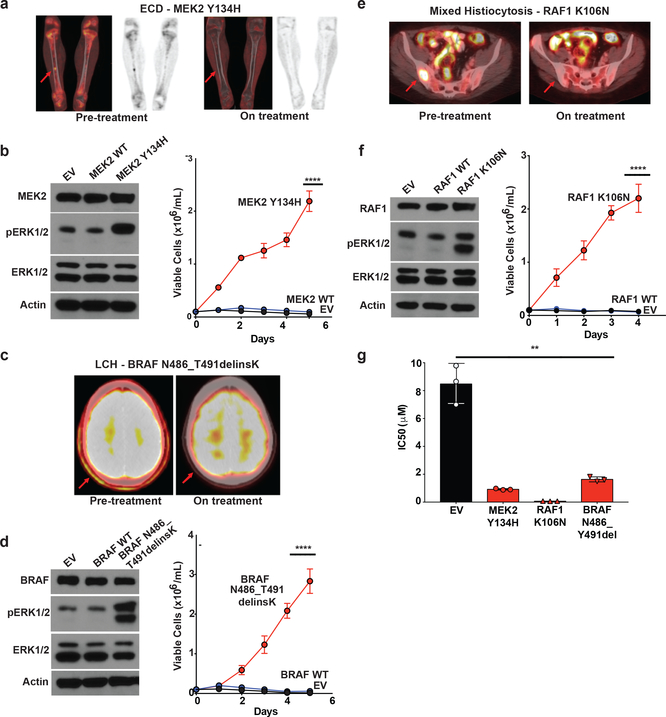
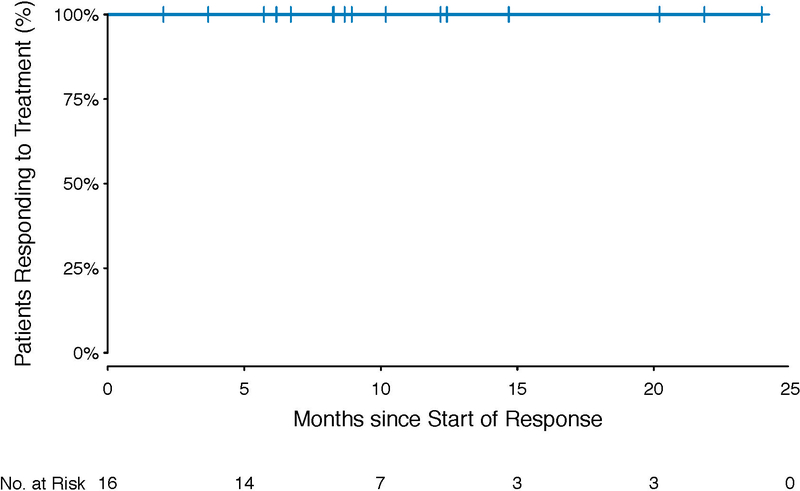
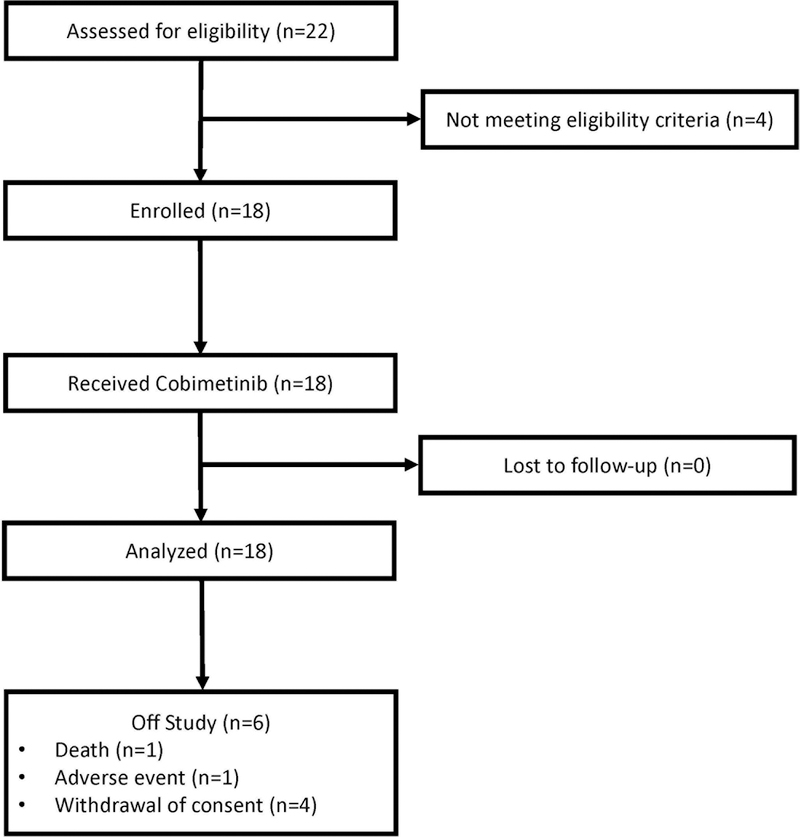
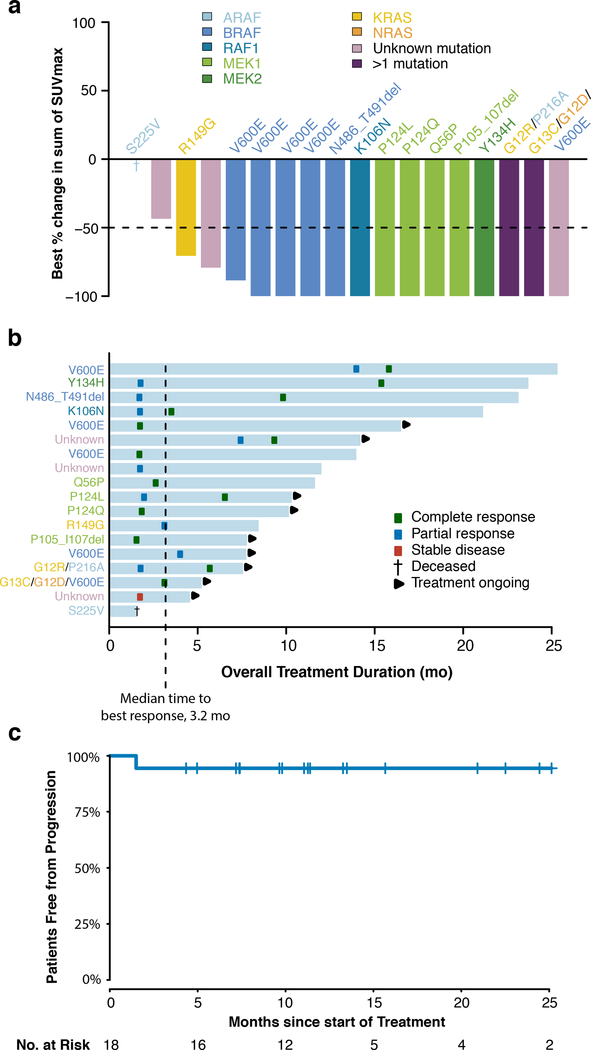
Histiocytic neoplasms are a heterogeneous group of clonal haematopoietic disorders that are marked by diverse mutations in the mitogen-activated protein kinase (MAPK) pathway. For the 50% of patients with histiocytosis who have BRAF mutations, RAF inhibition is highly efficacious and has markedly altered the natural history of the disease. However, no standard therapy exists for the remaining 50% of patients who lack BRAF mutations. Although ERK dependence has been hypothesized to be a consistent feature across histiocytic neoplasms, this remains clinically unproven and many of the kinase mutations that are found in patients who lack BRAF mutations have not previously been biologically characterized. Here we show ERK dependency in histiocytoses through a proof-of-concept clinical trial of cobimetinib, an oral inhibitor of MEK1 and MEK2, in patients with histiocytoses. Patients were enrolled regardless of their tumour genotype. In parallel, MAPK alterations that were identified in treated patients were characterized for their ability to activate ERK. In the 18 patients that we treated, the overall response rate was 89% (90% confidence interval of 73-100). Responses were durable, with no acquired resistance to date. At one year, 100% of responses were ongoing and 94% of patients remained progression-free. Cobimetinib treatment was efficacious regardless of genotype, and responses were observed in patients with ARAF, BRAF, RAF1, NRAS, KRAS, MEK1 (also known as MAP2K1) and MEK2 (also known as MAP2K2) mutations. Consistent with the observed responses, the characterization of the mutations that we identified in these patients confirmed that the MAPK-pathway mutations were activating. Collectively, these data demonstrate that histiocytic neoplasms are characterized by a notable dependence on MAPK signalling-and that they are consequently responsive to MEK inhibition. These results extend the benefits of molecularly targeted therapy to the entire spectrum of patients with histiocytosis.
组织细胞肿瘤是一组异质性克隆性造血系统疾病,其特点是丝裂原活化蛋白激酶(MAPK)通路中存在不同的突变。对于 50%的组织细胞肿瘤患者存在 BRAF 突变,RAF 抑制作用非常有效,显著改变了疾病的自然病程。然而,对于另外 50%缺乏 BRAF 突变的患者,目前还没有标准的治疗方法。虽然 ERK 依赖性被假设为组织细胞肿瘤的一个一致特征,但这在临床上尚未得到证实,并且在缺乏 BRAF 突变的患者中发现的许多激酶突变以前没有进行过生物学特征描述。在这里,我们通过对组织细胞肿瘤患者进行 cobimetinib 的概念验证临床试验,证明了 ERK 的依赖性,cobimetinib 是一种 MEK1 和 MEK2 的口服抑制剂。患者被招募,无论其肿瘤基因型如何。同时,对接受治疗的患者中发现的 MAPK 改变进行了特征分析,以确定其激活 ERK 的能力。在我们治疗的 18 名患者中,总缓解率为 89%(90%置信区间为 73-100)。反应持久,目前尚未出现获得性耐药。在一年时,100%的反应仍在持续,94%的患者无进展。无论基因型如何,cobimetinib 治疗均有效,并且在 ARAF、BRAF、RAF1、NRAS、KRAS、MEK1(也称为 MAP2K1)和 MEK2(也称为 MAP2K2)突变的患者中观察到反应。与观察到的反应一致,我们在这些患者中鉴定的突变特征证实 MAPK 通路突变是激活的。总的来说,这些数据表明组织细胞肿瘤的特征是明显依赖于 MAPK 信号,并且因此对 MEK 抑制有反应。这些结果将分子靶向治疗的益处扩展到整个组织细胞肿瘤患者群体。