Department of Pharmacy, School of Applied Sciences, University of Huddersfield, Huddersfield, HD1 3DH, UK.
Institute of Cancer Therapeutics, University of Bradford, Bradford, BD7 1DP, UK.
Cancer Chemother Pharmacol. 2019 Jun;83(6):1183-1189. doi: 10.1007/s00280-019-03812-7. Epub 2019 Mar 13.
Despite positive responses in phase II clinical trials, the bioreductive prodrug apaziquone failed to achieve statistically significant activity in non-muscle invasive bladder cancer in phase III trials. Apaziquone was administered shortly after transurethral resection and here we test the hypothesis that haematuria inactivates apaziquone.
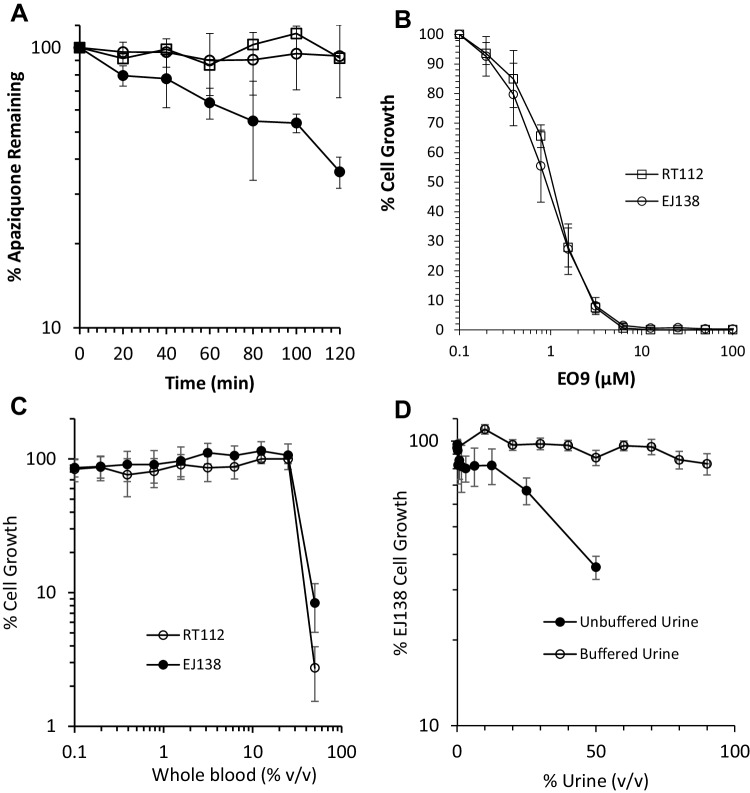
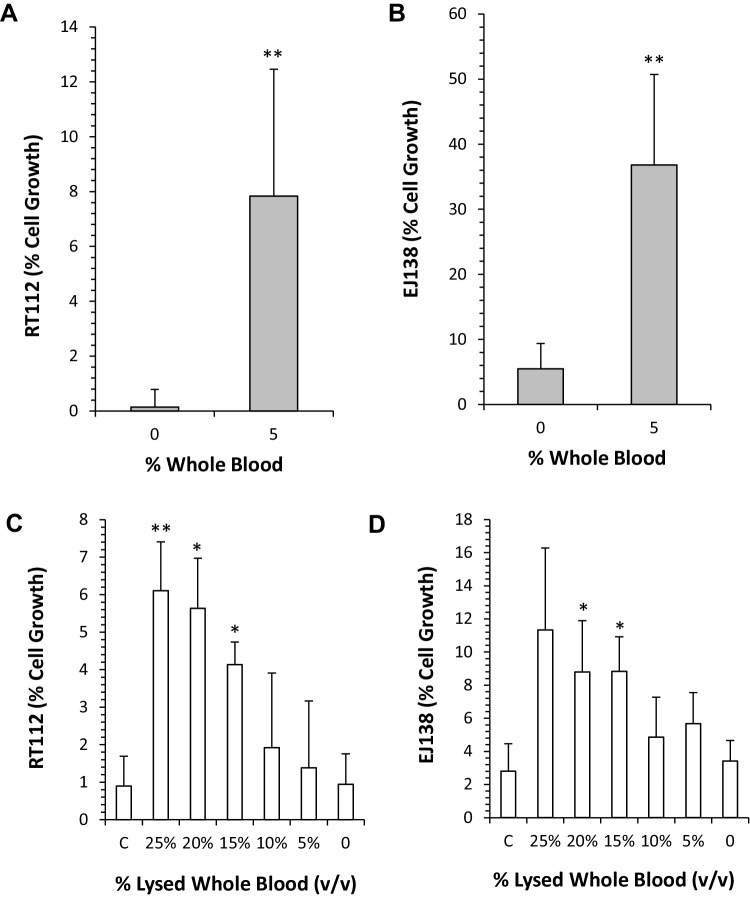
HPLC analysis was used to determine the ability of human whole blood to metabolise apaziquone ex vivo. An in vitro model of haematuria was developed and the response of RT112 and EJ138 cells following a 1-h exposure to apaziquone was determined in the presence of urine plus or minus whole blood or lysed whole blood.
HPLC analysis demonstrated that apaziquone is metabolised by human whole blood with a half-life of 78.6 ± 23.0 min. As a model for haematuria, incubation of cells in media containing up to 75% buffered (pH 7.4) urine and 25% whole blood was not toxic to cells for a 1-h exposure period. Whole blood (5% v/v) significantly (p < 0.01) reduced the potency of apaziquone in this experimental model. Lysed whole blood also significantly (p < 0.05) reduced cell growth, although higher concentrations were required to achieve an effect (15% v/v).
The results of this study demonstrate that haematuria can reduce the potency of apaziquone in this experimental model. These findings impact upon the design of further phase III clinical trials and strongly suggest that apaziquone should not be administered immediately after transurethral resection of non-muscle invasive bladder cancer when haematuria is common.
尽管在 II 期临床试验中取得了积极的反应,但生物还原前药阿帕醌在 III 期临床试验中未能在非肌肉浸润性膀胱癌中取得统计学显著的疗效。阿帕醌在经尿道切除术后不久给予,在这里我们检验血尿使阿帕醌失活的假设。
使用 HPLC 分析来确定人全血在体外代谢阿帕醌的能力。开发了血尿的体外模型,并在存在尿液加或不加全血或溶解全血的情况下,确定 RT112 和 EJ138 细胞在 1 小时暴露于阿帕醌后的反应。
HPLC 分析表明,阿帕醌被人全血代谢,半衰期为 78.6±23.0 分钟。作为血尿模型,在含有高达 75%缓冲(pH 7.4)尿液和 25%全血的培养基中孵育细胞 1 小时对细胞没有毒性。全血(5%v/v)显著(p<0.01)降低了该实验模型中阿帕醌的效力。溶解的全血也显著(p<0.05)降低了细胞生长,尽管需要更高的浓度才能达到效果(15%v/v)。
本研究的结果表明,血尿可以降低该实验模型中阿帕醌的效力。这些发现影响到进一步的 III 期临床试验的设计,并强烈表明当血尿常见时,阿帕醌不应在非肌肉浸润性膀胱癌经尿道切除术后立即给予。