Wesson Paul Douglas, Adhikary Rajatashuvra, Jonas Anna, Gerndt Krysta, Mirzazadeh Ali, Katuta Frieda, Maher Andrew, Banda Karen, Mutenda Nicholus, McFarland Willi, Lowrance David, Prybylski Dimitri, Patel Sadhna
Center for AIDS Prevention Studies, Division of Prevention Science, University of California, San Francisco, San Francisco, CA, United States.
Strategic Information/Monitoring and Evaluation, WHO India Country Office, Gurugaon, Haryana, India.
JMIR Public Health Surveill. 2019 Mar 14;5(1):e11737. doi: 10.2196/11737.
Key populations, including female sex workers (FSWs), are at a disproportionately high risk for HIV infection. Estimates of the size of these populations serve as denominator data to inform HIV prevention and treatment programming and are necessary for the equitable allocation of limited public health resources.
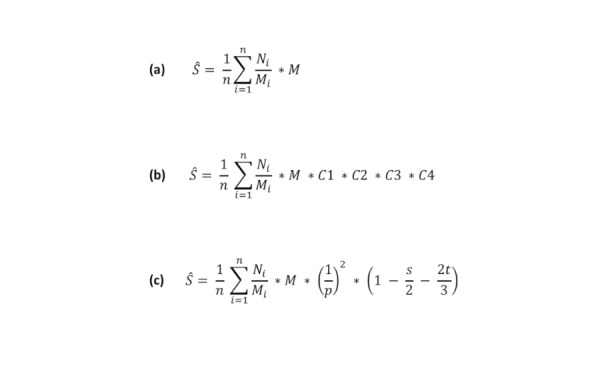
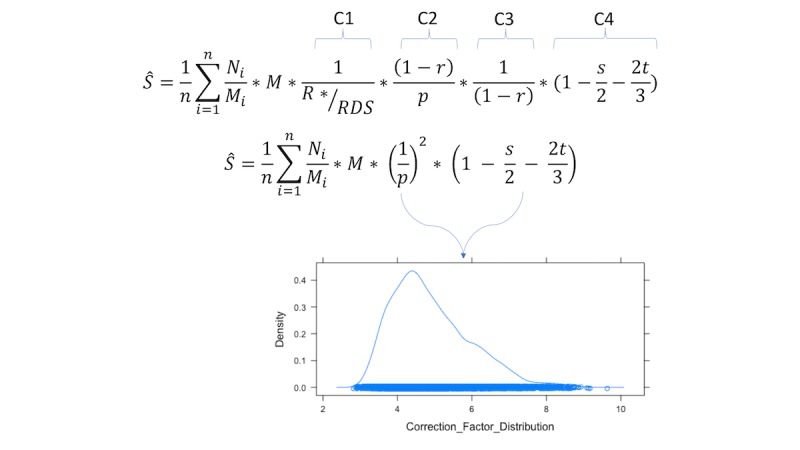
This study aimed to present the respondent-driven sampling (RDS) adjusted reverse tracking method (RTM; RadR), a novel population size estimation approach that combines venue mapping data with RDS data to estimate the population size, adjusted for double counting and nonattendance biases.
We used data from a 2014 RDS survey of FSWs in Windhoek and Katima Mulilo, Namibia, to demonstrate the RadR method. Information from venue mapping and enumeration from the survey formative assessment phase were combined with survey-based venue-inquiry questions to estimate population size, adjusting for double counting, and FSWs who do not attend venues. RadR estimates were compared with the official population size estimates, published by the Namibian Ministry of Health and Social Services (MoHSS), and with the unadjusted RTM.
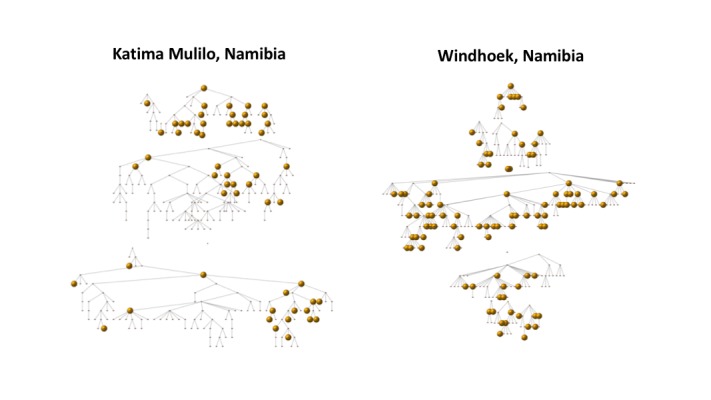
Using the RadR method, we estimated 1552 (95% simulation interval, SI, 1101-2387) FSWs in Windhoek and 453 (95% SI: 336-656) FSWs in Katima Mulilo. These estimates were slightly more conservative than the MoHSS estimates-Windhoek: 3000 (1800-3400); Katima Mulilo: 800 (380-2000)-though not statistically different. We also found 75 additional venues in Windhoek and 59 additional venues in Katima Mulilo identified by RDS participants' responses that were not detected during the initial mapping exercise.
The RadR estimates were comparable with official estimates from the MoHSS. The RadR method is easily integrated into RDS studies, producing plausible population size estimates, and can also validate and update key population maps for outreach and venue-based sampling.
包括女性性工作者(FSW)在内的重点人群感染艾滋病毒的风险极高。对这些人群规模的估计作为分母数据,为艾滋病毒预防和治疗规划提供信息,也是公平分配有限公共卫生资源所必需的。
本研究旨在介绍应答驱动抽样(RDS)调整后的反向追踪方法(RTM;RadR),这是一种新的人口规模估计方法,它将场所映射数据与RDS数据相结合,以估计人口规模,并针对重复计数和未出勤偏差进行调整。
我们使用了2014年在纳米比亚温得和克及卡蒂马穆利洛对女性性工作者进行的RDS调查数据来演示RadR方法。将场所映射信息和调查形成性评估阶段的枚举数据与基于调查的场所询问问题相结合,以估计人口规模,对重复计数和未到场所的女性性工作者进行调整。将RadR估计值与纳米比亚卫生和社会服务部(MoHSS)公布的官方人口规模估计值以及未调整的RTM进行比较。
使用RadR方法,我们估计温得和克有1552名(95%模拟区间,SI,1101-2387)女性性工作者,卡蒂马穆利洛有453名(95% SI:336-656)女性性工作者。这些估计值比MoHSS的估计值略为保守——温得和克:3000(1800-3400);卡蒂马穆利洛:800(380-2000)——尽管在统计学上没有差异。我们还发现,RDS参与者的回答确定了温得和克另外75个场所,卡蒂马穆利洛另外59个场所在最初的映射工作中未被发现。
RadR估计值与MoHSS的官方估计值相当。RadR方法很容易整合到RDS研究中,能得出合理的人口规模估计值,还可以验证和更新用于外展和基于场所抽样的重点人群地图。