Institute of Translational Pharmacology, National Research Council, Rome, Italy.
Institute of Human Physiology, Università Cattolica del Sacro Cuore, Rome, Italy.
PLoS Pathog. 2019 Mar 14;15(3):e1007617. doi: 10.1371/journal.ppat.1007617. eCollection 2019 Mar.
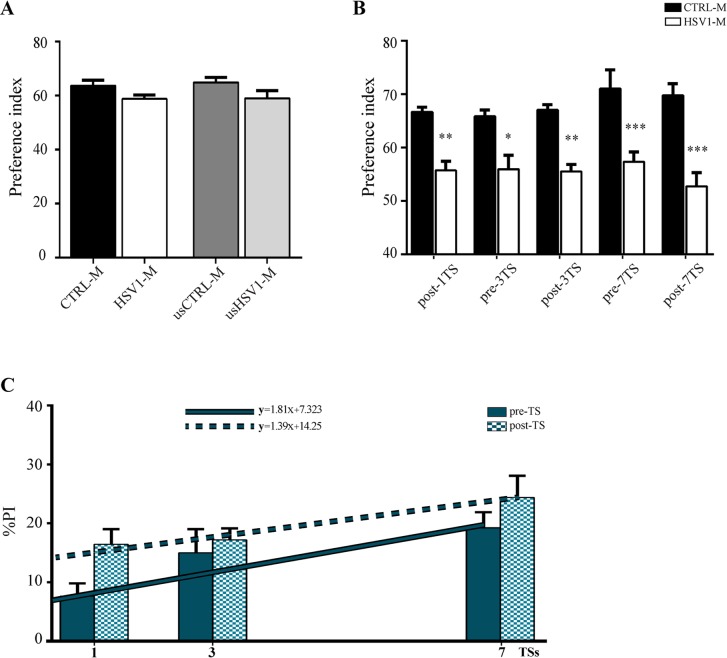
Herpes simplex virus type 1 (HSV-1) is a DNA neurotropic virus, usually establishing latent infections in the trigeminal ganglia followed by periodic reactivations. Although numerous findings suggested potential links between HSV-1 and Alzheimer's disease (AD), a causal relation has not been demonstrated yet. Hence, we set up a model of recurrent HSV-1 infection in mice undergoing repeated cycles of viral reactivation. By virological and molecular analyses we found: i) HSV-1 spreading and replication in different brain regions after thermal stress-induced virus reactivations; ii) accumulation of AD hallmarks including amyloid-β protein, tau hyperphosphorylation, and neuroinflammation markers (astrogliosis, IL-1β and IL-6). Remarkably, the progressive accumulation of AD molecular biomarkers in neocortex and hippocampus of HSV-1 infected mice, triggered by repeated virus reactivations, correlated with increasing cognitive deficits becoming irreversible after seven cycles of reactivation. Collectively, our findings provide evidence that mild and recurrent HSV-1 infections in the central nervous system produce an AD-like phenotype and suggest that they are a risk factor for AD.
单纯疱疹病毒 1 型(HSV-1)是一种 DNA 嗜神经病毒,通常在三叉神经节中建立潜伏感染,随后周期性地重新激活。尽管有大量研究结果表明 HSV-1 与阿尔茨海默病(AD)之间存在潜在联系,但尚未证明存在因果关系。因此,我们建立了一种在经历反复病毒再激活循环的小鼠中反复感染 HSV-1 的模型。通过病毒学和分子分析,我们发现:i)在热应激诱导的病毒再激活后,HSV-1 在不同脑区的传播和复制;ii)AD 标志物的积累,包括淀粉样β蛋白、tau 过度磷酸化和神经炎症标志物(星形胶质细胞增生、IL-1β 和 IL-6)。值得注意的是,由反复病毒再激活引发的 HSV-1 感染小鼠新皮层和海马体中 AD 分子生物标志物的进行性积累,与认知缺陷的增加相关,在经过七轮再激活后,这些缺陷变得不可逆转。总的来说,我们的研究结果提供了证据,表明中枢神经系统中轻度和反复的 HSV-1 感染会产生类似 AD 的表型,并表明它们是 AD 的一个危险因素。