Department of Anthropology, University of Denver, Denver, CO 80210, USA.
Virtus Heritage, Pottsville 2489, Queensland, Australia.
Sensors (Basel). 2019 Mar 12;19(5):1239. doi: 10.3390/s19051239.
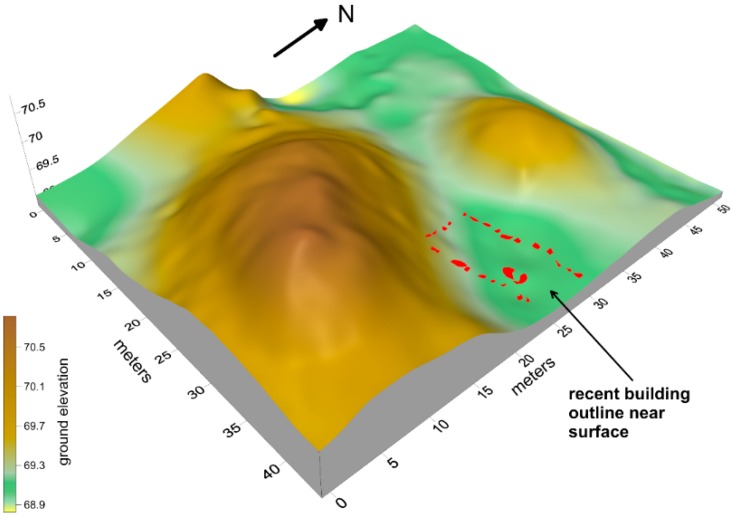
A robust 3-D GPR dataset provides interpreters with a variety of methods for extracting important information at buried archaeological sites. An iterative approach that uses reflection profile analysis, amplitude slice-mapping, and often both in conjunction is often necessary as neither method by itself is sufficient. In northern Australia, two constructed mounds contain a number of cultural and geological horizons and features, which can be imaged with GPR. The reflection profiles display the modified ground surface prior to mound construction and some initial construction layers. On the pre-mound surface, amplitude maps of reflective layers that were built-up on the ground surface indicate that they were constructed in an intentional manner. Those surfaces were later covered by sand to produce mounds used for human burial. Human internments in the mound can only be seen in reflection profiles, but once discovered, the profiles can be re-sliced to produce high definition amplitude images of these remains. No one method of analysis can provide an overall interpretation of these complex internal mound features. When the methods are varied, depending on the results of one method, a detailed and varied analysis of certain aspects of the mounds' internal features are visible, leading to the generation of a number of hypotheses about how this area of northern Australia was used in the past. The 3-D data from GPR shows that this area was an important location on the landscape in the past, and was modified by the construction of a monumental mound, which was then used for human burials, and more recently, the construction of what was likely a ritual enclosure.
一个强大的三维探地雷达数据集为解译人员提供了各种方法,以便从埋藏的考古遗址中提取重要信息。一种迭代方法,通常结合反射剖面分析、振幅切片映射以及两者,是必要的,因为这两种方法本身都不够充分。在澳大利亚北部,两个建造的土丘包含了许多文化和地质层面和特征,可以用探地雷达进行成像。反射剖面显示了在土丘建造之前的修改后的地面表面和一些初始建造层。在土丘表面之前,反射层的振幅图显示了它们是在地面上有意建造的。这些表面后来被沙子覆盖,形成了用于人类埋葬的土丘。在土丘中的人类埋葬只能在反射剖面上看到,但一旦发现,这些剖面可以重新切片,以产生这些遗骸的高清晰度振幅图像。没有一种分析方法可以提供对这些复杂的内部土丘特征的整体解释。当根据一种方法的结果改变方法时,可以对土丘内部特征的某些方面进行详细和多样化的分析,从而产生关于澳大利亚北部这一地区过去如何使用的一些假设。探地雷达的三维数据表明,该地区过去是景观中的一个重要位置,通过建造一座纪念性的土丘进行了修改,然后用于人类埋葬,最近,可能建造了一个仪式围场。