Department of Nutrition, Food Sciences and Gastronomy, Faculty of Pharmacy and Food Sciences, University of Barcelona, Av. Joan XXIII 27-31, E-08028 Barcelona, Spain.
Institut de Recerca en Nutrició i Seguretat Alimentària de la UB (INSA-UB), 08921 Barcelona, Spain.
Nutrients. 2019 Mar 12;11(3):602. doi: 10.3390/nu11030602.
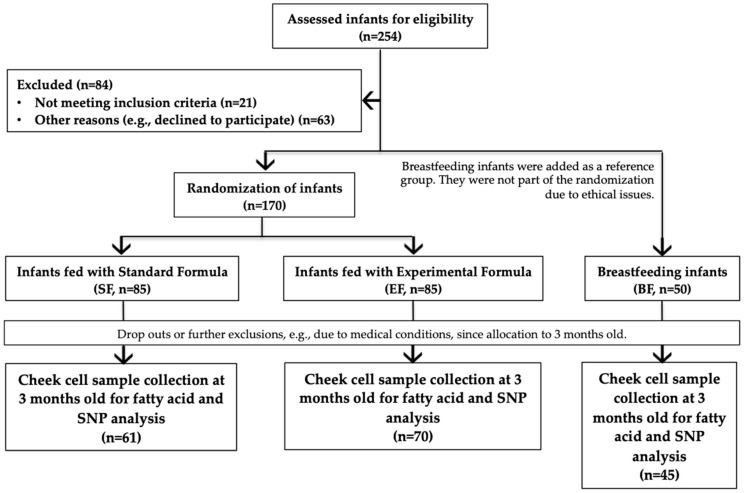
Polymorphisms in the fatty acid desaturase (FADS) genes influence the arachidonic (AA) and docosahexaenoic (DHA) acid concentrations (crucial in early life). Infants with specific genotypes may require different amounts of these fatty acids (FAs) to maintain an adequate status. The aim of this study was to determine the effect of an infant formula supplemented with AA and DHA on FAs of infants with different FADS genotypes. In total, 176 infants from the COGNIS study were randomly allocated to the Standard Formula (SF; n = 61) or the Experimental Formula (EF; n = 70) group, the latter supplemented with AA and DHA. Breastfed infants were added as a reference group (BF; n = 45). FAs and FADS polymorphisms were analyzed from cheek cells collected at 3 months of age. FADS minor allele carriership in formula fed infants, especially those supplemented, was associated with a declined desaturase activity and lower AA and DHA levels. Breastfed infants were not affected, possibly to the high content of AA and DHA in breast milk. The supplementation increased AA and DHA levels, but mostly in major allele carriers. In conclusion, infant FADS genotype could contribute to narrow the gap of AA and DHA concentrations between breastfed and formula fed infants.
脂肪酸去饱和酶(FADS)基因多态性影响花生四烯酸(AA)和二十二碳六烯酸(DHA)的浓度(对生命早期至关重要)。具有特定基因型的婴儿可能需要不同量的这些脂肪酸(FA)来维持足够的状态。本研究旨在确定补充 AA 和 DHA 的婴儿配方对具有不同 FADS 基因型的婴儿 FA 的影响。共有 176 名来自 COGNIS 研究的婴儿被随机分配到标准配方(SF;n = 61)或实验配方(EF;n = 70)组,后者补充 AA 和 DHA。母乳喂养的婴儿作为参考组(BF;n = 45)。从 3 个月大的脸颊细胞中分析 FA 和 FADS 多态性。配方喂养婴儿,尤其是补充的婴儿,携带 FADS 次要等位基因与脱饱和酶活性下降以及 AA 和 DHA 水平降低有关。母乳喂养的婴儿不受影响,可能是因为母乳中 AA 和 DHA 的含量较高。补充剂增加了 AA 和 DHA 的水平,但主要在主要等位基因携带者中增加。总之,婴儿 FADS 基因型可能有助于缩小母乳喂养和配方喂养婴儿之间 AA 和 DHA 浓度的差距。