Nishitani Kohei, Kuriyama Shinichi, Nakamura Shinichiro, Ito Hiromu, Matsuda Shuicih
Department of Orthopaedic Surgery, Graduate School of Medicine, Kyoto University, Kyoto, Japan.
Knee Surg Relat Res. 2019 Mar 1;31(1):25-30. doi: 10.5792/ksrr.18.013.
Despite the long history of drain use in total knee arthroplasty (TKA), no drain has been gaining popularity. The purpose of this study was to investigate whether drainage is related to the length of hospital stay.
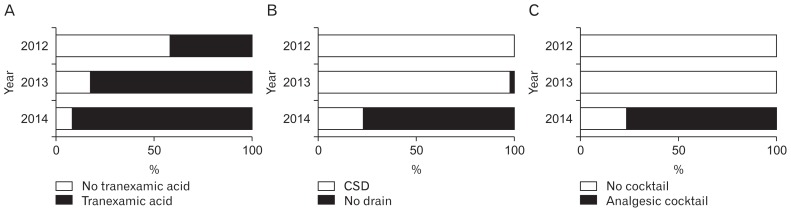
A total of 166 consecutive unilateral TKAs performed on 135 patients with osteoarthritis were retrospectively reviewed. Closed suction drainage was used in 111 cases (67%). Length of hospital stay after surgery was recorded, and a multivariate linear regression analysis was performed to evaluate various variables (patient factors, surgical factors, and post-surgical factors) and to investigate whether drainage was an independent variable.
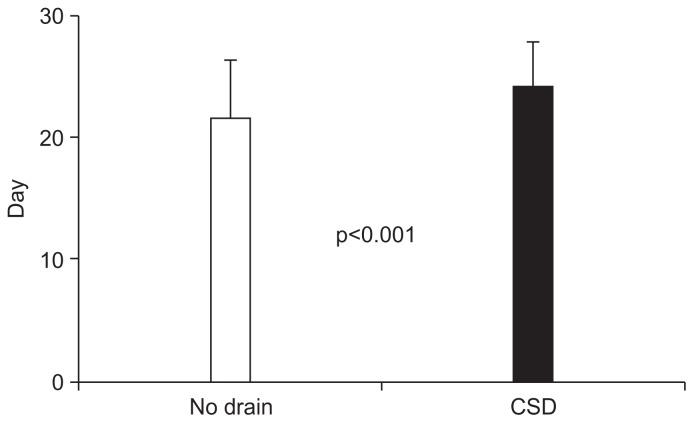
Hospital stay was shorter in no drain cases (21.7±4.8 days) than in drain cases (24.2±3.7 days, p<0.001). The multivariate analysis showed that older age (β=0.12, p=0.02), drain use (β=2.81, p=0.03), and occurrence of comorbidity (β=1.46, p=0.04) were the independent variables associated with the extended hospital stay. There was no difference in comorbidity between drain cases (39.6%) and no drain cases (27.2%, p=0.13).
The drain use, age, and occurrence of comorbidity were related to the length of hospital stay. TKA without drain is an effective procedure both medically and economically.
尽管在全膝关节置换术(TKA)中使用引流管已有很长历史,但目前尚无一种引流管得到广泛应用。本研究的目的是调查引流与住院时间长短是否相关。
回顾性分析了135例骨关节炎患者连续进行的166例单侧全膝关节置换术。111例(67%)使用了闭式吸引引流。记录术后住院时间,并进行多因素线性回归分析以评估各种变量(患者因素、手术因素和术后因素),并调查引流是否为独立变量。
未使用引流管的患者住院时间(21.7±4.8天)比使用引流管的患者(24.2±3.7天,p<0.001)短。多因素分析显示,年龄较大(β=0.12,p=0.02)、使用引流管(β=2.81,p=0.03)和合并症的发生(β=1.46,p=0.04)是与住院时间延长相关的独立变量。使用引流管的患者(39.6%)和未使用引流管的患者(27.2%,p=0.13)合并症发生率无差异。
引流管的使用、年龄和合并症的发生与住院时间长短有关。不使用引流管的全膝关节置换术在医学和经济方面都是一种有效的手术方式。