Lee Yong Seuk
Department of Orthopaedic Surgery, Seoul National University Bundang Hospital, Seongnam, Korea.
Knee Surg Relat Res. 2017 Jun 1;29(2):80-86. doi: 10.5792/ksrr.16.024.
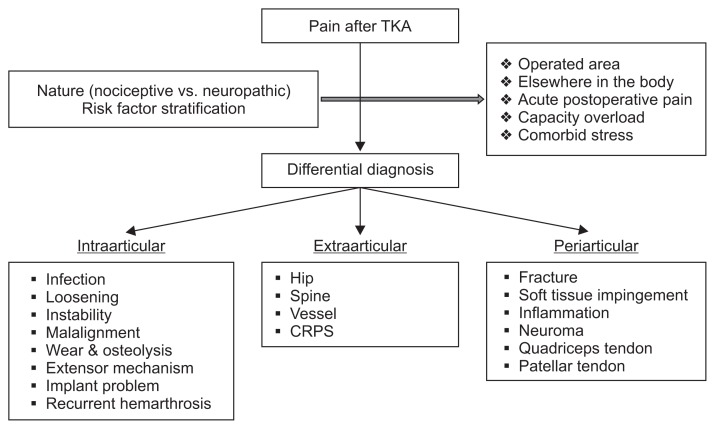
Total knee arthroplasty (TKA) has been much improved recently and it is regarded as one of the most common and successful surgical procedures that provides pain relief and improves function in patients with severe knee arthritis. However, recent studies have reported that 15%-20% of patients are not satisfied after TKA without evident clinical or radiological findings and the most common causes of patient dissatisfaction include residual pain and limited function. The evaluation and treatment of painful TKA relies on a thorough understanding of the origin by careful evaluation, and a systematic approach is essential to efficiently and effectively resolve the pain. Periarticular injections (PAIs) and nerve blocks are gaining popularity because they are associated with less side effects than systemic regimens. The analgesic efficacy and safety of PAI compared with nerve blocks for postoperative pain management still remain controversial. Therefore, more study is needed to determine if any changes in the regimen of the injection or technique could provide added benefit to long-term functional improvement beyond the perioperative period.
全膝关节置换术(TKA)近年来有了很大改进,它被视为最常见且成功的外科手术之一,能缓解重度膝关节炎患者的疼痛并改善其功能。然而,近期研究报告称,15% - 20%的患者在全膝关节置换术后虽无明显临床或影像学表现但仍不满意,患者不满意的最常见原因包括残留疼痛和功能受限。疼痛性全膝关节置换术的评估和治疗依赖于通过仔细评估全面了解疼痛根源,采用系统方法对于有效解决疼痛至关重要。关节周围注射(PAIs)和神经阻滞越来越受欢迎,因为它们比全身用药方案副作用更少。与神经阻滞相比,关节周围注射用于术后疼痛管理的镇痛效果和安全性仍存在争议。因此,需要更多研究来确定注射方案或技术的任何改变是否能在围手术期之外为长期功能改善带来额外益处。