Department of Pharmacology & Therapeutics, Makerere University, P.O. Box 7072, Kampala, Uganda.
Africa Centre for Systematic Reviews and Knowledge Translation, Makerere University College of Health Sciences, P.O. Box 7072, Kampala, Uganda.
Malar J. 2019 Mar 12;18(1):76. doi: 10.1186/s12936-019-2716-z.
Chloroquine, a previous highly efficacious, easy to use and affordable anti-malarial agent was withdrawn from malaria endemic regions due to high levels of resistance. This review collated evidence from published-reviewed articles to establish prevalence of Pfcrt 76T and Pfmdr-1 86Y alleles in malaria affected countries following official discontinuation of chloroquine use.
A review protocol was developed, registered in PROSPERO (#CRD42018083957) and published in a peer-reviewed journal. Article search was done in PubMed, Scopus, Lilacs/Vhl and Embase databases by two experienced librarians (AK, RS) for the period 1990-to-Febuary 2018. Mesh terms and Boolean operators (AND, OR) were used. Data extraction form was designed in Excel spread sheet 2007. Data extraction was done by three reviewers (NL, BB and MO), discrepancies were resolved by discussion. Random effects analysis was done in Open Meta Analyst software. Heterogeneity was established using I-statistic.
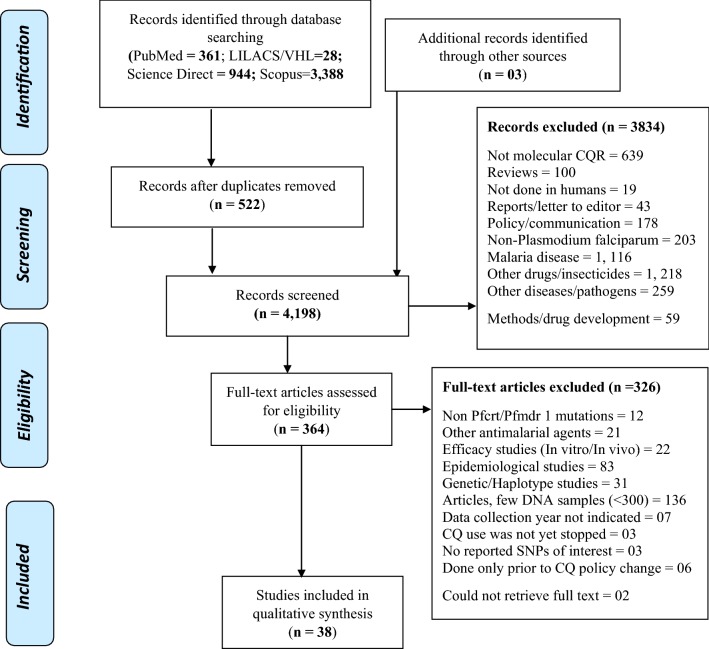
A total of 4721 citations were retrieved from article search (Pubmed = 361, Lilac/vhl = 28, Science Direct = 944, Scopus = 3388). Additional targeted search resulted in three (03) eligible articles. After removal of duplicates (n = 523) and screening, 38 articles were included in the final review. Average genotyping success rate was 63.6% (18,343/28,820) for Pfcrt K76T and 93.5% (16,232/17,365) for Pfmdr-1 86Y mutations. Prevalence of Pfcrt 76T was as follows; East Africa 48.9% (2528/5242), Southern Africa 18.6% (373/2163), West Africa 58.3% (3321/6608), Asia 80.2% (1951/2436). Prevalence of Pfmdr-1 86Y was; East Africa 32.4% (1447/5722), Southern Africa 36.1% (544/1640), West Africa 52.2% (1986/4200), Asia 46.4% (1276/2217). Over half, 52.6% (20/38) of included studies reported continued unofficial chloroquine use following policy change. Studies done in Madagascar and Kenya reported re-emergence of chloroquine sensitive parasites (IC < 30.9 nM). The average time (years) since discontinuation of chloroquine use to data collection was 8.7 ± 7.4. There was high heterogeneity (I > 95%).
The prevalence of chloroquine resistance alleles among Plasmodium falciparum parasites have steadily declined since discontinuation of chloroquine use. However, Pfcrt K76T and Pfmdr-1 N86Y mutations still persist at moderate frequencies in most malaria affected countries.
氯喹曾是一种高效、易于使用且价格实惠的抗疟药物,但由于耐药性高,已从疟疾流行地区撤出。本综述汇集了已发表的综述文章中的证据,以确定在官方停止使用氯喹后,疟疾流行国家中 PfCRT 76T 和 Pfmdr-1 86Y 等位基因的流行情况。
制定了一项综述方案,在 PROSPERO 中进行了注册(#CRD42018083957)并在同行评议期刊上发表。两名经验丰富的图书管理员在 1990 年至 2018 年 2 月期间在 PubMed、Scopus、Lilacs/Vhl 和 Embase 数据库中进行了文章搜索。使用了主题词和布尔运算符(AND、OR)。在 Excel 2007 电子表格中设计了数据提取表格。NL、BB 和 MO 三位评审员进行了数据提取,通过讨论解决了分歧。在 Open Meta Analyst 软件中进行了随机效应分析。使用 I 统计量确定异质性。
从文章搜索中检索到 4721 条引文(PubMed=361,Lilac/vhl=28,Science Direct=944,Scopus=3388)。额外的有针对性搜索导致了 3 篇符合条件的文章。在去除重复项(n=523)和筛选后,38 篇文章被纳入最终综述。PfCRT K76T 的平均基因分型成功率为 63.6%(18,343/28,820),Pfmdr-1 86Y 突变的成功率为 93.5%(16,232/17,365)。PfCRT 76T 的流行率如下:东非 48.9%(2528/5242),南非 18.6%(373/2163),西非 58.3%(3321/6608),亚洲 80.2%(1951/2436)。Pfmdr-1 86Y 的流行率为:东非 32.4%(1447/5722),南非 36.1%(544/1640),西非 52.2%(1986/4200),亚洲 46.4%(1276/2217)。超过一半(52.6%,20/38)的纳入研究报告在政策改变后继续使用未经官方批准的氯喹。马达加斯加和肯尼亚的研究报告称,氯喹敏感寄生虫(IC<30.9 nM)再次出现。自停止使用氯喹至数据收集的平均时间(年)为 8.7±7.4。存在高度异质性(I>95%)。
自停止使用氯喹以来,恶性疟原虫 PfCRT 76T 和 Pfmdr-1 N86Y 等位基因的耐药性已稳步下降。然而,在大多数疟疾流行国家,PfCRT K76T 和 Pfmdr-1 86Y 突变仍以中等频率持续存在。