Thomson R Camilla, Chick John P, Harrison Gareth P
School of Engineering, Institute for Energy Systems, University of Edinburgh, Edinburgh, EH9 3DW UK.
Int J Life Cycle Assess. 2019;24(1):51-63. doi: 10.1007/s11367-018-1504-2. Epub 2018 Jul 23.
To date, very few studies have attempted to quantify the environmental impacts of a wave energy converter, and almost all of these focus solely on the potential climate change impacts and embodied energy. This paper presents a full life cycle assessment (LCA) of the first-generation Pelamis wave energy converter, aiming to contribute to the body of published studies and examine any potential trade-offs or co-benefits across a broad range of environmental impacts.
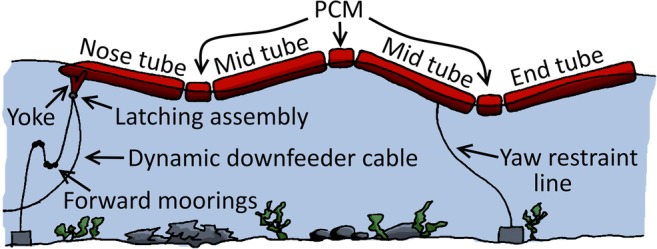
The process-based attributional LCA was carried out on the full cradle-to-grave life cycle of the Pelamis P1 wave energy converter, including the device, its moorings and sub-sea connecting cable up to the point of connection with the grid. The case study was for a typical wave farm located off the north-west coast of Scotland. Foreground data was mostly sourced from the manufacturer. Background inventory data was mostly sourced from the ecoinvent database (v3.3), and the ReCiPe and CED impact assessment methods were applied.
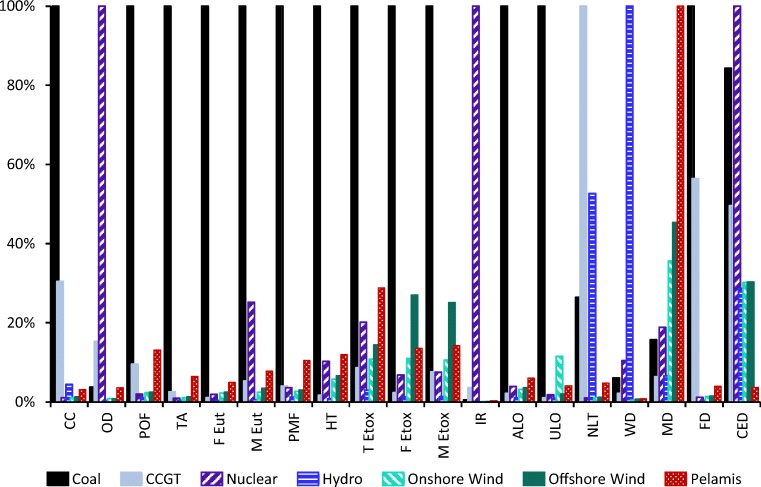
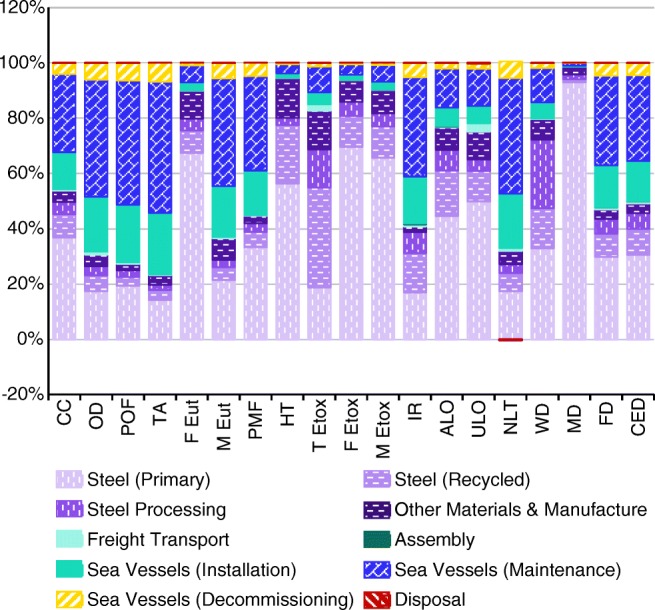
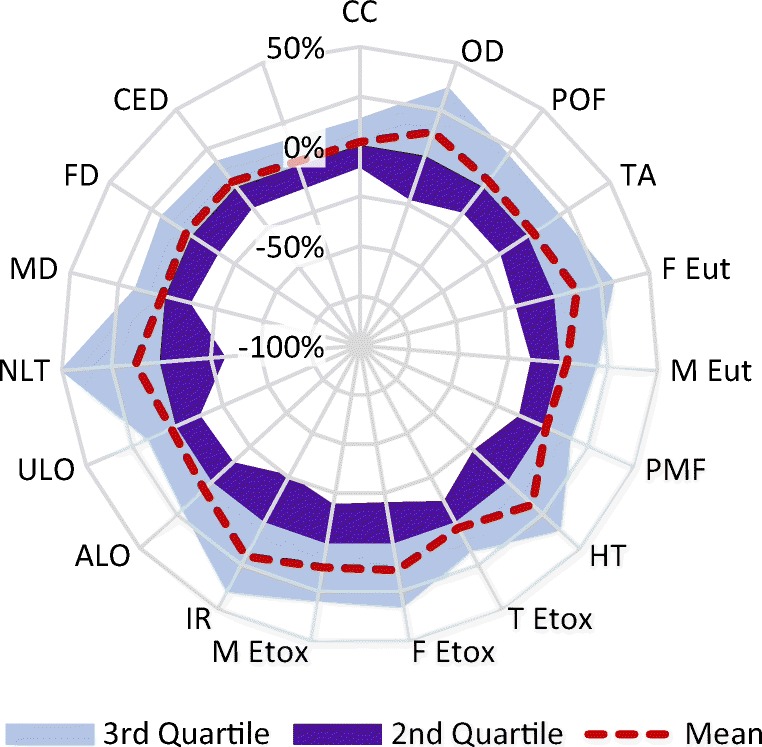
The Pelamis was found to have significantly lower environmental impacts than conventional fossil generation in 6 impact categories, but performed worse than most other types of generation in 8 of the remaining 13 categories studied. The greatest impacts were from steel manufacture and sea vessel operations. The device performs quite well in the two most frequently assessed impacts for renewable energy converters: climate change and cumulative energy demand. The carbon payback period is estimated to be around 24 months (depending on the emissions intensity of the displaced generation mix), and the energy return on investment is 7.5. The contrast between this and the poor performance in other impact categories demonstrates the limitations of focussing only on carbon and energy.
The Pelamis was found to generally have relatively high environmental impacts across many impact categories when compared to other types of power generation; however, these are mostly attributable to the current reliance on fossil fuels in the global economy and the early development stage of the technology. Opportunities to reduce this also lie in reducing requirements for steel in the device structure, and decreasing the requirements for sea vessel operations during installation, maintenance and decommissioning.
迄今为止,很少有研究试图量化波浪能转换器对环境的影响,而且几乎所有这些研究都仅关注潜在的气候变化影响和隐含能源。本文对第一代Pelamis波浪能转换器进行了全面的生命周期评估(LCA),旨在为已发表的研究做出贡献,并研究在广泛的环境影响中可能存在的权衡或协同效益。
基于过程的归因LCA是针对Pelamis P1波浪能转换器从摇篮到坟墓的整个生命周期进行的,包括设备、其系泊系统和直至与电网连接点的海底连接电缆。案例研究针对的是位于苏格兰西北海岸外的一个典型波浪农场。前景数据大多来自制造商。背景清单数据大多来自ecoinvent数据库(v3.3),并应用了ReCiPe和CED影响评估方法。
研究发现,Pelamis在6个影响类别中的环境影响明显低于传统化石发电,但在其余13个研究类别中的8个类别中表现不如大多数其他类型的发电。最大的影响来自钢铁制造和海上船舶运营。该设备在可再生能源转换器最常评估的两个影响方面表现相当出色:气候变化和累积能源需求。碳回收期估计约为24个月(取决于被替代发电组合的排放强度),能源投资回报率为7.5。这与在其他影响类别中的糟糕表现形成对比,表明仅关注碳和能源存在局限性。
与其他类型的发电相比,Pelamis在许多影响类别中通常具有相对较高的环境影响;然而,这些大多归因于全球经济目前对化石燃料的依赖以及该技术的早期发展阶段。减少这种影响的机会还在于降低设备结构中对钢铁的需求,以及减少安装、维护和退役期间对海上船舶运营的需求。