Esteves Sandro C, Carvalho José F, Bento Fabiola C, Santos Jonathan
ANDROFERT, Andrology and Human Reproduction Clinic, Campinas, Brazil.
Statistika Consulting, Campinas, Brazil.
Front Endocrinol (Lausanne). 2019 Feb 28;10:99. doi: 10.3389/fendo.2019.00099. eCollection 2019.
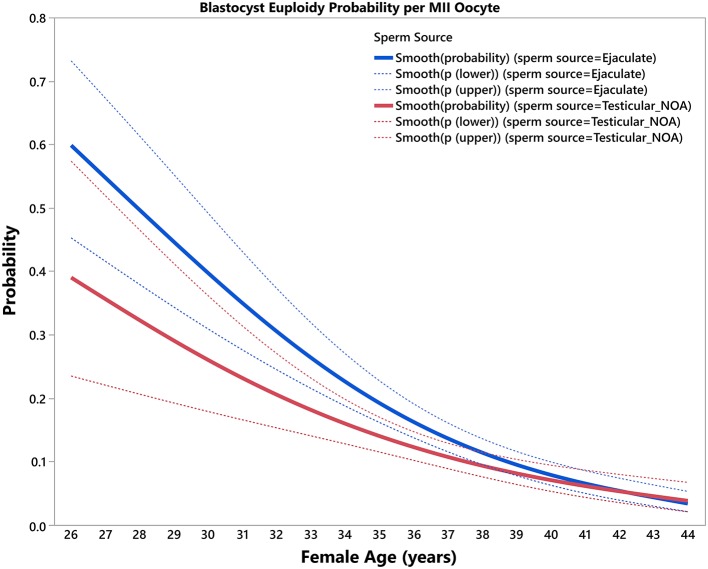
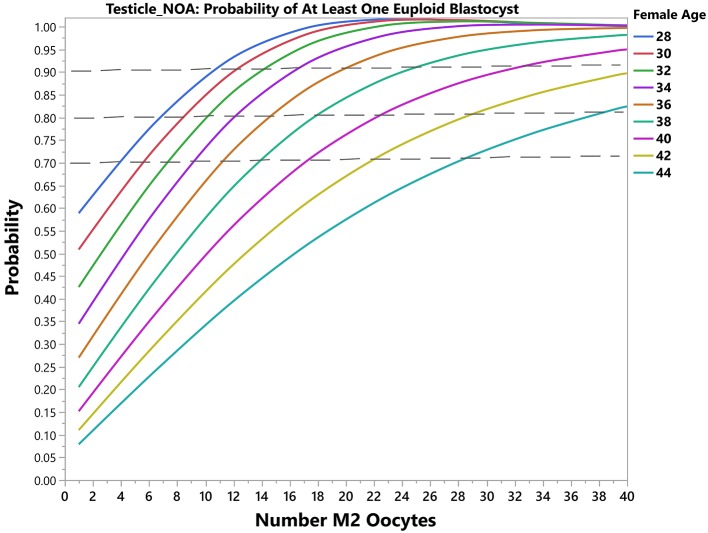
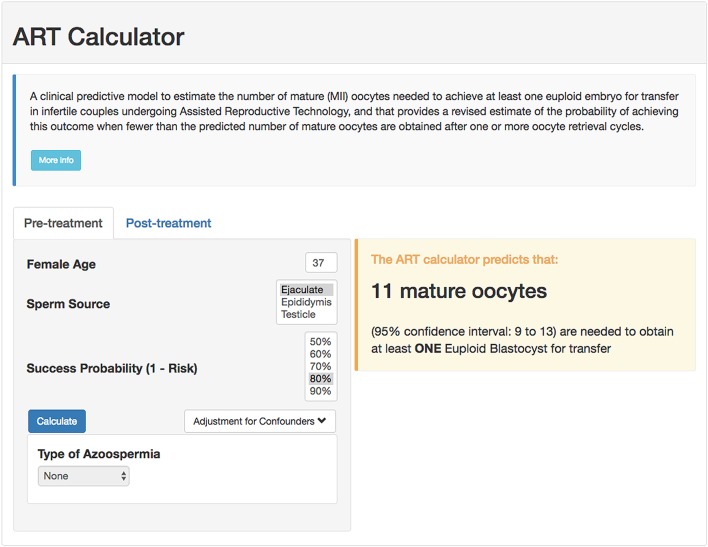
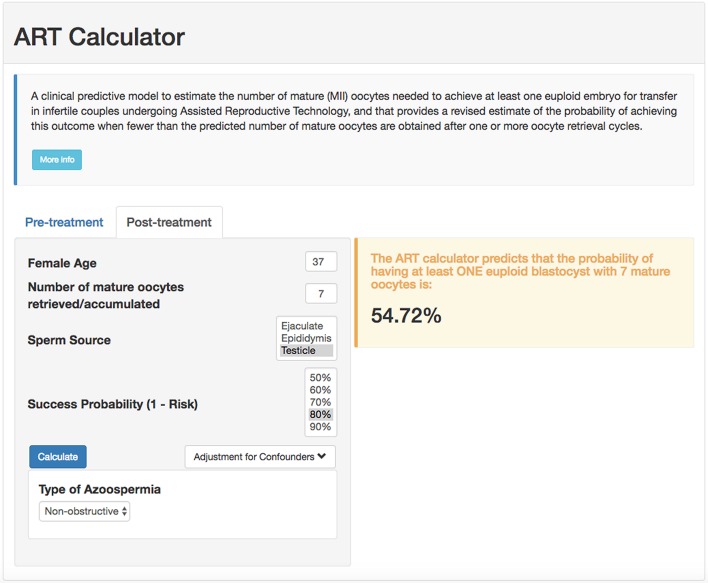
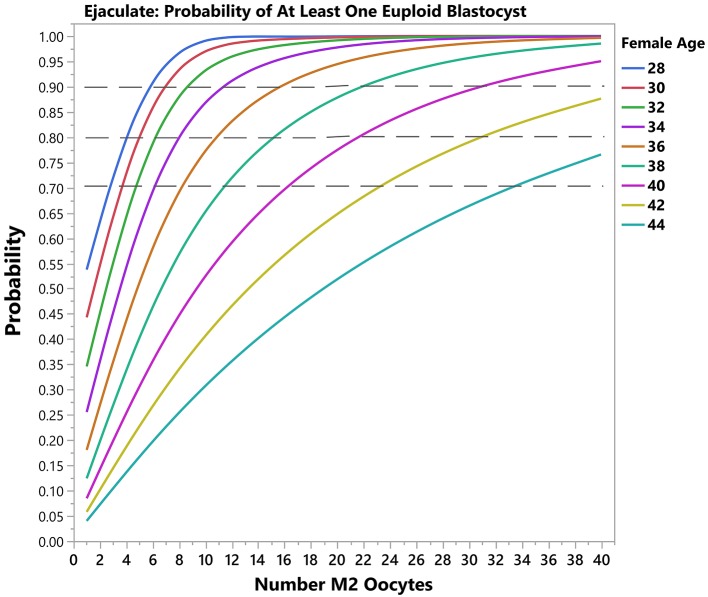
The POSEIDON group (atient-riented trategies ncompassing ndividualizeocyte umber) has introduced "the ability to retrieve the number of oocytes needed to achieve at least one euploid embryo for transfer" as an intermediate marker of successful outcome in IVF/ICSI cycles. This study aimed to develop a novel calculator to predict the POSEIDON marker. We analyzed clinical and embryonic data of infertile couples who underwent IVF/ICSI with the intention to have trophectoderm biopsy for preimplantation genetic testing for aneuploidy. We used the negative binomial distribution to model the number of euploid blastocysts and the adaptive LASSO (Least Absolute Shrinkage and Selection Operator) method for variable selection. The fitted model selected female age, sperm source used for ICSI, and the number of mature (metaphase II) oocytes as predictors ( < 0.0001). Female age was the most important factor for predicting the probability of a blastocyst being euploid given each mature oocyte (loglikelihood of age [adjusted for sperm source]: 30.9; = 2; < 0.0001). The final predictive model was developed using logistic regression analysis, and internally validated by the holdout method. The predictive ability of the model was assessed by the ROC curve, which resulted in an area under the curve of 0.716. Using the final model and mathematical equations, we calculated the individualized probability of blastocyst euploidy per mature retrieved oocyte and the minimum number of mature oocytes required to obtain ≥1 euploid blastocyst-with their 95% confidence interval [CI]-for different probabilities of success. The estimated predicted probabilities of a mature oocyte turn into a euploid blastocyst decreased progressively with female age and was negatively modulated overall by use of testicular sperm across age ( < 0.001). A calculator was developed to make two types of predictions automatically, one using pretreatment information to estimate the minimum number of mature oocytes to achieve ≥1 euploid blastocyst, and another based on the actual number of mature oocytes collected/accumulated to estimate the chances of having a euploid blastocyst using that oocyte cohort for IVF/ICSI. The new ART calculator may assist in clinical counseling and individualized treatment planning regarding the number of oocytes required for at least one euploid blastocyst in IVF/ICSI procedures.
POSEIDON组(以患者为导向的策略,包括个体化卵母细胞数量)引入了“获取至少一个可用于移植的整倍体胚胎所需卵母细胞数量的能力”,作为体外受精/卵胞浆内单精子注射(IVF/ICSI)周期成功结局的一个中间指标。本研究旨在开发一种新型计算器来预测POSEIDON指标。我们分析了接受IVF/ICSI且打算进行滋养外胚层活检以进行非整倍体植入前基因检测的不孕夫妇的临床和胚胎学数据。我们使用负二项分布对整倍体囊胚数量进行建模,并使用自适应套索(Least Absolute Shrinkage and Selection Operator,LASSO)方法进行变量选择。拟合模型选择了女性年龄、ICSI所使用的精子来源以及成熟(中期II)卵母细胞数量作为预测因子(<0.0001)。在每个成熟卵母细胞的情况下,女性年龄是预测囊胚为整倍体概率的最重要因素(年龄的对数似然值[根据精子来源调整]:30.9;自由度=2;<0.0001)。最终的预测模型通过逻辑回归分析构建,并采用留出法进行内部验证。通过ROC曲线评估模型的预测能力,曲线下面积为0.716。使用最终模型和数学公式,我们计算了每个回收的成熟卵母细胞形成整倍体囊胚的个体化概率,以及获得≥1个整倍体囊胚所需的成熟卵母细胞的最少数量及其95%置信区间[CI],针对不同的成功概率。成熟卵母细胞发育为整倍体囊胚的估计预测概率随着女性年龄的增加而逐渐降低,并且在各年龄组中,使用睾丸精子会对其产生总体负向调节作用(<0.001)。开发了一种计算器来自动进行两种类型的预测,一种使用治疗前信息来估计获得≥1个整倍体囊胚所需的成熟卵母细胞最少数量,另一种基于收集/积累的成熟卵母细胞实际数量来估计使用该批卵母细胞进行IVF/ICSI获得整倍体囊胚的可能性。这种新的辅助生殖技术计算器可能有助于在IVF/ICSI程序中就获得至少一个整倍体囊胚所需的卵母细胞数量进行临床咨询和个体化治疗规划。