Odum School of Ecology, University of Georgia, Athens, GA 30602, USA.
Center for the Ecology of Infectious Disease, University of Georgia, Athens, GA 30602, USA.
Integr Comp Biol. 2019 Nov 1;59(5):1176-1189. doi: 10.1093/icb/icz007.
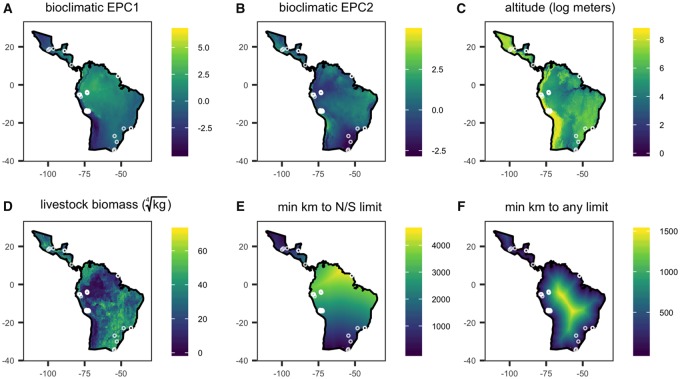
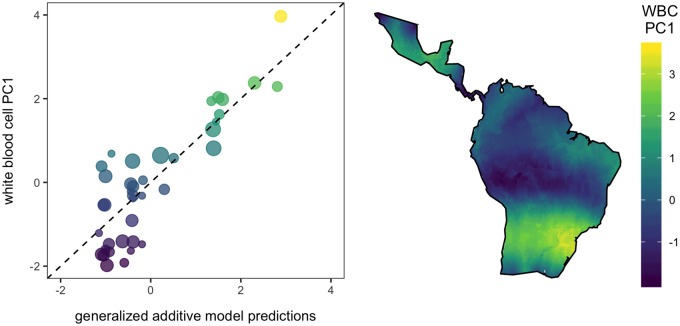
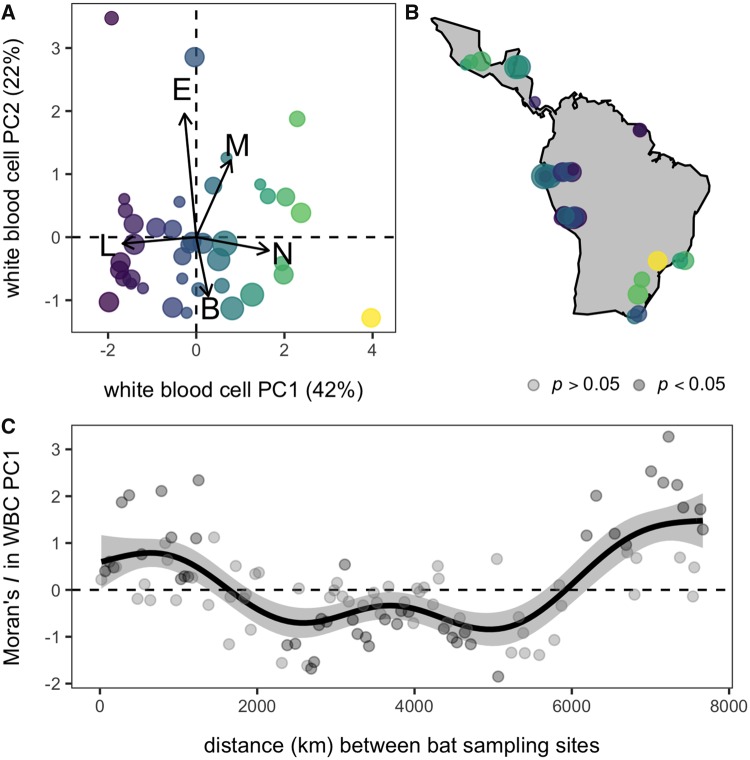
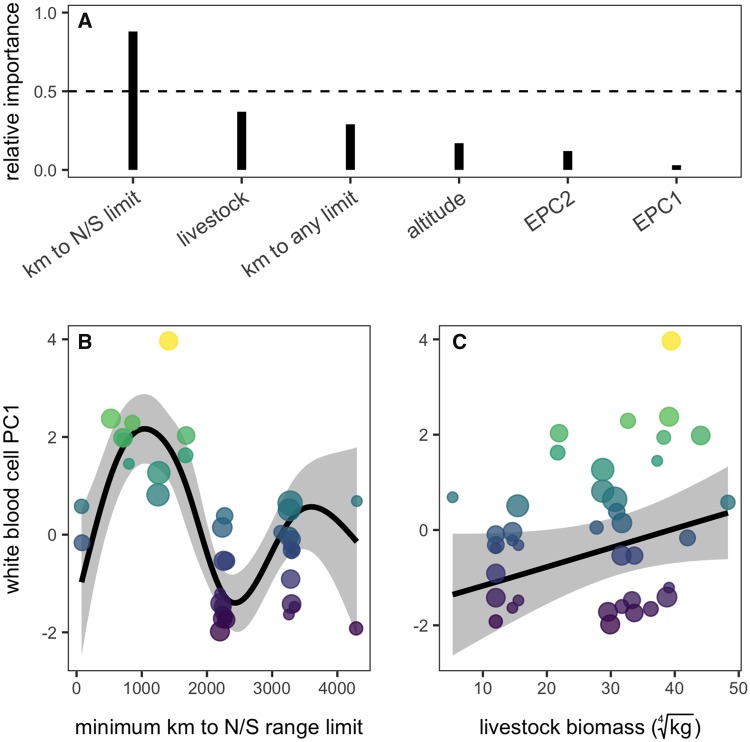
Quantifying how the environment shapes host immune defense is important for understanding which wild populations may be more susceptible or resistant to pathogens. Spatial variation in parasite risk, food and predator abundance, and abiotic conditions can each affect immunity, and these factors can also manifest at both local and biogeographic scales. Yet identifying predictors and the spatial scale of their effects is limited by the rarity of studies that measure immunity across many populations of broadly distributed species. We analyzed leukocyte profiles from 39 wild populations of the common vampire bat (Desmodus rotundus) across its wide geographic range throughout the Neotropics. White blood cell differentials varied spatially, with proportions of neutrophils and lymphocytes varying up to six-fold across sites. Leukocyte profiles were spatially autocorrelated at small and very large distances, suggesting that local environment and large-scale biogeographic factors influence cellular immunity. Generalized additive models showed that bat populations closer to the northern and southern limits of the species range had more neutrophils, monocytes, and basophils, but fewer lymphocytes and eosinophils, than bats sampled at the core of their distribution. Habitats with access to more livestock also showed similar patterns in leukocyte profiles, but large-scale patterns were partly confounded by time between capture and sampling across sites. Our findings suggest that populations at the edge of their range experience physiologically limiting conditions that predict higher chronic stress and greater investment in cellular innate immunity. High food abundance in livestock-dense habitats may exacerbate such conditions by increasing bat density or diet homogenization, although future spatially and temporally coordinated field studies with common protocols are needed to limit sampling artifacts. Systematically assessing immune function and response over space will elucidate how environmental conditions influence traits relevant to epidemiology and help predict disease risks with anthropogenic disturbance, land conversion, and climate change.
量化环境如何塑造宿主的免疫防御能力对于理解哪些野生动物种群可能更容易或更不容易受到病原体的影响是很重要的。寄生虫风险、食物和捕食者丰度以及非生物条件的空间变化都可能影响免疫,这些因素也可以在局部和生物地理尺度上表现出来。然而,由于研究跨越广泛分布物种的许多种群来测量免疫的情况很少,因此确定预测因子及其影响的空间尺度受到限制。我们分析了来自 39 个分布在整个新热带地区的普通吸血蝙蝠(Desmodus rotundus)的野生种群的白细胞谱。白细胞差异在空间上存在差异,中性粒细胞和淋巴细胞的比例在不同地点之间变化可达六倍。白细胞谱在小距离和非常大的距离上具有空间自相关性,表明局部环境和大尺度生物地理因素影响细胞免疫。广义加性模型表明,与在分布核心采样的蝙蝠相比,接近物种分布范围北部和南部边界的蝙蝠种群具有更多的中性粒细胞、单核细胞和嗜碱性粒细胞,但淋巴细胞和嗜酸性粒细胞较少。可以接触到更多牲畜的栖息地的白细胞谱也表现出类似的模式,但大尺度模式部分受到不同地点之间采样时间的干扰。我们的研究结果表明,在其分布范围边缘的种群经历着生理限制条件,这预示着更高的慢性压力和对细胞先天免疫的更大投资。在牲畜密集的栖息地中,高食物丰度可能会通过增加蝙蝠密度或饮食均匀化来加剧这种情况,尽管需要进行具有共同协议的空间和时间上协调的实地研究来限制采样干扰。系统地评估免疫功能和反应的空间差异将阐明环境条件如何影响与流行病学相关的特征,并有助于预测与人为干扰、土地转化和气候变化相关的疾病风险。