Novo Nordisk A/S, Søborg, Denmark.
Ossian Health Economics and Communications GmbH, Basel, Switzerland.
Adv Ther. 2019 May;36(5):1190-1199. doi: 10.1007/s12325-019-00915-8. Epub 2019 Mar 14.
The SUSTAIN 3 and 7 clinical trials compared the efficacy and safety of once-weekly semaglutide relative to exenatide extended-release (ER) and dulaglutide, respectively, in the treatment of patients with type 2 diabetes (T2D). The trials included a series of clinically relevant single and composite endpoints focused on improving glycemic control and reducing body weight, while avoiding hypoglycemia. The present study combined SUSTAIN 3 and 7 outcomes with short-term treatment costs to evaluate the relative cost of control of once-weekly semaglutide versus exenatide ER and dulaglutide.
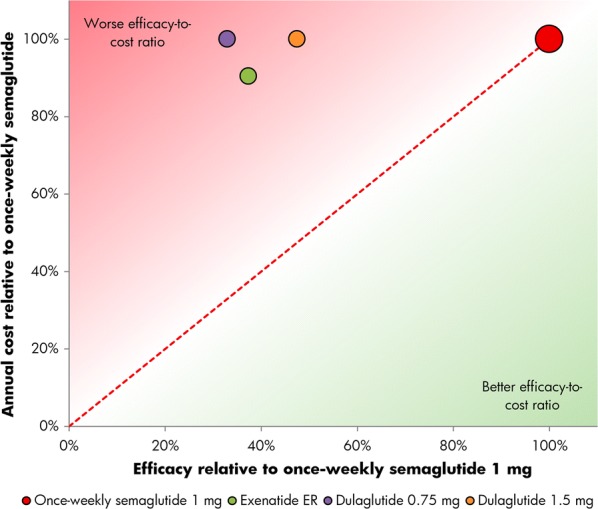
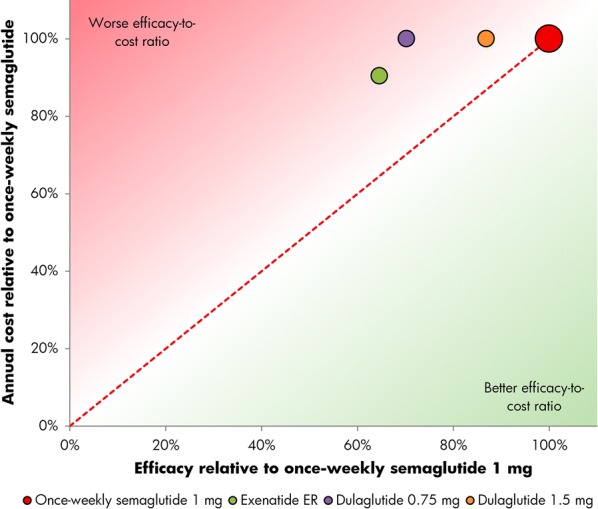
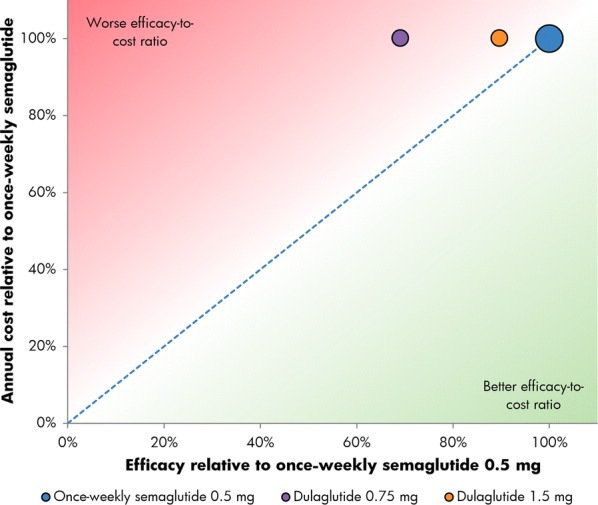
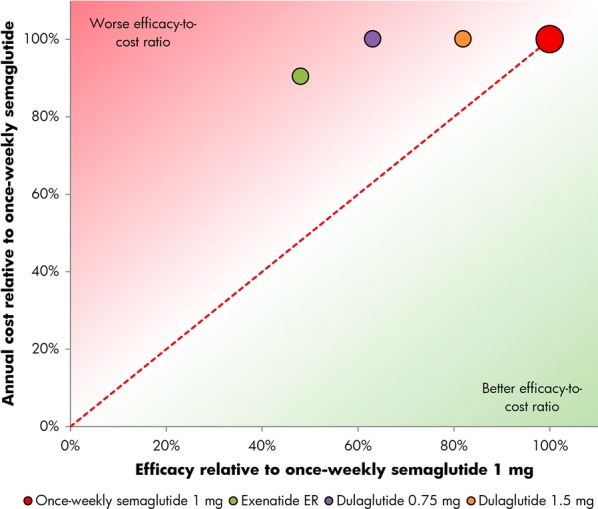
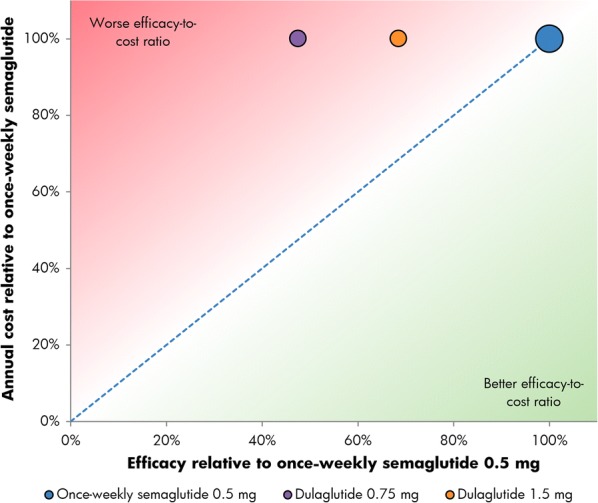
Proportions of patients reaching three endpoints were taken from SUSTAIN 3 and 7 for comparisons with exenatide ER and dulaglutide, respectively. The endpoints investigated were HbA1c < 7.0%, HbA1c < 7.0% without hypoglycemia or weight gain, and a ≥ 1.0% HbA1c reduction with ≥ 5.0% weight loss. Annual per patient treatment costs were based on US wholesale acquisition costs from July 2018. Relative cost of control was calculated by plotting the ratio of the treatment costs and the ratio of the proportions of patients reaching each endpoint on the cost-efficacy plane.
Once-weekly semaglutide 0.5 mg and 1.0 mg were most effective at bringing patients to each of the three endpoints across both SUSTAIN trials. The efficacy-to-cost ratios for once-weekly semaglutide 0.5 mg and 1.0 mg were also superior to all comparators when assessing both the single endpoint of HbA1c < 7.0% and the two composite endpoints including weight loss and hypoglycemia.
The present study showed that once-weekly semaglutide 0.5 mg and 1.0 mg offer superior cost of control versus exenatide ER and dulaglutide in terms of achieving single and composite endpoints, based on an analysis of retrieved dropout data. Once-weekly semaglutide 0.5 mg and 1.0 mg would therefore represent good value for money in the USA, particularly in the attainment of multi-model T2D treatment goals.
Novo Nordisk A/S.
SUSTAIN 3 号和 7 号临床试验比较了每周一次司美格鲁肽与艾塞那肽延长释放剂(ER)和度拉糖肽分别在治疗 2 型糖尿病(T2D)患者中的疗效和安全性。这些试验包括一系列关注改善血糖控制和减轻体重,同时避免低血糖的临床相关单一和复合终点。本研究结合 SUSTAIN 3 号和 7 号的结果和短期治疗成本,评估每周一次司美格鲁肽相对于艾塞那肽 ER 和度拉糖肽的控制成本。
从 SUSTAIN 3 号和 7 号试验中获取达到三个终点的患者比例,分别与艾塞那肽 ER 和度拉糖肽进行比较。研究的终点包括:HbA1c<7.0%、HbA1c<7.0%且无低血糖或体重增加、HbA1c 降低≥1.0%且体重减轻≥5.0%。每位患者的年度治疗成本基于 2018 年 7 月的美国批发采购成本。通过在成本-效果平面上绘制治疗成本比和达到每个终点的患者比例比,计算控制成本的相对成本。
每周一次司美格鲁肽 0.5mg 和 1.0mg 在两个 SUSTAIN 试验中最有效地使患者达到三个终点中的每一个。在评估 HbA1c<7.0%的单一终点和包括体重减轻和低血糖在内的两个复合终点时,每周一次司美格鲁肽 0.5mg 和 1.0mg 的疗效-成本比也优于所有对照药物。
本研究显示,基于检索到的脱落数据分析,每周一次司美格鲁肽 0.5mg 和 1.0mg 在达到单一和复合终点方面提供了优于艾塞那肽 ER 和度拉糖肽的控制成本,因此在美国,每周一次司美格鲁肽 0.5mg 和 1.0mg 具有较好的性价比,尤其是在实现多模式 T2D 治疗目标方面。
诺和诺德公司。