Animal Breeding and Genomics, Wageningen University & Research, Wageningen, the Netherlands.
Norsvin SA, Hamar, Norway.
PLoS Genet. 2019 Mar 15;15(3):e1008055. doi: 10.1371/journal.pgen.1008055. eCollection 2019 Mar.
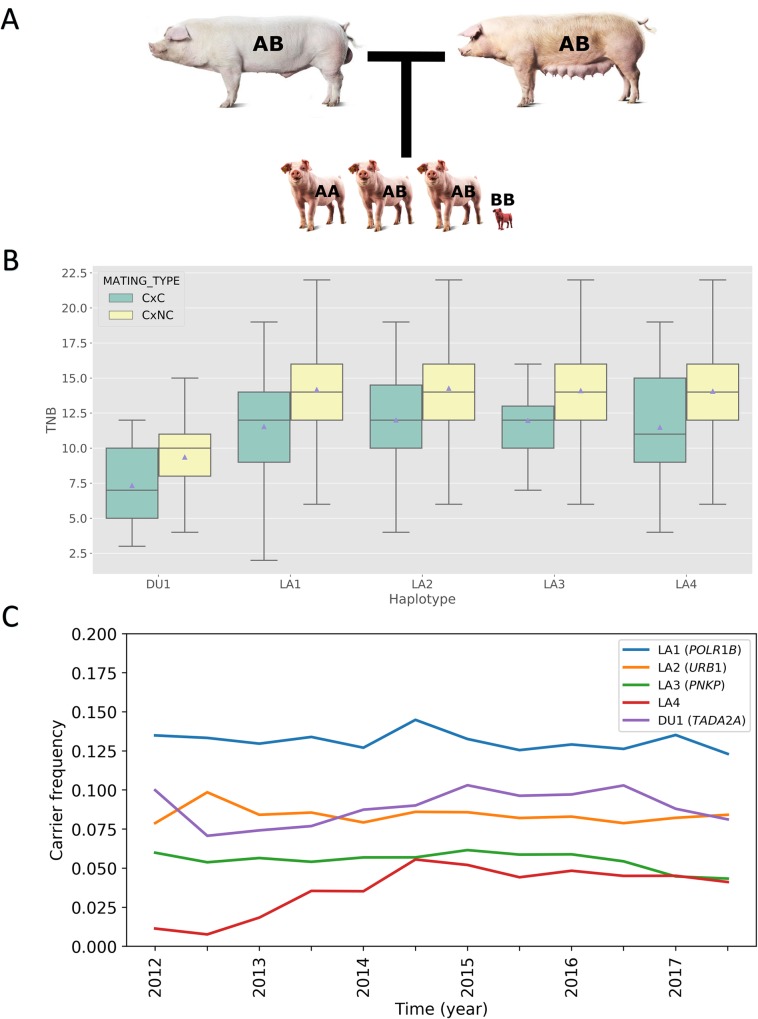
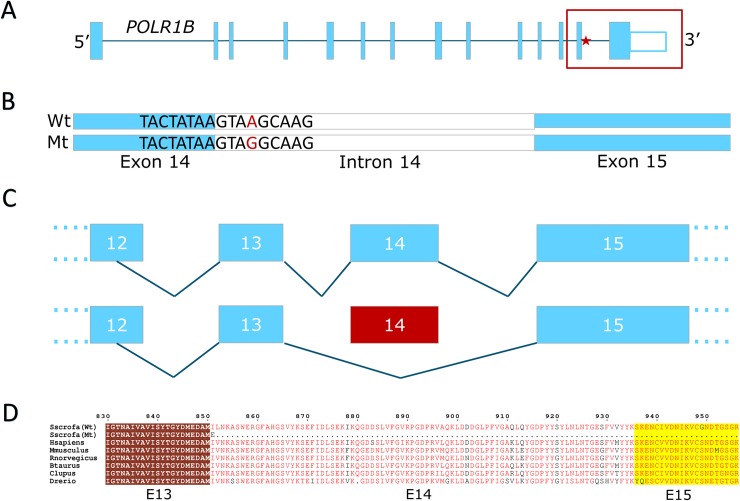
Lethal recessive alleles cause pre- or postnatal death in homozygous affected individuals, reducing fertility. Especially in small size domestic and wild populations, those alleles might be exposed by inbreeding, caused by matings between related parents that inherited the same recessive lethal allele from a common ancestor. In this study we report five relatively common (up to 13.4% carrier frequency) recessive lethal haplotypes in two commercial pig populations. The lethal haplotypes have a large effect on carrier-by-carrier matings, decreasing litter sizes by 15.1 to 21.6%. The causal mutations are of different type including two splice-site variants (affecting POLR1B and TADA2A genes), one frameshift (URB1), and one missense (PNKP) variant, resulting in a complete loss-of-function of these essential genes. The recessive lethal alleles affect up to 2.9% of the litters within a single population and are responsible for the death of 0.52% of the total population of embryos. Moreover, we provide compelling evidence that the identified embryonic lethal alleles contribute to the observed heterosis effect for fertility (i.e. larger litters in crossbred offspring). Together, this work marks specific recessive lethal variation describing its functional consequences at the molecular, phenotypic, and population level, providing a unique model to better understand fertility and heterosis in livestock.
隐性致死等位基因导致纯合受影响个体的产前或产后死亡,降低了生育能力。特别是在小型家养和野生种群中,这些等位基因可能会因近亲繁殖而暴露出来,这种近亲繁殖是由具有相同隐性致死等位基因的相关父母交配引起的,这些等位基因是从共同祖先那里遗传下来的。在这项研究中,我们报告了两个商业猪群中五个相对常见(最高携带者频率为 13.4%)的隐性致死单倍型。致死单倍型对携带者间交配有很大影响,使窝仔数减少 15.1%至 21.6%。这些因果突变具有不同的类型,包括两个剪接位点变异(影响 POLR1B 和 TADA2A 基因)、一个移码突变(URB1)和一个错义突变(PNKP),导致这些必需基因完全失去功能。隐性致死等位基因影响单个群体中多达 2.9%的窝仔数,并导致该群体中 0.52%的胚胎总死亡。此外,我们提供了令人信服的证据表明,所鉴定的胚胎致死等位基因导致了观察到的杂种优势效应,即杂交后代的窝仔数更大。总之,这项工作标志着特定的隐性致死变异,描述了其在分子、表型和群体水平上的功能后果,为更好地理解家畜的生育能力和杂种优势提供了一个独特的模型。