Department of Toxicology and Cancer Biology, University of Kentucky, Lexington, Kentucky, United States of America.
Lucille Parker Markey Cancer Center, University of Kentucky, Lexington, Kentucky, United States of America.
PLoS One. 2019 Mar 15;14(3):e0209392. doi: 10.1371/journal.pone.0209392. eCollection 2019.
Triple negative breast cancer (TNBC) is the most lethal and aggressive subtype of breast cancer. AMP-activated protein kinase (AMPK) is a major energy regulator that suppresses tumor growth, and 1-(3-chloro-4-((trifluoromethyl)thio)phenyl)-3-(4-(trifluoromethoxy)phenyl)urea (FND-4b) is a novel AMPK activator that inhibits growth and induces apoptosis in colon cancer. The purpose of this project was to test the effects of FND-4b on AMPK activation, proliferation, and apoptosis in breast cancer with a particular emphasis on TNBC.
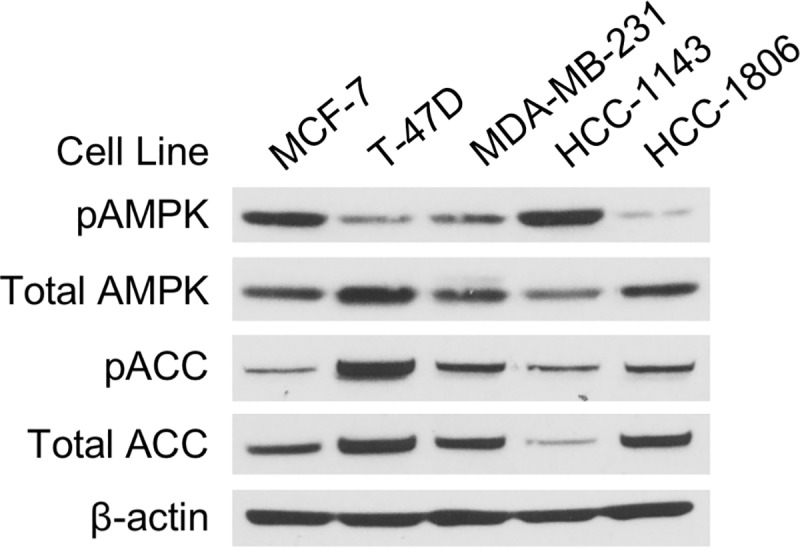
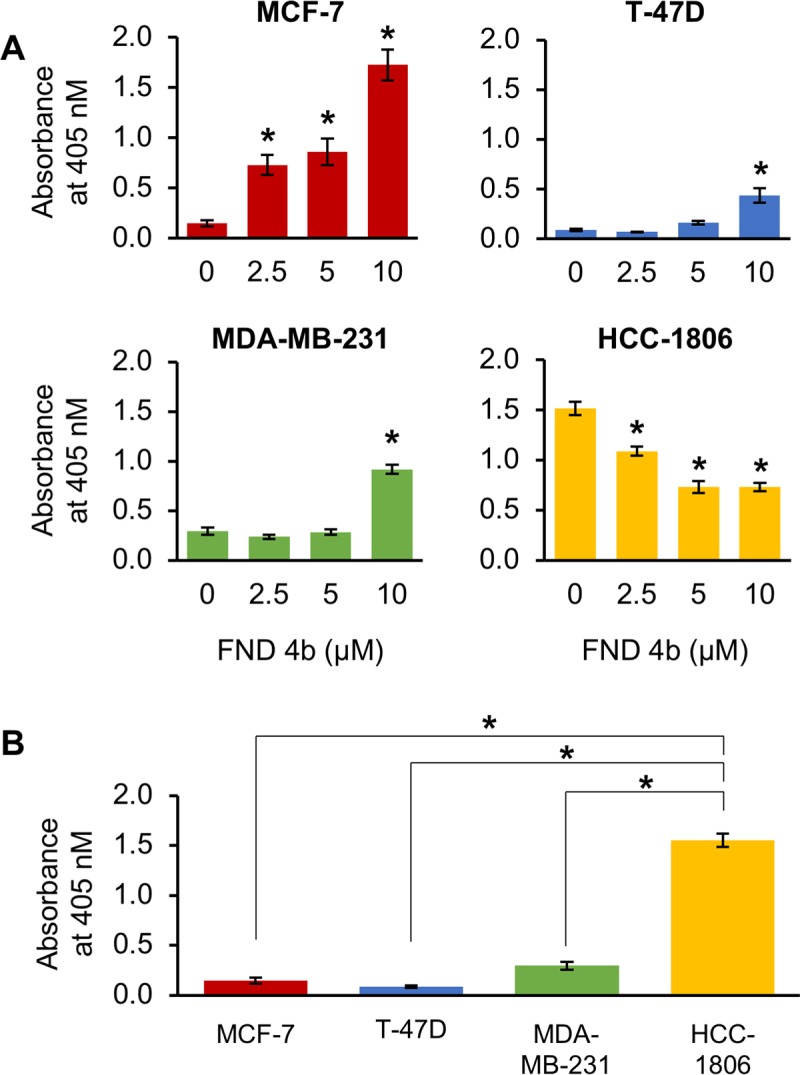
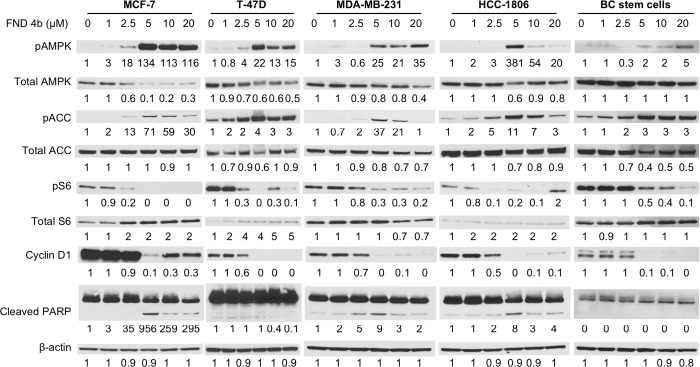
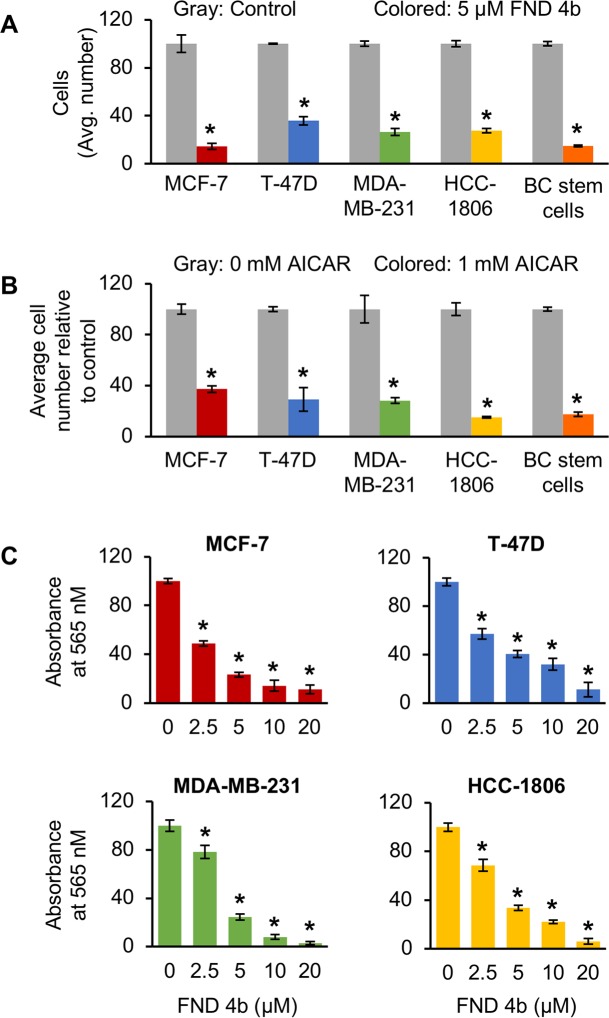
(i) Estrogen-receptor positive breast cancer (ER+BC; MCF-7, and T-47D), TNBC (MDA-MB-231 and HCC-1806), and breast cancer stem cells were treated with FND-4b for 24h. Immunoblot analysis assessed AMPK, acetyl-CoA carboxylase (ACC), ribosomal protein S6, cyclin D1, and cleaved PARP. (ii) Sulforhodamine B growth assays were performed after treating ER+BC and TNBC cells with FND-4b for 72h. Proliferation was also assessed by counting cells after 72h of FND-4b treatment. (iii) Cell death ELISA assays were performed after treating ER+BC and TNBC cells with FND-4b for 72h.
(i) FND-4b increased AMPK activation with concomitant decreases in ACC activity, phosphorylated S6, and cyclin D1 in all subtypes. (ii) FND-4b decreased proliferation in all cells, while dose-dependent growth decreases were found in ER+BC and TNBC. (iii) Increases in apoptosis were observed in ER+BC and the MDA-MB-231 cell line with FND-4b treatment.
Our findings indicate that FND-4b decreases proliferation for a variety of breast cancers by activating AMPK and has notable effects on TNBC. The growth reductions were mediated through decreases in fatty acid synthesis (ACC), mTOR signaling (S6), and cell cycle flux (cyclin D1). ER+BC cells were more susceptible to FND-4b-induced apoptosis, but MDA-MB-231 cells still underwent apoptosis with higher dose treatment. Further development of FND compounds could result in a novel therapeutic for TNBC.
三阴性乳腺癌(TNBC)是乳腺癌中最致命和侵袭性的亚型。AMP 激活的蛋白激酶(AMPK)是一种主要的能量调节剂,可抑制肿瘤生长,1-(3-氯-4-((三氟甲基)硫代)苯基)-3-(4-(三氟甲氧基)苯基)脲(FND-4b)是一种新型的 AMPK 激活剂,可抑制结肠癌的生长并诱导其凋亡。本项目的目的是测试 FND-4b 对乳腺癌中 AMPK 激活、增殖和凋亡的影响,特别是 TNBC。
(i)用 FND-4b 处理雌激素受体阳性乳腺癌(ER+BC;MCF-7 和 T-47D)、TNBC(MDA-MB-231 和 HCC-1806)和乳腺癌干细胞 24 小时。免疫印迹分析评估 AMPK、乙酰辅酶 A 羧化酶(ACC)、核糖体蛋白 S6、细胞周期蛋白 D1 和裂解的 PARP。(ii)用 FND-4b 处理 ER+BC 和 TNBC 细胞 72 小时后进行磺酰罗丹明 B 生长测定。72 小时 FND-4b 处理后通过计数细胞来评估增殖。(iii)用 FND-4b 处理 ER+BC 和 TNBC 细胞 72 小时后进行细胞死亡 ELISA 测定。
(i)FND-4b 增加了所有亚型的 AMPK 激活,同时降低了 ACC 活性、磷酸化 S6 和细胞周期蛋白 D1。(ii)FND-4b 降低了所有细胞的增殖,而在 ER+BC 和 TNBC 中发现了剂量依赖性的生长减少。(iii)用 FND-4b 处理后,在 ER+BC 和 MDA-MB-231 细胞系中观察到细胞凋亡增加。
我们的研究结果表明,FND-4b 通过激活 AMPK 降低了多种乳腺癌的增殖,并且对 TNBC 具有显著的影响。生长减少是通过降低脂肪酸合成(ACC)、mTOR 信号(S6)和细胞周期通量(细胞周期蛋白 D1)来介导的。ER+BC 细胞对 FND-4b 诱导的凋亡更敏感,但 MDA-MB-231 细胞仍在较高剂量治疗下发生凋亡。进一步开发 FND 化合物可能会为 TNBC 提供一种新的治疗方法。