Fisheries Research, NSW Department of Primary Industries, Nelson Bay, New South Wales, Australia.
New South Wales Office of Environment and Heritage, New South Wales, Sydney, Australia.
PLoS One. 2019 Mar 15;14(3):e0206778. doi: 10.1371/journal.pone.0206778. eCollection 2019.
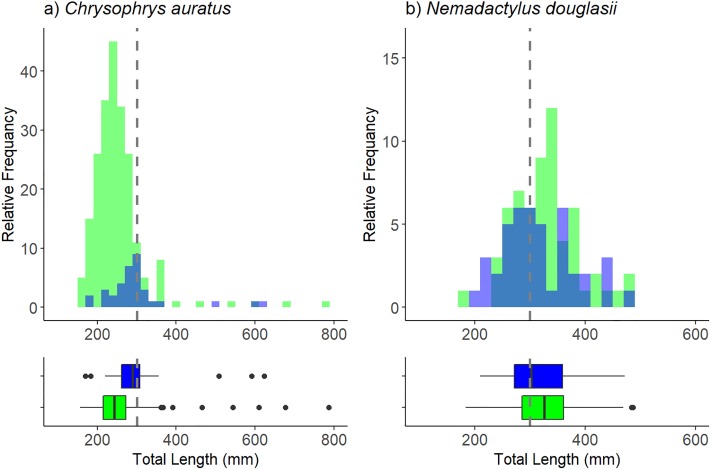
The spatial distribution of a species assemblage is often determined by habitat and climate. In the marine environment, depth can become an important factor as declining light and water temperature leads to changes in the biological habitat structure. To date, much of the focus of ecological fish research has been based on reefs in less than 40 m with little research on the ecological role of mesophotic reefs. We deployed baited remote underwater stereo video systems (stereo-BRUVS) on temperate reefs in two depth categories: shallow (20-40 m) and mesophotic (80-120 m), off Port Stephens, Australia. Sites were selected using data collected by swath acoustic sounder to ensure stereo-BRUVS were deployed on reef. The sounder also provided rugosity, slope and relief data for each stereo-BRUVS deployment. Multivariate analysis indicates that there are significant differences in the fish assemblages between shallow and mesophotic reefs, primarily driven by Ophthalmolepis lineolatus and Notolabrus gymnogenis only occurring on shallow reefs and schooling species of fish that were unique to each depth category: Atypichthys strigatus on shallow reefs and Centroberyx affinis on mesophotic reefs. While shallow reefs had a greater species richness and abundance of fish when compared to mesophotic reefs, mesophotic reefs hosted the same species richness of fishery-targeted species. Chrysophrys auratus and Nemodactylus douglassii are two highly targeted species in this region. While C. auratus was numerically more abundant on shallow reefs, mesophotic reefs provide habitat for larger fish. In comparison, N. douglassii were evenly distributed across all sites sampled. Generalized linear models revealed that depth and habitat type provided the most parsimonious model for predicting the distribution of C. auratus, while habitat type alone best predicted the distribution of N. douglassii. These results demonstrate the importance of mesophotic reefs to fishery-targeted species and therefore have implications for informing the management of these fishery resources on shelf rocky reefs.
物种组合的空间分布通常由栖息地和气候决定。在海洋环境中,深度可能成为一个重要因素,因为光和水温的下降导致生物栖息地结构发生变化。迄今为止,生态鱼类研究的大部分重点都基于水深不超过 40 米的珊瑚礁,而对中层珊瑚礁的生态作用研究甚少。我们在澳大利亚斯蒂芬斯港的两个水深类别(浅水区[20-40 米]和中层区[80-120 米])部署了带诱饵的远程水下立体视频系统(立体-BRUVS)。使用条带声学测深仪收集的数据选择站点,以确保在珊瑚礁上部署立体-BRUVS。该测深仪还为每个立体-BRUVS 部署提供了粗糙度、坡度和海拔数据。多元分析表明,浅水区和中层区的鱼类组合存在显著差异,主要由仅在浅水区出现的 Ophthalmolepis lineolatus 和 Notolabrus gymnogenis 以及每个水深类别特有的洄游鱼类驱动:Atypichthys strigatus 在浅水区,Centroberyx affinis 在中层区。虽然与中层区相比,浅水区的鱼类物种丰富度和丰度更高,但中层区拥有与渔业目标物种相同的物种丰富度。Chrysophrys auratus 和 Nemodactylus douglassii 是该地区两个高度针对性的物种。虽然 C. auratus 在浅水区的数量更多,但中层区为更大的鱼类提供了栖息地。相比之下,N. douglassii 在所有采样点的分布均匀。广义线性模型表明,深度和栖息地类型为预测 C. auratus 分布提供了最简约的模型,而栖息地类型则单独最佳预测了 N. douglassii 的分布。这些结果表明中层珊瑚礁对渔业目标物种的重要性,因此对告知这些沿海岩礁渔业资源的管理具有启示意义。