Institute for Marine and Antarctic Studies, University of Tasmania, Hobart, Tasmania, Australia.
Fisheries Research, Port Stephens Fisheries Institute, NSW Department of Primary Industries, Taylors Beach, NSW, Australia.
PLoS One. 2022 Mar 24;17(3):e0265067. doi: 10.1371/journal.pone.0265067. eCollection 2022.
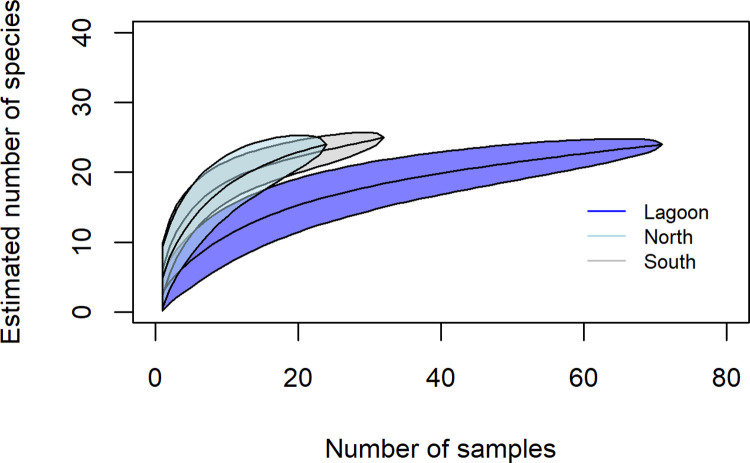
Predatory fishes on coral reefs continue to decline globally despite playing key roles in ecosystem functioning. Remote atolls and platform reefs provide potential refugia for predator populations, but quantitative information on their spatial distribution is required to establish accurate baselines for ongoing monitoring and conservation management. Current knowledge of predatory fish populations has been derived from targeted shallow diver-based surveys (<15 m). However, the spatial distribution and extent of predatory fishes on outer mesophotic shelf environments has remained under described. Middleton Reef is a remote, high-latitude, oceanic platform reef that is located within a no-take area in the Lord Howe Marine Park off eastern Australia. Here we used baited remote underwater stereo video to sample predatory fishes across lagoon and outer shelf habitats from depths 0-100 m, extending knowledge on use of mesophotic depths and habitats. Many predatory fish demonstrated clear depth and habitat associations over this depth range. Carcharhinid sharks and Carangid fishes were the most abundant predators sampled on Middleton Reef, with five predatory fishes accounting for over 90% of the predator fish biomass. Notably, Galapagos shark (Carcharhinus galapagensis) and the protected black rockcod (Epinephelus daemelii) dominated the predator fish assemblage. A higher richness of predator fish species was sampled on reef areas north and south of the lagoon. The more exposed southern aspect of the reef supported a different suite of predator fish across mesophotic habitats relative to the assemblage recorded in the north and lagoonal habitats, a pattern potentially driven by differences in hard coral cover. Biomass of predatory fishes in the more sheltered north habitats was twice that of other areas, predominantly driven by high abundances of Galapagos shark. This work adds to the growing body of literature highlighting the conservation value of isolated oceanic reefs and the need to ensure that lagoon, shallow and mesophotic habitats in these systems are adequately protected, as they support vulnerable ecologically and economically important predator fish assemblages.
尽管掠食性鱼类在生态系统功能中起着关键作用,但它们在全球范围内仍持续减少。偏远的环礁和台礁为掠食性鱼类种群提供了潜在的避难所,但需要有关其空间分布的定量信息,才能为正在进行的监测和保护管理建立准确的基线。目前对掠食性鱼类种群的了解来自于有针对性的浅水潜水员调查(<15 米)。然而,外中光架环境中掠食性鱼类的空间分布和范围仍未得到充分描述。米德尔顿礁是一个偏远的高纬度海洋台礁,位于澳大利亚东部豪勋爵海洋公园内的一个禁捕区。在这里,我们使用诱饵远程水下立体视频在 0-100 米深的泻湖和外架生境中对掠食性鱼类进行了采样,扩展了对中光深度和生境利用的了解。在这个深度范围内,许多掠食性鱼类表现出明显的深度和生境相关性。长尾鲨和鲷科鱼类是在米德尔顿礁上采样到的最丰富的掠食者,其中五种掠食性鱼类占掠食性鱼类生物量的 90%以上。值得注意的是,加拉帕戈斯鲨鱼(Carcharhinus galapagensis)和受保护的黑岩鳕鱼(Epinephelus daemelii)在掠食性鱼类中占主导地位。在泻湖北部和南部的珊瑚礁区域采样到了更多种类的掠食性鱼类。与北部和泻湖生境中记录的鱼类组合相比,珊瑚礁更暴露的南部区域在中光生境中支持着不同的掠食性鱼类组合,这种模式可能是由硬珊瑚覆盖率的差异驱动的。在受保护的北部生境中,掠食性鱼类的生物量是其他区域的两倍,这主要是由于加拉帕戈斯鲨鱼的高丰度所致。这项工作增加了越来越多的文献,强调了孤立海洋珊瑚礁的保护价值,并需要确保这些系统中的泻湖、浅水区和中光区得到充分保护,因为它们支持脆弱的生态和经济上重要的掠食性鱼类组合。