CIC biomaGUNE, Parque Tecnológico de San Sebastián, Paseo Miramón 182, 20014, Donostia-San Sebastián, Spain.
IMDEA Nanociencia, Campus Universitario de Cantoblanco, 28049, Madrid, Spain.
Angew Chem Int Ed Engl. 2019 May 6;58(19):6214-6219. doi: 10.1002/anie.201813576. Epub 2019 Apr 1.
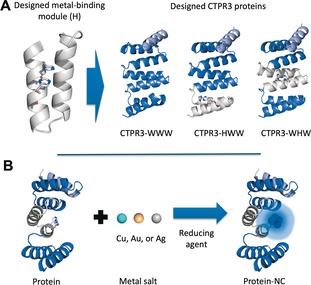
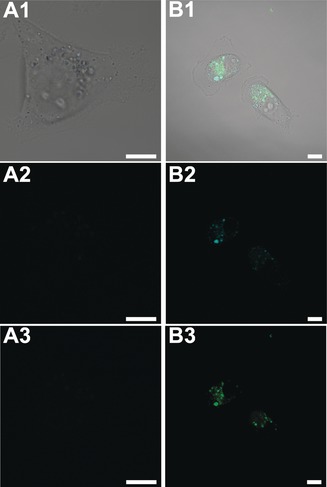
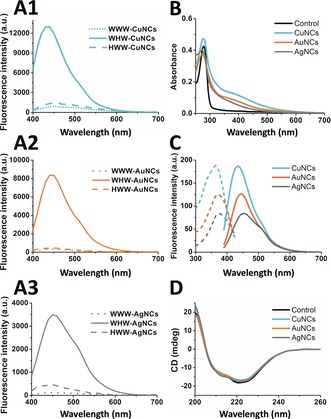
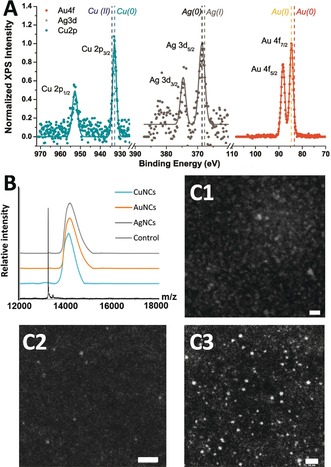
Metal nanoclusters (NCs) are considered ideal nanomaterials for biological applications owing to their strong photoluminescence (PL), excellent photostability, and good biocompatibility. This study presents a simple and versatile strategy to design proteins, via incorporation of a di-histidine cluster coordination site, for the sustainable synthesis and stabilization of metal NCs with different metal composition. The resulting protein-stabilized metal NCs (Prot-NCs) of gold, silver, and copper are highly photoluminescent and photostable, have a long shelf life, and are stable under physiological conditions. The biocompatibility of the clusters was demonstrated in cell cultures in which Prot-NCs showed efficient cell internalization without affecting cell viability or losing luminescence. Moreover, the approach is translatable to other proteins to obtain Prot-NCs for various biomedical applications such as cell imaging or labeling.
金属纳米团簇(NCs)因其强荧光(PL)、优异的光稳定性和良好的生物相容性而被认为是生物应用的理想纳米材料。本研究提出了一种简单而通用的策略,通过引入双组氨酸簇配位位点来设计蛋白质,以可持续合成和稳定具有不同金属成分的金属 NCs。所得的金、银和铜的蛋白稳定金属 NCs(Prot-NCs)具有高度的荧光和光稳定性,保质期长,在生理条件下稳定。在细胞培养中,证明了这些团簇的生物相容性,Prot-NCs 可以有效地进入细胞,而不影响细胞活力或丧失荧光。此外,该方法可转化为其他蛋白质,以获得用于各种生物医学应用的 Prot-NCs,如细胞成像或标记。