Center of Integrated Protein Science Munich (CIPS-M) and Division of Clinical Pharmacology, Department of Medicine IV, University Hospital, Ludwig-Maximilians-Universität München, Member of the German Center for Lung Research (DZL), 80337 Munich, Germany.
Int J Mol Sci. 2019 Mar 14;20(6):1283. doi: 10.3390/ijms20061283.
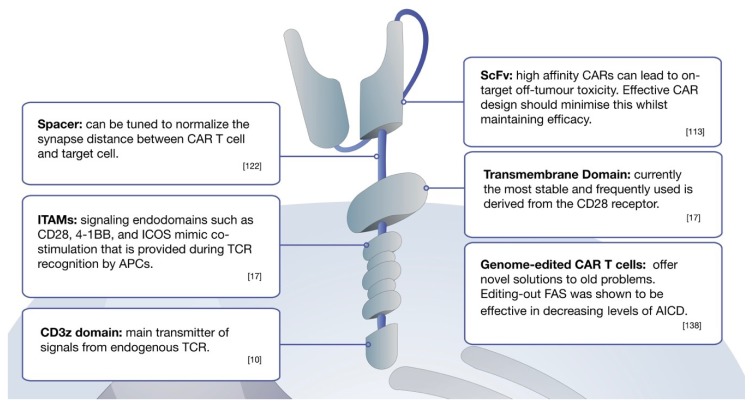
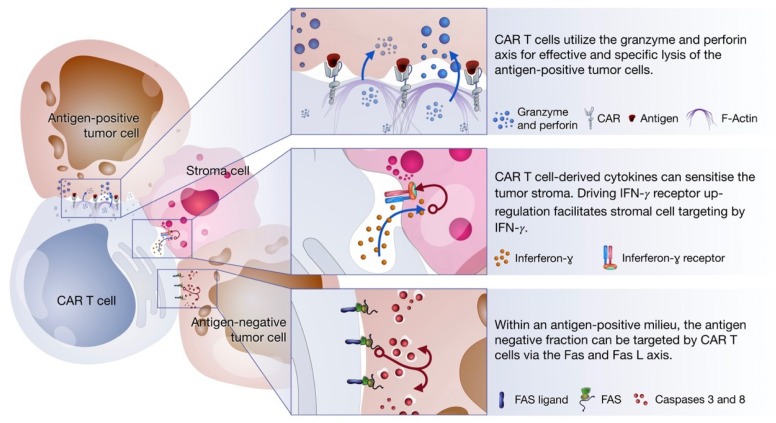
Effective adoptive T cell therapy (ACT) comprises the killing of cancer cells through the therapeutic use of transferred T cells. One of the main ACT approaches is chimeric antigen receptor (CAR) T cell therapy. CAR T cells mediate MHC-unrestricted tumor cell killing by enabling T cells to bind target cell surface antigens through a single-chain variable fragment (scFv) recognition domain. Upon engagement, CAR T cells form a non-classical immune synapse (IS), required for their effector function. These cells then mediate their anti-tumoral effects through the perforin and granzyme axis, the Fas and Fas ligand axis, as well as the release of cytokines to sensitize the tumor stroma. Their persistence in the host and functional outputs are tightly dependent on the receptor's individual components-scFv, spacer domain, and costimulatory domains-and how said component functions converge to augment CAR T cell performance. In this review, we bring forth the successes and limitations of CAR T cell therapy. We delve further into the current understanding of how CAR T cells are designed to function, survive, and ultimately mediate their anti-tumoral effects.
有效的过继性 T 细胞疗法(ACT)包括通过转移 T 细胞的治疗性应用来杀伤癌细胞。ACT 的主要方法之一是嵌合抗原受体(CAR)T 细胞疗法。CAR T 细胞通过单链可变片段(scFv)识别域使 T 细胞能够结合靶细胞表面抗原,从而实现 MHC 非限制性肿瘤细胞杀伤。结合后,CAR T 细胞形成非经典免疫突触(IS),这是其效应功能所必需的。然后,这些细胞通过穿孔素和颗粒酶轴、Fas 和 Fas 配体轴以及释放细胞因子来敏化肿瘤基质来发挥其抗肿瘤作用。它们在宿主中的持久性和功能输出与受体的各个组成部分——scFv、间隔区和共刺激结构域——以及这些成分的功能如何汇聚以增强 CAR T 细胞的性能密切相关。在这篇综述中,我们提出了 CAR T 细胞疗法的成功和局限性。我们进一步深入探讨了目前对 CAR T 细胞如何被设计来发挥作用、存活以及最终介导其抗肿瘤作用的理解。