Le Tri, Gerber David E
Department of Internal Medicine, University of Texas Southwestern Medical Center, Dallas, TX 75390-8852, USA.
Department of Clinical Sciences, University of Texas Southwestern Medical Center, Dallas, TX 75390-8852, USA.
Cancers (Basel). 2019 Mar 15;11(3):366. doi: 10.3390/cancers11030366.
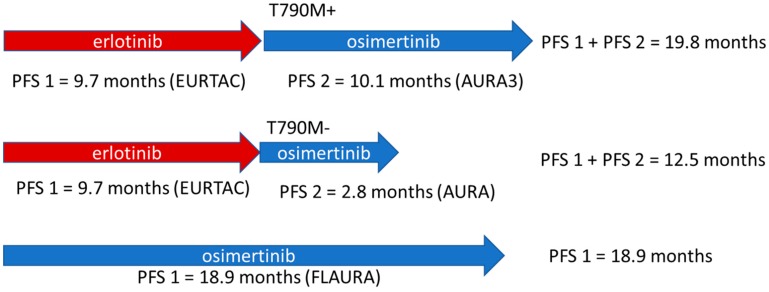
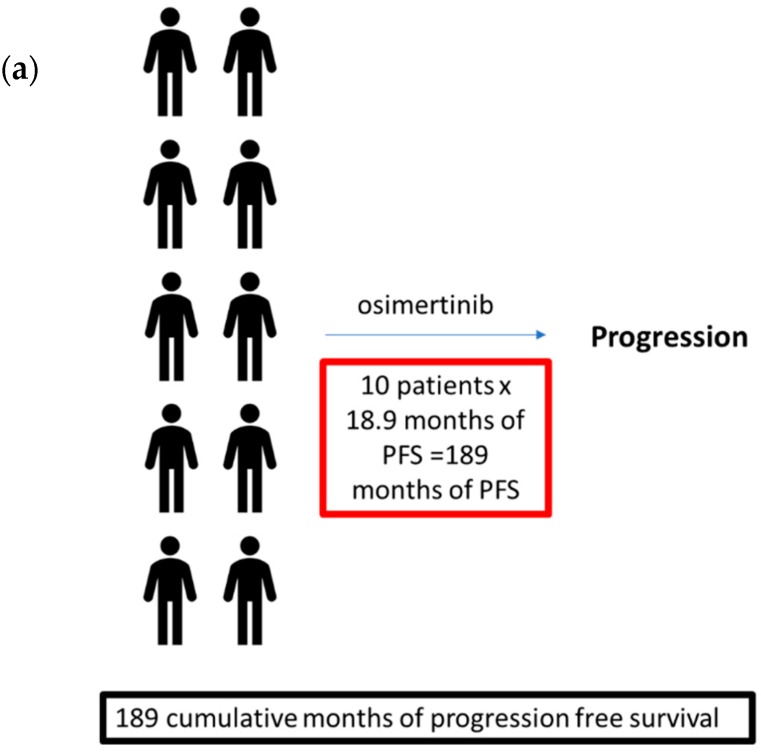
The FLAURA trial established osimertinib, a third-generation epidermal growth factor receptor (EGFR) tyrosine kinase inhibitor (TKI), as a viable first-line therapy in non-small cell lung cancer (NSCLC) with sensitizing mutations, namely exon 19 deletion and L858R. In this phase 3 randomized, controlled, double-blind trial of treatment-naïve patients with mutant NSCLC, osimertinib was compared to standard-of-care EGFR TKIs (i.e., erlotinib or gefinitib) in the first-line setting. Osimertinib demonstrated improvement in median progression-free survival (18.9 months vs. 10.2 months; hazard ratio 0.46; 95% CI, 0.37 to 0.57; < 0.001) and a more favorable toxicity profile due to its lower affinity for wild-type EGFR. Furthermore, similar to later-generation anaplastic lymphoma kinase (ALK) inhibitors, osimertinib has improved efficacy against brain metastases. Despite this impressive effect, the optimal sequencing of osimertinib, whether in the first line or as subsequent therapy after the failure of earlier-generation EGFR TKIs, is not clear. Because up-front use of later-generation TKIs may result in the inability to use earlier-generation TKIs, this treatment paradigm must be evaluated carefully. For mutant NSCLC, considerations include the incidence of T790M resistance mutations, quality of life, whether there is a potential role for earlier-generation TKIs after osimertinib failure, and overall survival. This review explores these issues for EGFR inhibitors and other molecularly targeted therapies.
FLAURA试验证实,第三代表皮生长因子受体(EGFR)酪氨酸激酶抑制剂(TKI)奥希替尼可作为伴有敏感突变(即19外显子缺失和L858R)的非小细胞肺癌(NSCLC)的一线可行治疗方案。在这项针对初治的EGFR突变NSCLC患者的3期随机、对照、双盲试验中,将奥希替尼与一线治疗的标准EGFR-TKI(即厄洛替尼或吉非替尼)进行了比较。奥希替尼显示出中位无进展生存期有所改善(18.9个月对10.2个月;风险比0.46;95%CI,0.37至0.57;P<0.001),并且由于其对野生型EGFR的亲和力较低,毒性特征更有利。此外,与新一代间变性淋巴瘤激酶(ALK)抑制剂类似,奥希替尼对脑转移的疗效有所提高。尽管有这种令人印象深刻的效果,但奥希替尼的最佳用药顺序,无论是一线用药还是在早期EGFR-TKI治疗失败后作为后续治疗,仍不清楚。由于提前使用新一代TKI可能导致无法使用早期TKI,因此必须仔细评估这种治疗模式。对于EGFR突变的NSCLC,需要考虑的因素包括T790M耐药突变的发生率、生活质量、奥希替尼治疗失败后早期TKI是否有潜在作用以及总生存期。本综述探讨了EGFR抑制剂和其他分子靶向治疗的这些问题。