Division of Allergy/Immunology & Rheumatology, University of Rochester Medical Center, Rochester, New York.
Transl Res. 2019 Jul;209:77-89. doi: 10.1016/j.trsl.2019.02.010. Epub 2019 Feb 23.
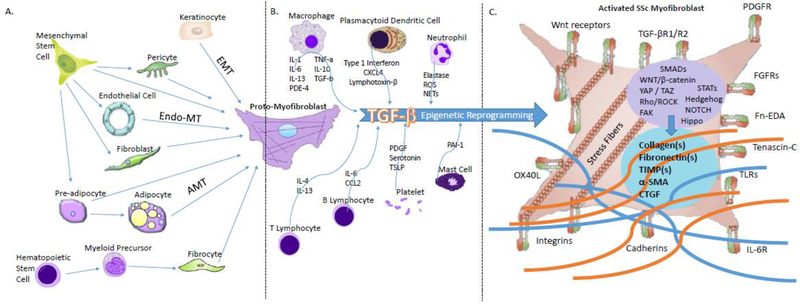
Systemic sclerosis (SSc, scleroderma) is a complex multisystem disease characterized by autoimmunity, vasculopathy, and most notably, fibrosis. Multiple lines of evidence demonstrate a variety of emerging cellular and molecular pathways which are relevant to fibrosis in SSc. The myofibroblast remains the key effector cell in SSc. Understanding the development, differentiation, and function of the myofibroblast is therefore crucial to understanding the fibrotic phenotype of SSc. Studies now show that (1) multiple cell types give rise to myofibroblasts, (2) fibroblasts and myofibroblasts are heterogeneous, and (3) that a large number of (primarily immune) cells have important influences on the transition of fibroblasts to an activated myofibroblasts. In SSc, this differentiation process involves multiple pathways, including well known signaling cascades such as TGF-β and Wnt/β-Catenin signaling, as well as epigenetic reprogramming and a number of more recently defined cellular pathways. After reviewing the major and emerging cellular and molecular mechanisms underlying SSc, this article looks to identify clinical applications where this new molecular knowledge may allow for targeted treatment and personalized medicine approaches.
系统性硬化症(SSc,硬皮病)是一种复杂的多系统疾病,其特征为自身免疫、血管病变,以及最显著的纤维化。多种证据表明,多种新兴的细胞和分子途径与 SSc 中的纤维化有关。肌成纤维细胞仍然是 SSc 中的关键效应细胞。因此,了解肌成纤维细胞的发育、分化和功能对于理解 SSc 的纤维化表型至关重要。目前的研究表明:(1)多种细胞类型可产生肌成纤维细胞;(2)成纤维细胞和肌成纤维细胞具有异质性;(3)大量(主要是免疫)细胞对成纤维细胞向激活的肌成纤维细胞的转化有重要影响。在 SSc 中,这个分化过程涉及多个途径,包括众所周知的信号级联,如 TGF-β和 Wnt/β-Catenin 信号通路,以及表观遗传重编程和一些最近定义的细胞途径。在回顾了 SSc 中主要和新兴的细胞和分子机制之后,本文旨在确定这些新的分子知识可能在哪些临床应用中允许进行靶向治疗和个性化医学方法。