From the School of Physiology, Pharmacology & Neuroscience, University of Bristol, Bristol BS8 1TD, United Kingdom.
From the School of Physiology, Pharmacology & Neuroscience, University of Bristol, Bristol BS8 1TD, United Kingdom.
Cell Signal. 2019 Jul;59:34-40. doi: 10.1016/j.cellsig.2019.03.015. Epub 2019 Mar 14.
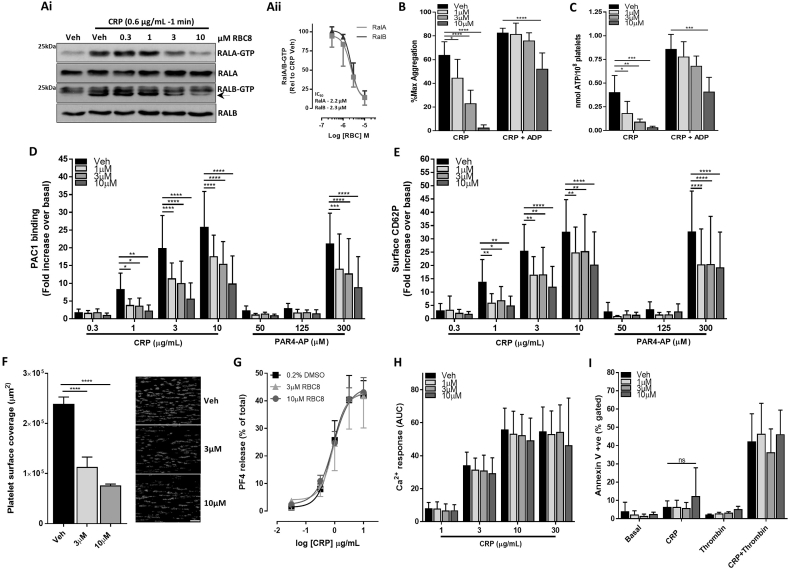
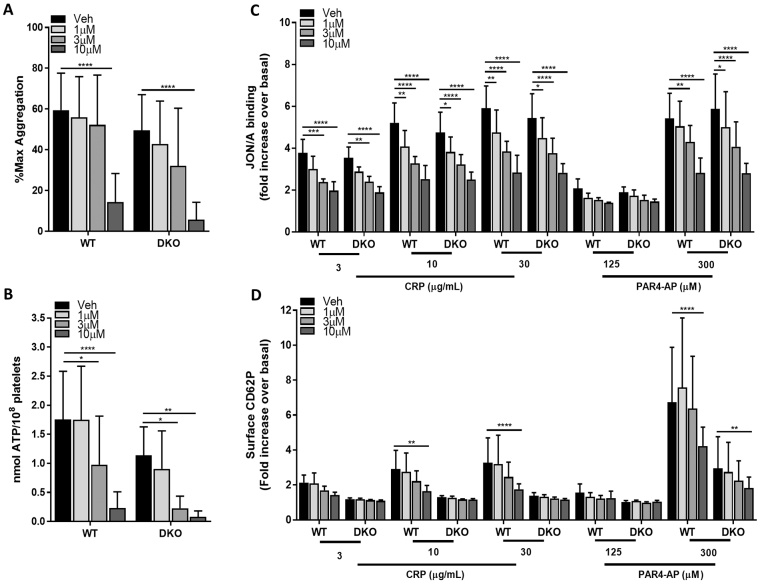
The Ral GTPases, RalA and RalB, have been implicated in numerous cellular processes, but are most widely known for having regulatory roles in exocytosis. Recently, we demonstrated that deletion of both Ral genes in a platelet-specific mouse gene knockout caused a substantial defect in surface exposure of P-selectin, with only a relatively weak defect in platelet dense granule secretion that did not alter platelet functional responses such as aggregation or thrombus formation. We sought to investigate the function of Rals in human platelets using the recently described Ral inhibitor, RBC8. Initial studies in human platelets confirmed that RBC8 could effectively inhibit Ral GTPase activation, with an IC of 2.2 μM and 2.3 μM for RalA and RalB, respectively. Functional studies using RBC8 revealed significant, dose-dependent inhibition of platelet aggregation, secretion (α- and dense granule), integrin activation and thrombus formation, while α-granule release of platelet factor 4, Ca signalling or phosphatidylserine exposure were unaltered. Subsequent studies in RalAB-null mouse platelets pretreated with RBC8 showed dose-dependent decreases in integrin activation and dense granule secretion, with significant inhibition of platelet aggregation and P-selectin exposure at 10 μM RBC8. This study strongly suggests therefore that although RBC8 is useful as a Ral inhibitor in platelets, it is likely also to have off-target effects in the same concentration range as for Ral inhibition. So, whilst clearly useful as a Ral inhibitor, interpretation of data needs to take this into account when assessing roles for Rals using RBC8.
Ral GTPases(RalA 和 RalB)参与了许多细胞过程,但最广为人知的是它们在胞吐作用中的调节作用。最近,我们证明在血小板特异性基因敲除小鼠中敲除两个 Ral 基因会导致 P-选择素表面暴露出现实质性缺陷,而致密颗粒分泌的缺陷相对较弱,不会改变血小板的功能反应,如聚集或血栓形成。我们试图使用最近描述的 Ral 抑制剂 RBC8 研究 Ral 在人血小板中的功能。在人血小板中的初步研究证实,RBC8 可以有效地抑制 Ral GTPase 激活,对 RalA 和 RalB 的 IC 分别为 2.2μM 和 2.3μM。使用 RBC8 进行的功能研究显示,血小板聚集、分泌(α-和致密颗粒)、整合素激活和血栓形成均呈显著的、剂量依赖性抑制,而血小板因子 4 的α-颗粒释放、Ca 信号或磷脂酰丝氨酸暴露则未改变。随后在 RBC8 预处理的 RalAB 基因敲除小鼠血小板中的研究显示,整合素激活和致密颗粒分泌呈剂量依赖性下降,在 10μM RBC8 时血小板聚集和 P-选择素暴露明显受到抑制。因此,这项研究强烈表明,虽然 RBC8 作为血小板中的 Ral 抑制剂是有用的,但在相同浓度范围内,它也可能具有非靶点效应。因此,虽然 RBC8 作为 Ral 抑制剂显然是有用的,但在使用 RBC8 评估 Ral 作用时,需要考虑到这一点来解释数据。