Department of Surgical Critical Care Medicine, Fujian Provincial Hospital, Fujian Provincial Clinical Teaching Hospital Affiliated to the Fujian Medical University, Fuzhou, Fujian, China.
Microbiology Department of Fujian Provincial Hospital, Fujian Provincial Clinical Teaching Hospital Affiliated to the Fujian Medical University, Fuzhou, Fujian, China.
Biomed Res Int. 2019 Feb 6;2019:3080827. doi: 10.1155/2019/3080827. eCollection 2019.
Urosepsis and septic shock are a critical situation leading to a mortality rate up to 30% in patients with obstructive diseases of the urinary tract.
To analyze the bacterial distribution and drug resistance of pathogenic bacteria in patients with urosepsis and to provide a basis for the rational application of antibacterial drugs in clinical practice.
A retrospective analysis of 94 hospitalized patients with urosepsis for 6 years was performed. The strain composition, resistance characteristics, and the antibiogram of common bacteria from positive blood and midstream urine culture were analyzed.
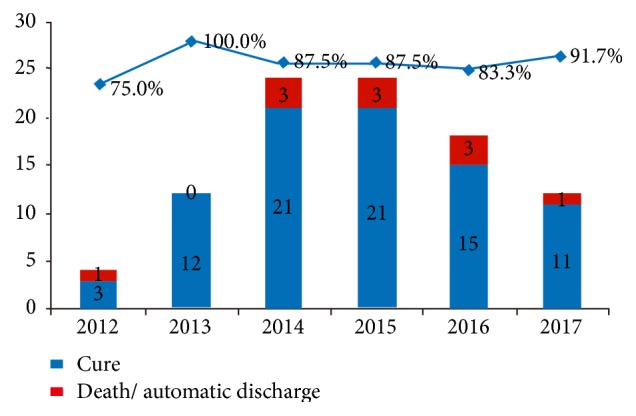
A total of 87 strains were isolated, including 65 strains (74.71%) of Gram-negative bacilli, 14 strains (16.09%) of Gram-positive cocci, and 8 strains (9.20%) of fungi. The Gram-negative bacilli included 42 strains of () (64.62%), among which 34 strains (80.95%) were producing ESBLs, and 14 strains (21.84%) of (), among which nine strains (64.29%) were producing ESBLs. The most common pathogenic bacteria, ESBL+ and strains, showed sensitivity towards imipenem, ertapenem, piperacillin/tazobactam, amikacin, and cefotetan, but were highly resistant to quinolones. The cure rate of urosepsis was 88.30%, and the susceptibility rate of septic shock was 45.47%.
Gram-negative bacterial infections are the main cause of urosepsis. The mild patient group showed more (ESBL-) infections, and the number of ESBL producing isolated from the mild group showed higher drug resistance rates for aztreonam and levofloxacin compared with isolates from the severe group.
尿脓毒症和脓毒性休克是导致尿路梗阻性疾病患者死亡率高达 30%的危急情况。
分析尿脓毒症患者的病原菌分布及耐药情况,为临床合理应用抗菌药物提供依据。
回顾性分析 6 年来 94 例住院尿脓毒症患者,分析血及中段尿培养阳性的常见细菌菌株构成、耐药特点及药敏谱。
共分离出 87 株病原菌,其中革兰阴性杆菌 65 株(74.71%),革兰阳性球菌 14 株(16.09%),真菌 8 株(9.20%)。革兰阴性杆菌中 (42 株,64.62%),产 ESBLs 菌株 34 株(80.95%), (14 株,21.84%),产 ESBLs 菌株 9 株(64.29%)。最常见的病原菌 ESBL+ 和 菌株对亚胺培南、厄他培南、哌拉西林/他唑巴坦、阿米卡星、头孢替坦较为敏感,但对喹诺酮类药物高度耐药。尿脓毒症患者的治愈率为 88.30%,脓毒性休克患者的药敏率为 45.47%。
革兰阴性细菌感染是尿脓毒症的主要原因。轻症患者组以 (ESBL-)感染为主,且轻症组分离的产 ESBL 菌株对氨曲南、左氧氟沙星的耐药率较重症组更高。