Proestakis Antonios, di Sorrentino Eugenia Polizzi, Brown Helen Elizabeth, van Sluijs Esther, Mani Ankur, Caldeira Sandra, Herrmann Benedikt
Joint Research Centre, European Commission, Ispra, Italy.
Institute of Cognitive Sciences and Technologies, National Research Council, Rome, Italy.
Nat Hum Behav. 2018 Oct;2(10):778-787. doi: 10.1038/s41562-018-0436-y. Epub 2018 Sep 24.
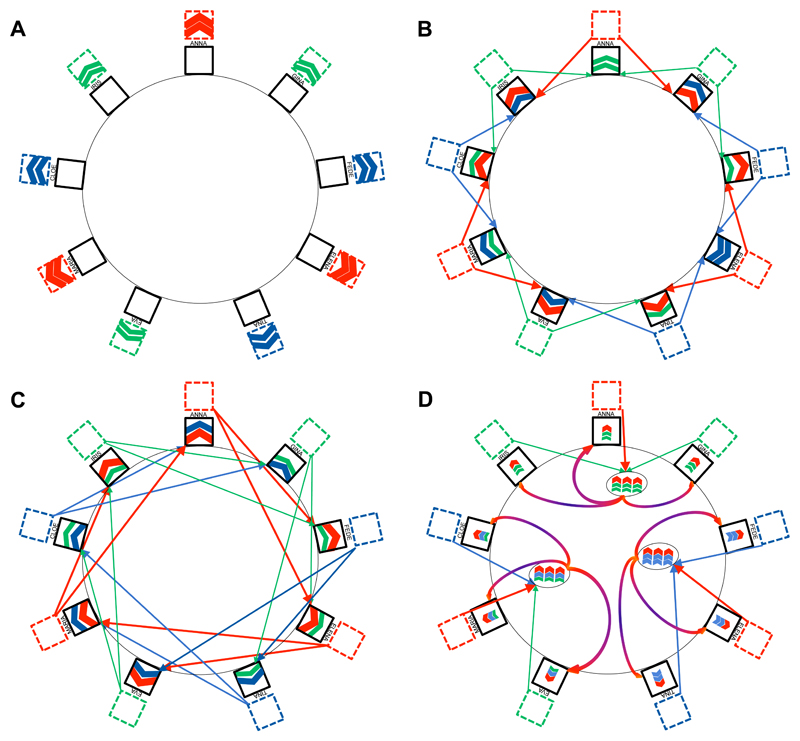
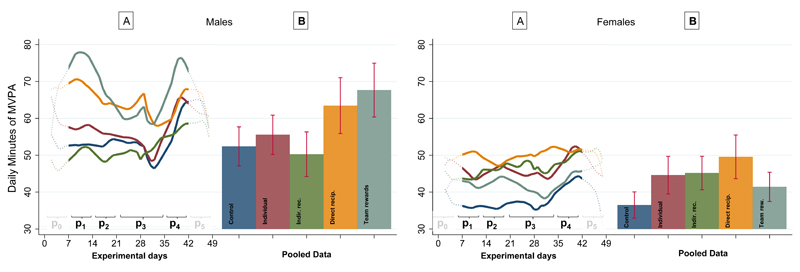
Network interventions can help achieve behavioural change by inducing peer-pressure in the network. However, inducing peer-pressure without considering the structure of the existing social network may render the intervention ineffective or weaker. In a 7-week school-based field experiment using preadolescents' physical activity (PA) as a proxy for estimating behavioural change, we test the hypothesis that boys' and girls' distinct networks are susceptible to different social incentives. We run three different social-rewards schemes, in which classmates' rewards depend on the PA of two friends either reciprocally (directly or indirectly) or collectively. Compared to a random-rewards control, social-rewards schemes had an overall significantly positive effect on PA (51.8% increase), with females being more receptive to the direct reciprocity scheme (76.4%) and males to team (collective) rewards (131.5%). Differences in the sex-specific sub-networks can explain these findings. Network interventions adapted to the network-specific characteristics may constitute a powerful tool for behavioural change.
网络干预可以通过在网络中施加同伴压力来帮助实现行为改变。然而,在不考虑现有社交网络结构的情况下施加同伴压力可能会使干预无效或效果减弱。在一项为期7周的以学校为基础的实地实验中,我们以青少年的身体活动(PA)作为估计行为变化的指标,检验了男孩和女孩不同的社交网络对不同社会激励敏感的假设。我们实施了三种不同的社会奖励计划,在这些计划中,同学的奖励取决于两个朋友的身体活动情况,这两个朋友的身体活动情况可以是相互(直接或间接)关联的,也可以是共同关联的。与随机奖励对照组相比,社会奖励计划对身体活动产生了总体上显著的积极影响(增加了51.8%),其中女性对直接互惠计划的接受程度更高(76.4%),而男性对团队(集体)奖励的接受程度更高(131.5%)。特定性别的子网差异可以解释这些结果。适应网络特定特征的网络干预可能构成行为改变的有力工具。