Department of Pediatrics, Pudong New District People's Hospital, Shanghai University of Medicine & Health Sciences, No.490 South Huanchuan Road, Pudong New District, Shanghai, 201200, China.
BMC Pulm Med. 2019 Mar 19;19(1):66. doi: 10.1186/s12890-019-0819-5.
Corticosteroids are widely used to control asthma symptoms, but steroid resistance (SR) is a common adverse reaction. Therefore, it is important to accurately predict the corticosteroid response of asthmatic patients. This study aims to evaluate the serum OX40 ligand (OX40L) in pediatric asthmatic patients, and to investigated its correlations with clinical characteristics and corticosteroid response.
A total of 192 pediatric asthmatic patients with inhaled corticosteroid (ICS) therapy and 130 healthy controls were selected. Clinical data were collected, and the serum levels of immunoglobulin (IgE), interleukin-6 (IL-6), thymic stromal lymphopoietin (TSLP), and OX40L were measured by enzyme-linked immunosorbent assay (ELISA). The level of serum OX40L was compared between the steroid-sensitive asthma (SSA) and steroid-resistant asthma (SRA) groups.
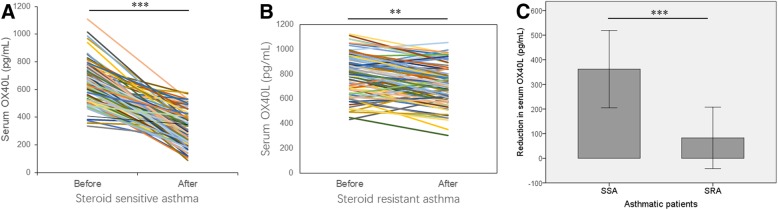
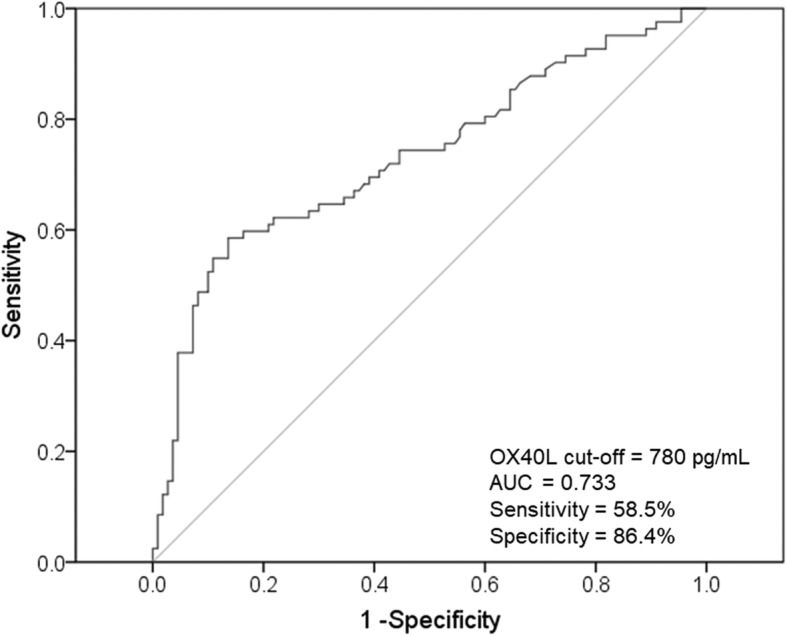
The serum OX40L level in asthmatic patients (713.5 ± 165.7 pg/mL) was significantly higher than that of the healthy controls (238.6 ± 27.8 pg/mL) (P < 0.001), and significantly higher in SRA group (791.2 ± 167.9 pg/mL) than in SSA group (655.6 ± 138.8 pg/mL) (P < 0.001). The serum OX40L level showed a significant positive correlation with serum IgE, blood percentages of eosinophils and neutrophils, serum IL-6 and TSLP, and showed a negative correlation with asthma control test (ACT) score and forced expiratory volume in first second (FEV1%). Receiver operating characteristics (ROC) curve was performed to obtain a cutoff value of serum OX40L as 780 pg/mL (sensitivity = 58.5%; specificity = 86.4%), which can identify SRA in asthmatic patients. Multivariate logistic regression analysis showed that elevated serum OX40L (≥780 pg/mL), as well as lymphocytes (%), ACT score, serum IL-6 and TSLP, were independent predictors of SRA (OX40L ≥ 780 pg/mL: odds ratio = 4.188; 95% CI = 1.800-9.746; P = 0.001). The serum OX40L level was decreased after ICS treatment in asthmatic patients, and the reduction in serum OX40L was significant higher in SSA group compared with SRA group.
High serum OX40L can be used as a biomarker to identify asthmatic patients with corticosteroid resistance, and the change in OX40L level also reflects the response to ICS treatment. These results suggest an association of OX40L with the pathophysiology, inflammation, and clinical outcomes of asthma. New agents targeting OX40L can provide more precise and personalized therapy for asthma.
皮质类固醇广泛用于控制哮喘症状,但类固醇抵抗(SR)是一种常见的不良反应。因此,准确预测哮喘患者的皮质类固醇反应非常重要。本研究旨在评估小儿哮喘患者的血清 OX40 配体(OX40L),并探讨其与临床特征和皮质类固醇反应的相关性。
选择了 192 例接受吸入皮质类固醇(ICS)治疗的小儿哮喘患者和 130 例健康对照者。收集临床资料,采用酶联免疫吸附试验(ELISA)检测血清免疫球蛋白(IgE)、白细胞介素-6(IL-6)、胸腺基质淋巴细胞生成素(TSLP)和 OX40L 水平。比较类固醇敏感哮喘(SSA)和类固醇抵抗哮喘(SRA)组之间血清 OX40L 水平的差异。
哮喘患者的血清 OX40L 水平(713.5±165.7pg/mL)明显高于健康对照组(238.6±27.8pg/mL)(P<0.001),且 SRA 组(791.2±167.9pg/mL)明显高于 SSA 组(655.6±138.8pg/mL)(P<0.001)。血清 OX40L 水平与血清 IgE、血嗜酸性粒细胞和中性粒细胞百分比、血清 IL-6 和 TSLP 呈显著正相关,与哮喘控制测试(ACT)评分和用力呼气量第一秒(FEV1%)呈显著负相关。进行受试者工作特征(ROC)曲线分析,得到血清 OX40L 的截断值为 780pg/mL(灵敏度=58.5%;特异性=86.4%),可识别哮喘患者中的 SRA。多变量逻辑回归分析显示,血清 OX40L 升高(≥780pg/mL)、淋巴细胞(%)、ACT 评分、血清 IL-6 和 TSLP 是 SRA 的独立预测因素(OX40L≥780pg/mL:比值比=4.188;95%置信区间=1.800-9.746;P=0.001)。哮喘患者经 ICS 治疗后血清 OX40L 水平下降,SSA 组与 SRA 组相比,血清 OX40L 下降更为显著。
高血清 OX40L 可作为识别哮喘患者皮质类固醇抵抗的生物标志物,OX40L 水平的变化也反映了对 ICS 治疗的反应。这些结果提示 OX40L 与哮喘的病理生理学、炎症和临床结局有关。靶向 OX40L 的新型药物可为哮喘提供更精确和个体化的治疗。