Zhang Jingxi, Bai Chong
Department of Respiratory and Critical Care Medicine, Changhai Hospital, the Second Military Medical University, Shanghai, China.
Tanaffos. 2017 Jun;16(4):260-269.
To explore the clinical significance of serum interleukin-8 (IL-8) level as a biomarker for uncontrolled asthma in order to improve our understanding of asthma phenotypes and facilitate the development of new therapeutic agents in the future.
A total of 246 uncontrolled asthma patients and 50 healthy controls were selected from an outpatient clinic during October 2015 and April 2016. The clinical data were collected, and the levels of IL-8, IL-6, tumor necrosis factor-α (TNF-α), and immunoglobulin (IgE) were measured in peripheral blood via ELISA assay. The level of serum IL-8 was compared between the glucocorticosteroid groups, receiving inhaled corticosteroids (ICs), oral corticosteroids (OCs), and intravenous corticosteroids (GCs), respectively. Changes in the serum IL-8 level were compared between asthmatics with good and poor glucocorticosteroid responsiveness.
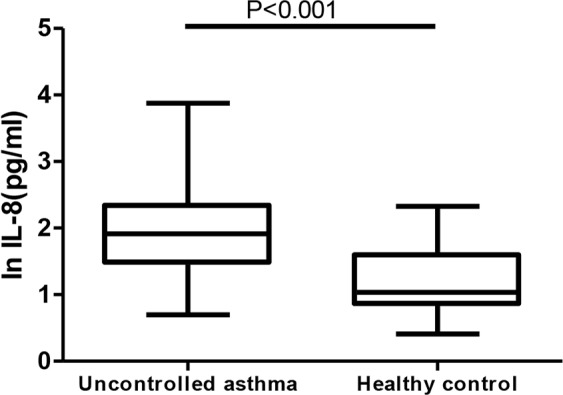
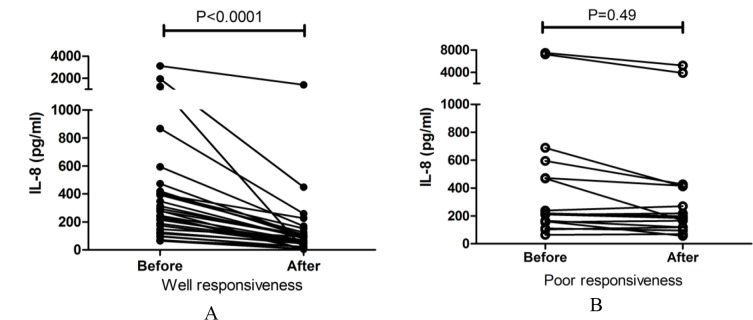
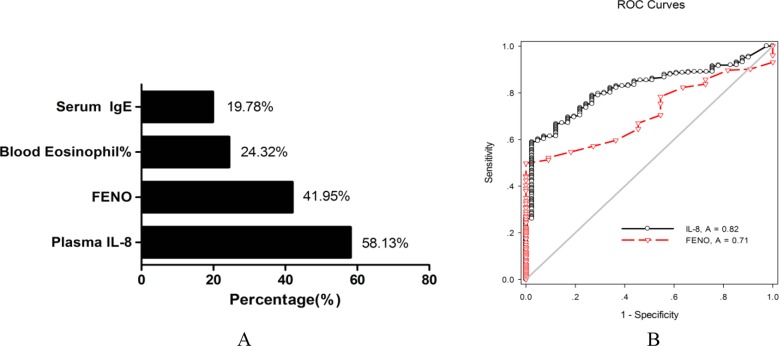
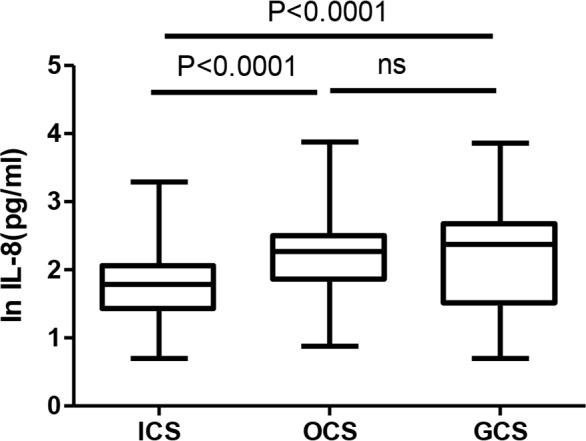
The serum IL-8 level in uncontrolled asthmatics (87.45 pg/mL; 5-7500) was significantly higher than that of the healthy controls (10.9 pg/mL; 6.8-39.65; < 0.001). The increase in the serum IL-8 level above the normal range occurred in 58.13% of uncontrolled asthmatics. The area under curve (AUC) for serum IL-8 level, indicative of uncontrolled asthma, was 0.816 (95% CI, 0.7605 to 0.8721; < 0.0001), which was greater than the AUC of fractional exhaled nitric oxide (AUC, 0.711; 95% CI, 0.6057 to 0.8153; = .0188). The serum IL-8 level showed a significant positive relationship with blood neutrophil count (= 0.0004), neutrophil percentage (= 0.027), serum TNF-α protein (< 0.0001), forced expiratory volume/forced vital capacity (FEV/FVC) ratio (< 0.05), and rate of FEV change after bronchodilation. The level of IL-8 in patients requiring OCs or GCs treatment was significantly higher than that of ICs patients (186 and 235 pg/mL vs. 61 pg/mL; < 0.0001). The reduction in the serum IL-8 level was more significant in asthmatic patients with good responsiveness (277 pg/mL (65.3-3124) to 67.8 pg/mL (5-1408); < 0.0001), compared to those with poor responsiveness (218 pg/mL (64.8-7500) vs. 197 pg/mL (56.9-5238); = 0.49).
The increase in serum IL-8 level can be used as a preferable biomarker to identify asthma status and initial treatment in asthmatics. The change in IL-8 level also reflects the response to glucocorticosteroids in uncontrolled asthma. These exploratory results suggest an association between the pathophysiology, inflammation, and clinical outcomes of asthma. This raises the possibility of developing new agents for IL-8 inhibition and helps provide more precise and personalized asthma care.
探讨血清白细胞介素-8(IL-8)水平作为未控制哮喘生物标志物的临床意义,以增进我们对哮喘表型的理解,并为未来新型治疗药物的研发提供帮助。
2015年10月至2016年4月期间,从门诊选取了246例未控制哮喘患者和50例健康对照。收集临床资料,并通过酶联免疫吸附测定(ELISA)法检测外周血中IL-8、IL-6、肿瘤坏死因子-α(TNF-α)和免疫球蛋白(IgE)的水平。比较分别接受吸入糖皮质激素(ICS)、口服糖皮质激素(OCS)和静脉注射糖皮质激素(GCs)治疗的糖皮质激素组之间的血清IL-8水平。比较哮喘控制良好和控制不佳的患者血清IL-8水平的变化。
未控制哮喘患者的血清IL-8水平(87.45 pg/mL;范围5 - 7500)显著高于健康对照(10.9 pg/mL;范围6.8 - 39.65;P < 0.001)。58.13%的未控制哮喘患者血清IL-8水平高于正常范围。血清IL-8水平作为未控制哮喘的指标,其曲线下面积(AUC)为0.816(95%置信区间,0.7605至0.8721;P < 0.0001),大于呼出一氧化氮分数的AUC(AUC,0.711;95%置信区间,0.6057至0.8153;P = 0.0188)。血清IL-8水平与血中性粒细胞计数(P = 0.0004)、中性粒细胞百分比(P = 0.027)、血清TNF-α蛋白(P < 0.0001)、用力呼气量/用力肺活量(FEV/FVC)比值(P < 0.05)以及支气管扩张后FEV变化率呈显著正相关。需要OCS或GCs治疗的患者的IL-8水平显著高于ICS治疗的患者(分别为186和235 pg/mL,对比61 pg/mL;P < 0.0001)。与反应不佳的哮喘患者相比(218 pg/mL(范围64.8 - 7500)对比197 pg/mL(范围56.9 - 5238);P = 0.49),反应良好的哮喘患者血清IL-8水平降低更显著(从277 pg/mL(范围65.3 - 3124)降至67.8 pg/mL(范围5 - 1408);P < 0.0001)。
血清IL-8水平升高可作为识别哮喘状态和哮喘患者初始治疗的较好生物标志物。IL-8水平的变化也反映了未控制哮喘患者对糖皮质激素的反应。这些探索性结果提示了哮喘的病理生理学、炎症和临床结局之间的关联。这增加了研发IL-8抑制新药的可能性,并有助于提供更精准和个性化的哮喘治疗。