TransVIHMI, University of Montpellier, Inserm, IRD, Montpellier, France.
Infectious and Tropical Diseases Department, University Hospital, Nîmes, France.
Parasit Vectors. 2019 Mar 19;12(1):114. doi: 10.1186/s13071-019-3345-7.
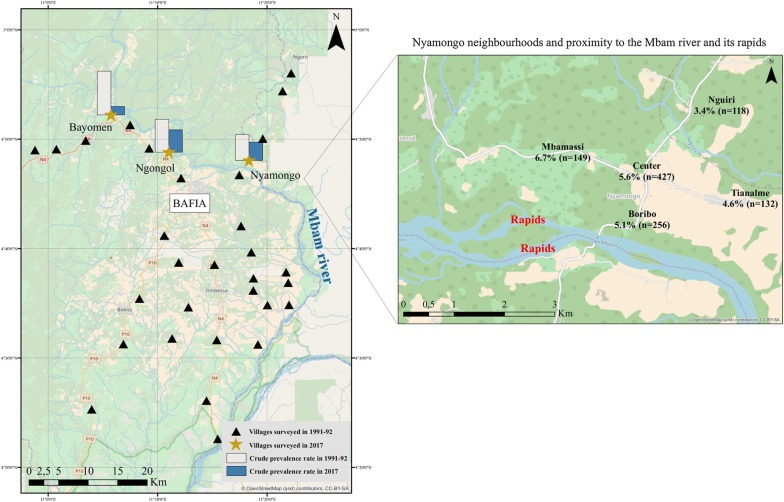
Surveys conducted in 1991-1992 in the Mbam Valley (Cameroon) revealed that onchocerciasis was highly endemic, with community microfilarial loads (CMFL) > 100 microfilariae/snip in some villages. Also in 1991-1992, a survey of suspected cases of epilepsy (SCE) found 746 SCE using a questionnaire administered to individuals identified by key informants, with prevalences reaching 13.6% in some communities. From 1998, annual community-directed treatment with ivermectin (CDTI) was implemented to control onchocerciasis. In 2017, a door-to-door household survey was conducted in three of the villages visited in 1991-1992, using a standardized 5-item epilepsy screening questionnaire.
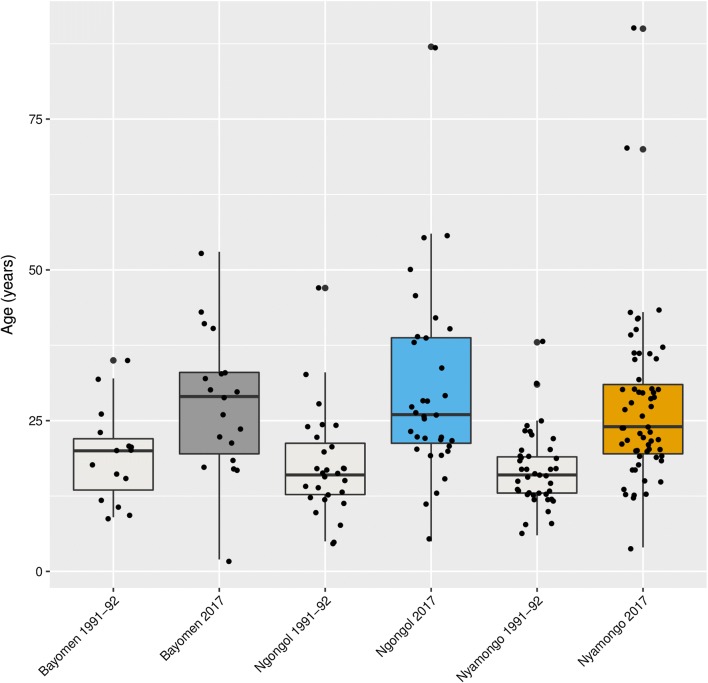
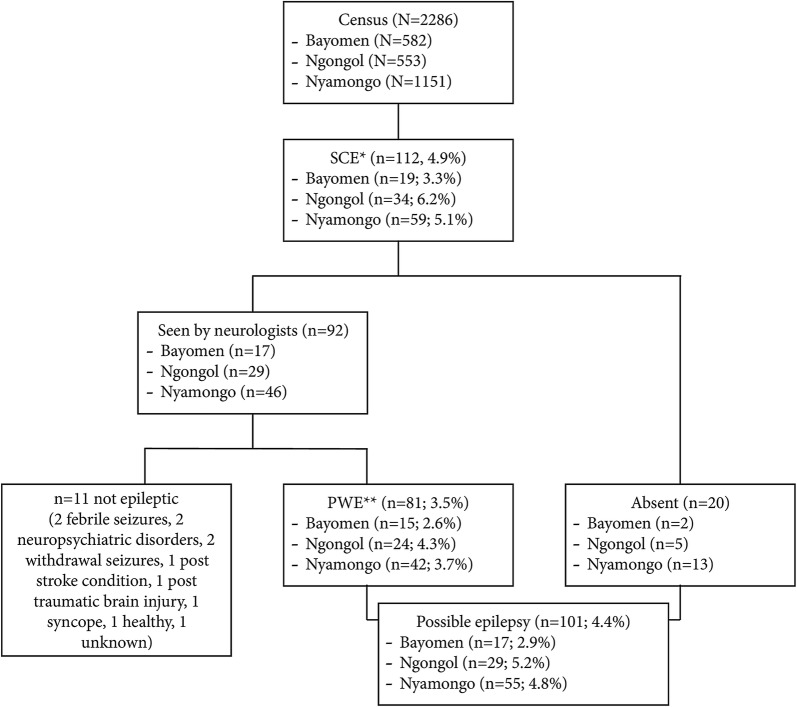
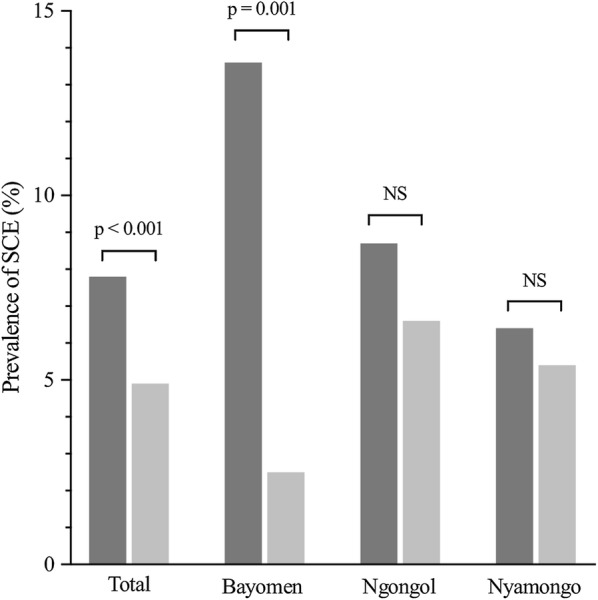
In 2017, a total of 2286 individuals living in 324 households were screened (582 in Bayomen, 553 in Ngongol and 1151 in Nyamongo) and 112 SCE were identified (4.9%). Neurologists examined 92 of these SCE and confirmed the diagnosis of epilepsy for 81 of them (3.5%). Between the surveys in 1991-1992 and 2017, the prevalence of SCE decreased from 13.6% to 2.5% in Bayomen (P = 0.001), from 8.7% to 6.6% in Ngongol (P = 0.205) and from 6.4% to 5.4% in Nyamongo (P = 0.282). The median age of SCE shifted from 20 (IQR: 12-23) to 29 years (IQR: 18-33; P = 0.018) in Bayomen, from 16 (IQR: 12-21) to 26 years (IQR: 21-39; P < 0.001) in Ngongol and from 16 (IQR: 13-19) to 24 years (IQR: 19-32; P < 0.001) in Nyamongo. The proportions of SCE aged < 10, 10-19, 20-29 and ≥ 30 years shifted from 9.5, 58.3, 25.0 and 7.1% in 1991-1992 to 2.7, 20.5, 39.3 and 37.5% in 2017, respectively.
SCE prevalence decreased overall between 1991-1992 and 2017. The age shift observed is probably due to a decrease in the number of new cases of epilepsy resulting from the dramatic reduction of Onchocerca volvulus transmission after 19 years of CDTI.
1991-1992 年在喀麦隆 Mbam 流域进行的调查显示,盘尾丝虫病高度流行,一些村庄的社区微丝蚴载量(CMFL)>100 条微丝蚴/夹。同样在 1991-1992 年,对疑似癫痫病例(SCE)的调查发现,使用关键信息提供者识别的个人的问卷,在一些社区中,患病率达到 13.6%。自 1998 年以来,每年都在实施社区定向伊维菌素治疗(CDTI)以控制盘尾丝虫病。2017 年,在 1991-1992 年访问的三个村庄进行了挨家挨户的家庭调查,使用了标准化的 5 项癫痫筛查问卷。
2017 年,共对 324 户家庭中的 2286 人进行了筛查(Bayomen 582 人,Ngongol 553 人,Nyamongo 1151 人),发现 112 例 SCE(4.9%)。神经科医生检查了其中的 92 例 SCE,并确认其中 81 例(3.5%)患有癫痫。在 1991-1992 年和 2017 年之间,SCE 的患病率从 Bayomen 的 13.6%下降到 2.5%(P=0.001),从 Ngongol 的 8.7%下降到 6.6%(P=0.205),从 Nyamongo 的 6.4%下降到 5.4%(P=0.282)。SCE 的中位年龄从 Bayomen 的 20(IQR:12-23)转移到 29 岁(IQR:18-33;P=0.018),从 Ngongol 的 16(IQR:12-21)转移到 26 岁(IQR:21-39;P<0.001),从 Nyamongo 的 16(IQR:13-19)转移到 24 岁(IQR:19-32;P<0.001)。年龄<10 岁、10-19 岁、20-29 岁和≥30 岁的 SCE 比例从 1991-1992 年的 9.5%、58.3%、25.0%和 7.1%分别变为 2017 年的 2.7%、20.5%、39.3%和 37.5%。
1991-1992 年至 2017 年期间,SCE 的患病率总体呈下降趋势。观察到的年龄转移可能是由于 19 年 CDTI 后盘尾丝虫传播的急剧减少导致新的癫痫病例数量减少所致。